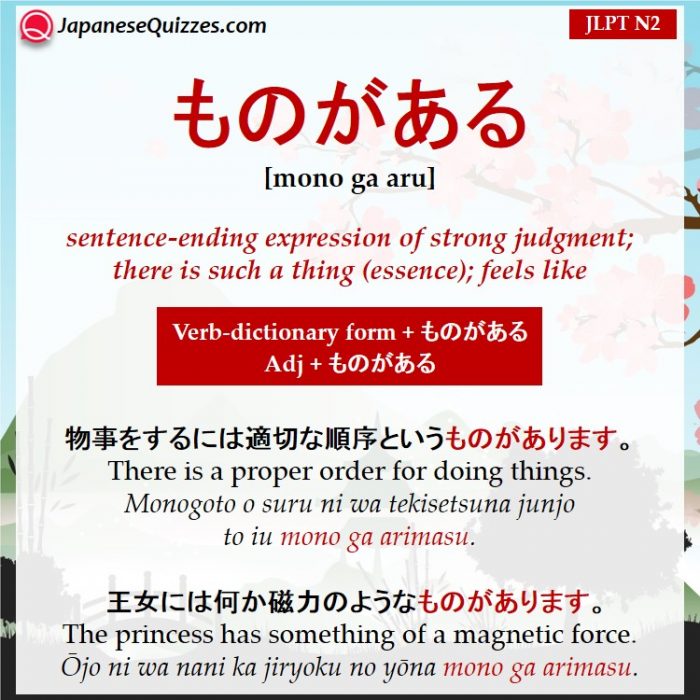
sentence-ending expression of strong judgment,there is such a thing (essence), feels like

Formations
Verb-dictionary form + ものがある
Adj + ものがある
Examples
後輩の歌には、人の心を動かすものがある / 人の心を動かすものがあります。
Kōhai no uta ni wa, hito no kokoro o ugokasu mono ga aru/ hito no kokoro o ugokasu mono ga arimasu.
The junior (at work or school) has the power to move people with her songs.
王女には何か磁力のようなものがある / 磁石のようなものがあります。
Ōjo ni wa nani ka jiryoku no yōna mono ga aru/ jishaku no yōna mono ga arimasu.
The princess has something of a magnetic force.
物事をするには適切な順序というものがある / 順序というものがあります。
Monogoto o suru ni wa tekisetsuna junjo to iu mono ga aru/ junjo to iu mono ga arimasu.
There is a proper order for doing things.
最近、カンボジアの経済発展には目覚しいものがある / 目覚ましいものがあります。
Saikin, Kanbojia no keizai hatten ni wa mezamashī mono ga aru/ mezamashī mono ga arimasu.
Cambodia’s economy has been growing at a remarkable rate lately.
抽象的な芸術には理解しにくいものがある / 理解しにくいものがあります。
Chūshōtekina geijutsu ni wa rikai shi nikui mono ga aru/ rikai shi nikui mono ga arimasu.
Some abstract art is difficult to understand.
私の人生には何か欠けているものがあるような気がする。……猫かな?
Watashi no jinsei ni wa nani ka kakete iru mono ga aru yōna ki ga suru.…… Neko ka na?
I have a feeling that something is lacking in my life…..maybe a cat?
See also

shouldn’t do something; it’s impossible to do something

Formations
Verb-dictionary form + ものではない
Verb-casual, past + ものではない
Examples
彼の説明は、決して満足のいくものではない / 満足のいくものではありません。
Kare no setsumei wa, kesshite manzoku no iku monode wanai/ manzoku no iku monode wa arimasen.
His explanation is far from satisfactory.
戦争は軽々しくするものではない / するものではありません。
Sensō wa karugarushiku suru monode wanai/ suru monode wa arimasen.
War isn’t something to be done lightly.
私たちは消費者を騙すようなことをするものではない / だますようなことをするものではありません。
Watashi tachi wa shōhisha o damasu yōna koto o suru monode wanai/ damasu yōna koto o suru monode wa arimasen.
We shouldn’t deceive the consumers.
外国語は数か月で身につけるものではない / 身につけるものではありません。
Gaikoku-go wa sū-kagetsu de mi ni tsukeru monode wanai/ mi ni tsukeru monode wa arimasen.
It’s impossible to master a foreign language in a few months.
民主主義は食料とかセメントのようには輸出できるものではない / 輸出できるものではありません。
Minshu shugi wa shokuryō toka semento no yō ni wa yushutsu dekiru monode wanai/ yushutsu dekiru monode wa arimasen.
Democracy is not exportable like food or cement.
彼の著書で示されているデータは科学的な観察に基づいたものではない / 基づいたものではありません。
Kare no chosho de shimesa rete iru dēta wa kagakutekina kansatsu ni motodzuita monode wanai/ motodzuita monode wa arimasen.
The data presented in his book are not based on scientific observations.
See also


Formations
Verb-casual + ものだから
Noun + なものだから
いadj + ものだから
なadj + なものだから
Examples
その鞄がかなり安かったものだから、私はそれを購入した / 購入しました。
Sono kaban ga kanari yasukatta monodakara, watashi wa sore o kōnyū shita/ kōnyū shimashita.
Since the bag was pretty cheap, I bought it.
梅雨が近いものだから、私はデパートで傘を買った / 買いました。
Tsuyu ga chikai monodakara, watashi wa depāto de kasa o katta/ kaimashita.
Because the rainy season is coming soon, I bought an umbrella at the department store.
メガネを持ってないものだから、全然見えない / 見えません。
Megane o mottenai monodakara, zenzen mienai/ miemasen.
I don’t have my glasses. So, I can’t see anything.
あなたが知っていると思ったものだから、私はあなたにそれを知らせなかった / 知らせませんでした。
Anata ga shitte iru to omotta monodakara, watashi wa anata ni sore o shirasenakatta/ shirasemasendeshita.
I thought you had known, so I didn’t let you know it.
私の部下は英語が上手なものだから、他の部署から通訳の仕事を頼まれた / 頼まれました。
Watashi no buka wa eigo ga jōzuna monodakara, hoka no busho kara tsūyaku no shigoto o tanomareta/ tanoma remashita.
Because my assistant is good at English, he was asked for an interpreter job by another department.
私は日本語能力試験N4を受けるものだから、一生懸命に勉強しなきゃならない / 勉強しなければなりません。
Watashi wa Nihon gonōryokushiken N 4 o ukeru monodakara, isshōkenmei ni benkyō shinakya naranai/ benkyō shinakereba narimasen.
Because I am taking the JLPT N4, I must study hard.
See also
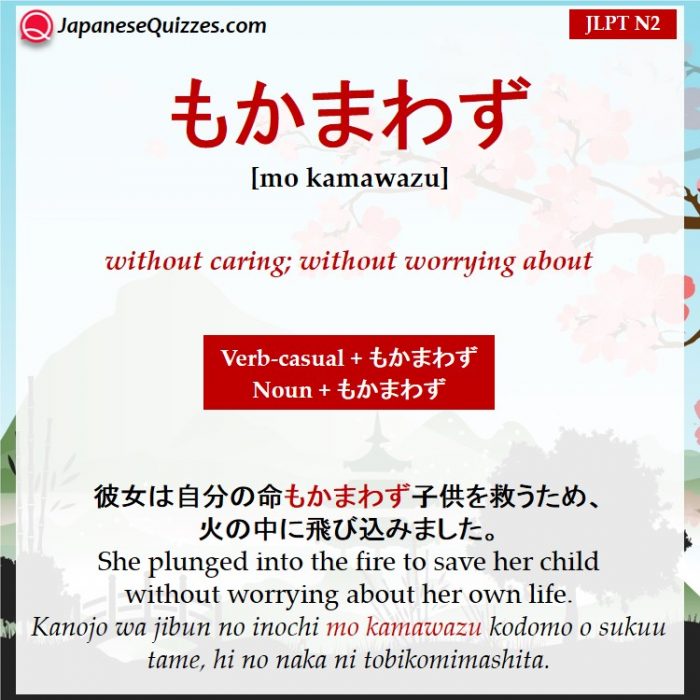
without caring; without worrying about

Formations
Verb-casual + もかまわず
Noun + もかまわず
Examples
彼は雨にぬれるのもかまわず歩き続けた / 歩き続けました。
Kare wa ame ni nureru no mo kamawazu aruki tsudzuketa/ aruki tsudzukemashita.
He continued walking in the rain without worrying about getting wet.
彼女は親の心配もかまわず、遅く帰宅した / 帰宅しました。
Kanojo wa oya no shinpai mo kamawazu, osoku kitaku shita/ kitaku shimashita.
She went home late without caring of her parent’s concern.
従姉妹は値段もかまわず、好きな料理をたくさん注文した / 注文しました。
Itoko wa nedan mo kamawazu, sukina ryōri o takusan chūmon shita/ chūmon shimashita.
My cousin (female) ordered a lot of her favorite dishes without caring of the prices.
従姉妹は他人の感情もかまわず思っていることを口に出す / 口に出します。
Itoko wa tanin no kanjō mo kamawazu omotte iru koto o kuchinidasu/ kuchi ni dashimasu.
My cousin (female) says what he thinks, regardless of other people’s feelings.
男は警官の注意もかまわず、赤信号で道を横断した / 横断しました。
Otoko wa keikan no chūi mo kamawazu, akashingō de michi o ōdan shita/ ōdan shimashita.
A man crossed the road with a red light without caring of the police officer’s warning.
彼女は自分の命もかまわず子供を救うため、火の中に飛び込んだ / 飛び込みました。
Kanojo wa jibun no inochi mo kamawazu kodomo o sukuu tame, hi no naka ni tobikonda/ tobikomimashita.
She plunged into the fire to save her child without worrying about her own life.
See also
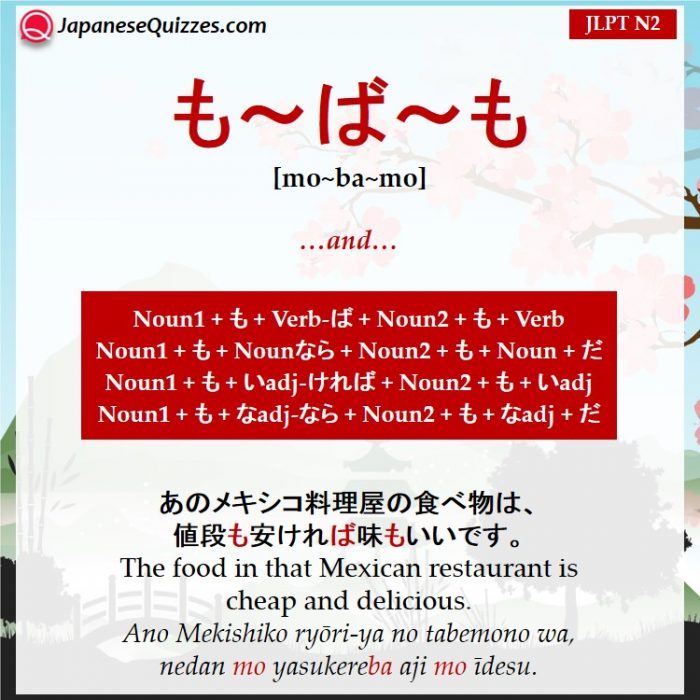

Formations
Noun1 + も + Verb-ば + Noun2 + も + Verb
Noun1 + も + Nounなら + Noun2 + も + Noun + だ
Noun1 + も + いadj-ければ + Noun2 + も + いadj
Noun1 + も + なadj-なら + Noun2 + も + なadj + だ
Examples
料理学校の授業では、レシピも学べば料理もする / 料理もします。
Ryōri gakkō no jugyōde wa, reshipi mo manabeba ryōri mo suru/ ryōri mo shimasu.
You can learn the recipe and cook during class at cooking schools.
あのメキシコ料理屋の食べ物は、値段も安ければ味もいい / 味もいいです。
Ano Mekishiko ryōri-ya no tabemono wa, nedan mo yasukereba aji mo ī/ aji mo īdesu.
The food in that Mexican restaurant is cheap and delicious.
姉は歌も上手なら踊りもうまい / 踊りもうまいです。
Ane wa uta mo jōzunara odori mo umai/ odori mo umaidesu.
My elder sister is good at singing and dancing.
この革靴は値段も手頃ならデザインも洗練されている / 洗練されています。
Kono kawagutsu wa nedan mo tegoronara dezain mo senren sa rete iru/ senren sa rete imasu.
These leather shoes have reasonable price and sophisticated in design.
あのゴールキーパーは反応も早ければ背もかなり高い / 高いです。
Ano gōrukīpā wa han’nō mo hayakereba se mo kanari takai/ takaidesu.
That goalkeeper is swift to respond and quite tall.
叔母は空腹も感じなければ、疲れも感じなかった / 感じませんでした。
Oba wa kūfuku mo kanjinakereba, tsukare mo kanjinakatta/ kanjimasendeshita.
My aunt did not feel either hungry or tired.
See also
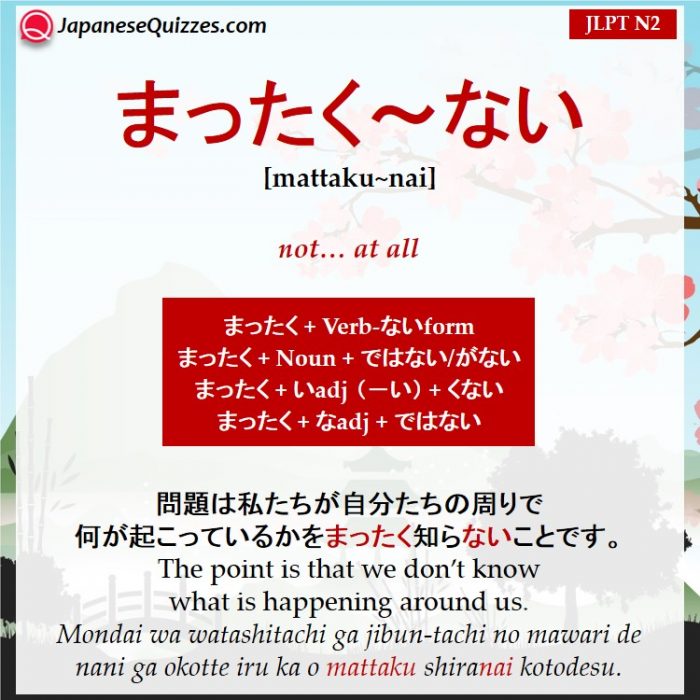

Formations
まったく + Verb-ないform
まったく + Noun + ではない/がない
まったく + いadj (-い) + くない
まったく + なadj + ではない
Examples
祖父はお酒をまったく飲めない / まったく飲めません。
Sofu wa o sake o mattaku nomenai/ mattaku nomemasen.
My grandfather can’t drink alcohol at all.
祖母は日本語での会話はまったくできない / まったくできません。
Sobo wa nihongode no kaiwa wa mattaku dekinai/ mattaku dekimasen.
My grandmother can’t handle conversation in Japanese at all.
私はその結論にまったく不満はない / まったく不満はありません。
Watashi wa sono ketsuron ni mattaku fuman wanai/ mattaku fuman wa arimasen.
I have nothing to complain of the conclusion.
その薬はまったく効かなかった / まったく効きませんでした。
Sono kusuri wa mattaku kikanakatta/ mattaku kikimasendeshita.
The medicine had no effect.
あなたには罰則がまったく効いていないようだ / 効いていないようです。
Anata ni wa bassoku ga mattaku kiite inai yōda/ kiite inai yōdesu.
Punishments do not appear to have any effect on you whatsoever.
問題は私たちが自分たちの周りで何が起こっているかをまったく知らないことだ / まったく知らないことです。
Mondai wa watashitachi ga jibun-tachi no mawari de nani ga okotte iru ka o mattaku shiranai kotoda/ mattaku shiranai kotodesu.
The point is that we don’t know what is happening around us.
See also