Formations
It is always pronounced as なん if the letter after 何 is part of the Ta line (た ち つ て と), Da line (だ ぢ づ で ど), or Na line (な に ぬ ね の). Otherwise, you always pronounce 何 as なに.
Examples
あれは何ですか。
Are wa nan desu ka.
What is that?
先週、あなたは何をしたか。
Senshū, anata wa nani o shita ka.
What did you do last week?
明日、あなたは何をしますか。
Ashita, anata wa nani o shimasu ka.
What will you do tomorrow?
あなたのお名前は何か。
Anata no onamae wa nani ka.
What is your name?
あなたの仕事は何か。
Anata no shigoto wa nani ka.
What is your job?
あなたの趣味は何か。
Anata no shumi wa nani ka.
What is your hobby?
彼の好きな食べ物は何か。
Kare no sukina tabemono wa nani ka.
What is his favorite food?
See also

don’t do/negative command

Formations
verb casual+な(na)
Examples
心配するな。
Shinpai suru na.
Don’t worry.
それを食べるな。
Sore wo taberu na.
Don’t eat that!
あまり飲むな。
Amari nomu na.
Don’t drink too much.
決して約束を破るな。
Kesshite yakusoku wo yaburu na.
Never break your promise.
そこを動くな。
Soko wo ugoku na.
Don’t move over there.
そんなに急ぐな。
Sonna ni isogu na.
Don’t rush like that.
See also

Examples
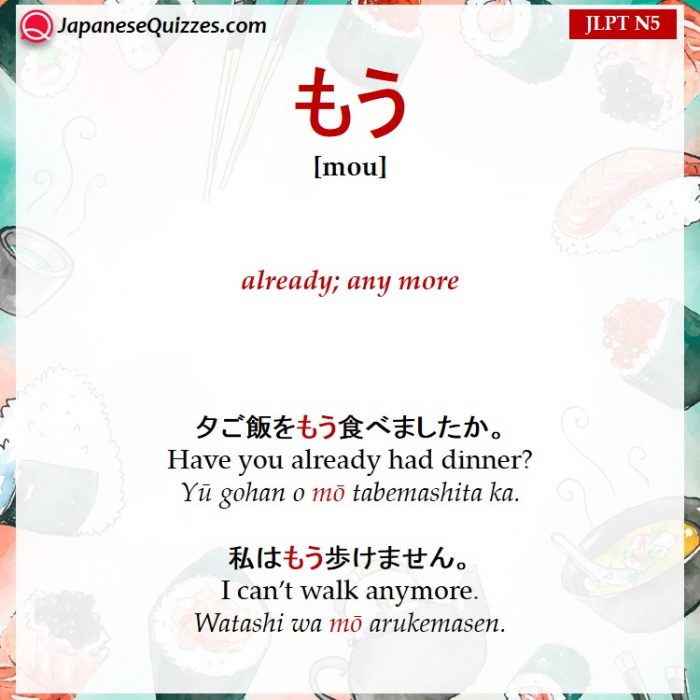
彼はもうここにいる。
Kare wa mō koko ni iru.
He is already here.
もう5時を過ぎた。
Mō go-ji o sugita.
It’s already past five o’clock.
夕ご飯をもう食べましたか。
Yū gohan o mō tabemashita ka.
Have you already had dinner?
宿題をもう終えたか。
Shukudai o mō oeta ka.
Have you already done your homework?
私はもう歩けません。
Watashi wa mō arukemasen.
I can’t walk anymore.
子供たちはもう食べられない。
Kodomo-tachi wa mō tabe rarenai.
Children can’t eat anymore.
See also

Formations
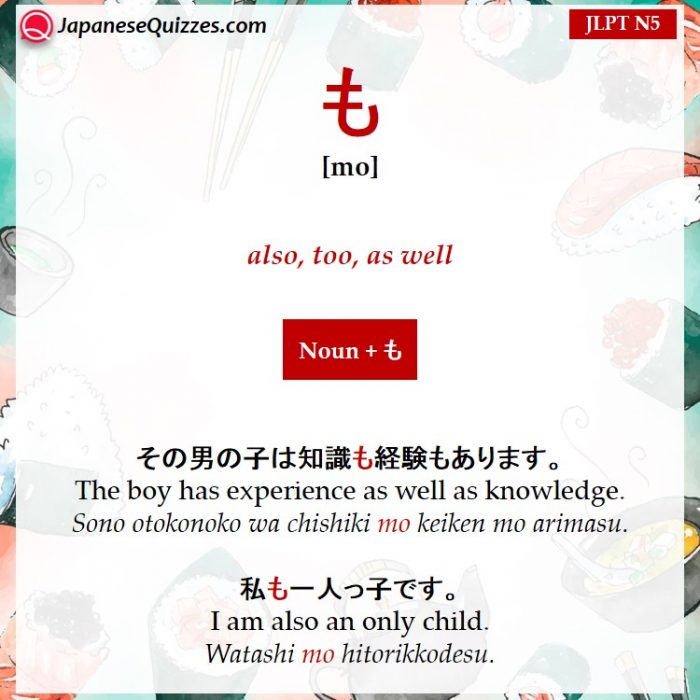
Noun + も
Examples
その男の子は知識も経験もあります。
Sono otokonoko wa chishiki mo keiken mo arimasu.
The boy has experience as well as knowledge.
あの女の子は英語もフランス語も話す。
Ano on’nanoko wa eigo mo furansugo mo hanasu.
That girl speaks French as well as English.
私はこの色もまた好きだ。
Watashi wa kono-iro mo mata sukida.
I like this color as well.
あの警官はロシア語も話す。
Ano keikan wa Roshiago mo hanasu.
That policeman speaks Russian as well.
私もあの学校でスペイン語を勉強している。
Watashi mo ano gakkō de Supeingo o benkyō shite iru.
I study Spanish at that school too.
私も一人っ子です。
Watashi mo hitorikko desu.
I am also an only child.
See also

let’s, shall we(Eliciting and Making Proposals)

Formations
Verb-masu stem + ましょう / ましょうか
Examples
学校で会いましょう。
Gakkō de aimashou.
Let’s meet at school!
一緒に日本語を勉強しましょう。
Issho ni nihongo o benkyō shimashou.
Let’s study Japanese together!
和食を食べましょう。
Washoku o tabemashou.
Let’s eat Japanese food.
手伝いましょうか。
Tetsudaimashou ka.
Shall I help you?
授業を始めましょうか。
Jugyō o hajimemashou ka.
Shall we begin the class?
帰りましょうか。
Kaerimashou ka.
Shall we go home?
See also

let’s, won’t you, wouldn’t you

Formations
Verb-polite negative form + ませんか
Examples
私と一緒に晩ごはんを食べませんか?
Watashito isshoni ban gohan o tabemasen ka?
)Won’t you have dinner with me?
私たちと一緒に座りませんか?
Watashitachi to issho ni suwarimasen ka?
Won’t you sit with us?
私の話を聞いてくれませんか?
Watashi no hanashi o kiite kuremasen ka?
Won’t you listen to my story?
日本語の文法を勉強しませんか?
Nihongo no bunpō o benkyō shimasen ka?
Why don’t we study Japanese grammar?
明日、どこかへ行きませんか?
Ashita, doko ka e ikimasen ka?
Why don’t we go somewhere tomorrow?
See also