JLPT N3 Grammar List
to the extent that, so much… that .

Formations
Verb-casual + くらい/ぐらい
いadjective + くらい/ぐらい
なadjective + なくらい/ぐらい
Noun + くらい/ぐらい
Examples
彼は私と同じくらい背が高いです。
Kare wa watashi to onaji kurai segatakaidesu.
He is the same height as me.
今日は昨日と同じくらい暑いです。
Kyō wa kinō to onaji kurai atsuidesu.
It is about as hot today as it was yesterday.
時間はお金と同じくらい重要です。
Jikan wa okane to onaji kurai jūyōdesu.
Time is as important as money.
See also

JLPT N3 Grammar List
there is no need to; never happens .

Formations
Verb-dictionary form + ことはない
Examples
君は何も心配することはありません。
Kimi wa nani mo shinpai suru koto wa arimasen.
There’s no need for you to worry.
君が謝ることはありません。
Kimi ga ayamaru koto wa arimasen.
There is no need for you to apologize.
彼は決して私を裏切ることはありません。
Kare wa kesshite watashi o uragiru koto wa arimasen.
He’ll never betray me.
See also

JLPT N3 Grammar List
to decide to
to decide (not) to ~ (focusing on one’s decision) .

Formations
Verb-dictionary form + ことにする
Verb-ないform + ことにする
Examples
明日、私たちは映画を見ることにしました。
Ashita, watashitachiha eiga o miru koto ni shimashita.
We have decided to watch a movie tomorrow.
私はあの会社に入社しないことにしました。
Watashi wa ano kaisha ni nyūsha shinai koto ni shimashita.
I have decided not to join that company.
明日から毎日、弟は漢字を一日に10個、覚えることにしました。
Ashita kara Mainichi, otōto wa kanji o ichinichi ni jyukko, oboeru koto ni shimashita.
Every day from tomorrow, my younger brother has decided to memorize 10 kanji a day.
See also

JLPT N3 Grammar List
it has been decided that…, it has been arranged so that…, it turns out that… .

Formations
Verb-dictionary form + ことになる
Examples
あなたはここを辞めることになるでしょう。
Anata wa koko o yameru koto ni narudeshou.
It’s been decided that you will quit here.
あなたはこの部屋に住むことになるでしょう。
Anata wa kono heya ni sumu koto ni narudeshou.
It’s been decided that you will live in this room.
私は来月からこの会社で働くことになるでしょう。
Watashi wa raigetsu kara kono kaisha de hataraku koto ni narudeshou.
It’s been decided that I will be working at this company from next month.
See also

JLPT N3 Grammar List

Formations
Verb-casual, past + ことに
Verb-dictionary form + ことに
いadj + ことに
なadj + なことに
Examples
あきれたことに、彼の禁酒は三日だけでした。
Akireta koto ni, kare no kinshu wa mikka dakedeshita.
To my disappointment, his abstinence was only three days.
困ったことに、来週の試験に対する学生の関心は低いです。
Komattakoto ni, raishū no shiken ni taisuru gakusei no kanshin wa hikuidesu.
Worrying thing is, the interest of the students for the test of the next week is low.
悲しいことに、彼の夢は実現しませんでした。
Kanashī koto ni, kare no yume wa jitsugen shimasendeshita.
To my sadness, his dream did not come true.
See also
JLPT N3 Grammar List
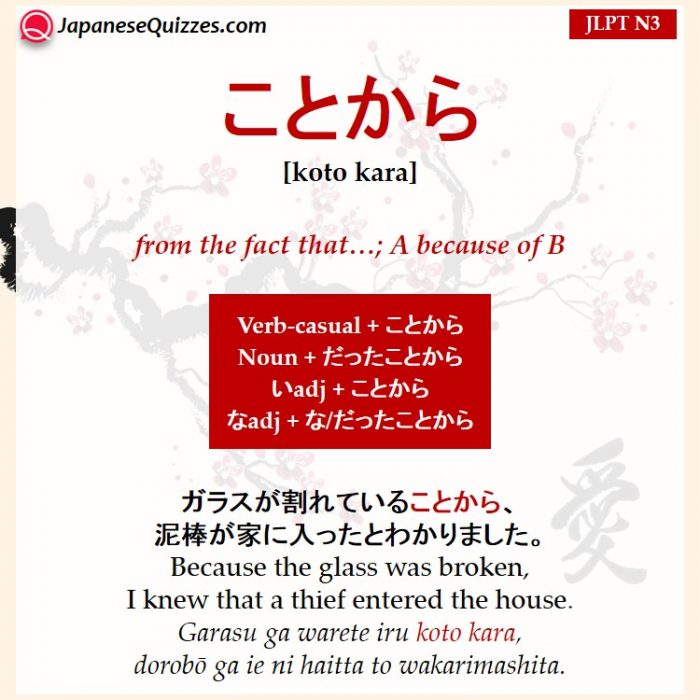
from the fact that…,A because of B (Reason, Cause).

Formations
Verb-casual + ことから
Noun + だったことから
いadj + ことから
なadj + な/だったことから
Examples
ガラスが割れていることから、泥棒が家に入ったとわかりました。
Garasu ga warete iru koto kara, dorobō ga ie ni haitta to wakarimashita.
Because the glass was broken, I knew that a thief entered the house.
顔がそっくりなことから、ナオコとカオリは双子であることがわかりました。
Kao ga sokkurina koto kara, Naoko to Kaori wa futago de aru koto ga wakarimashita.
Because their faces looked like two eggs, I understood that both Naoko and Kaori are twins.
眼鏡の形をしていることから、その橋を眼鏡橋と呼びます。
Megane no katachi o shite iru koto kara, sono hashi o meganebashi to yobimasu.
Because the bridge looks like the shape of glasses(megane), people call the bridge “Megane Bashi” (the glasses bridge).
See also