to make/let somebody do something

Formations
Rules for causative form conjugation
For ru-verbs: Replace the last 「る」 with 「させる」.
Example
食べる+させる = 食べさせる
出る+させる = 出させる
For u-verbs: Change the last character as you would for negative verbs but attach 「せる」 instead of 「ない」.
Example
飲む+ま+せる = 飲ませる
待つ+た+せる = 持たせる
買う+わ+せる = 買わせる
Exceptions:
する → させる
くる → こさせる
Examples
母はわたしに自分の部屋を片付けさせた。
Haha wa watashi ni jibun no heya o katadzuke saseta.
My mom made me clean my room.
その部長は、よく長時間働かせる。
Sono buchō wa, yoku chōjikan hatarakaseru.
That manager often makes (people) work long hours.
わたしは息子を買い物に行かせる。
Watashi wa musuko o kaimono ni ikaseru.
I make my son go shopping.
今日は仕事を休ませてください。
Kyō wa shigoto o yasumasete kudasai.
Please let me rest from work today.
See also

nominalizer for adjectives
You attach さ to an adjective to turn it into a Noun.
The sa-form allows to use an i-adjective as a noun or in other words to add ~ness to it.

Formations
いadj (-い) + さ
なadj + さ
Examples
その本の重さは1kgです。
Sono Hon no omo-sa wa ichi kiro guramu desu.
The weight of the book is 1 kilogram.
今年の暑さは普通ではありません。
Kotoshi no atsusa wa futsūde wa arimasen.
This year’s heat is not normal.
私はかわいさでは誰にも負けない。
Watashi wa kawai-sa de wa darenimo makenai.
Nobody can beat my“cuteness”
私は日本のお寺の美しさが好きです。
Watashi wa Nihon no otera no utsukushi-sa ga sukidesu.
I like the beauty of Japanese temples.
私は使いやすさで、この携帯を選びました。
Watashi wa tsukai yasuisade, kono keitai o erabimashita.
I chose this cell phone by the user-friendliness.
機内に持ち込めるバッグの重さと大きさを知りたい。
Kinai ni motte kuru baggu no omo-sa to ōki-sa o shiritai.
I would like to know the weight and the size of the carry-on bags.
See also

seems like; I heard that; it appears that

Formations
Verb-casual + らしい
Noun + らしい/ だったらしい
いadj + らしい/ いadj-た form + らしい
なadj + らしい/ だったらしい
Examples
午後は雨らしいです。
Gogo wa amerashii desu.
It looks like rain this afternoon.
明日は、いい天気らしいです。
Ashita wa, ii tenki rashii desu.
I heard that it will be sunny tomorrow.
彼は道に迷ったらしい。
Kare wa michi ni mayotta rashii.
It seems he got lost.
彼は失敗したらしい。
Kare wa shippai shita rashii.
It seems that he has failed.
彼がついに目を覚ましたらしいです。
Kare ga tsuini me wo samashita rashii desu.
He appears to have woken up at last.
彼は自分の言ったことが正しいと信じているらしいです。
Kare wa jibun no itta koto ga tadashii to shinjiteiru rashii desu.
It seems that he believes what he said is right.
彼女は先週インフルエンザだったらしいです。
Kanojo wa senshū infuruenza datta rashii desu.
I hear she had influenza last week.
天気予報によると明日は晴れるらしい。
Tenki yohō ni yoru to ashita wa hareru rashii.
According to the weather forecast, it is likely to be clear tomorrow.
彼は肉は食べないらしい。
Kare wa niku wa tabenai rashii.
It seems that he doesn’t eat meat.
彼はあまりよくないらしい。
Kare wa amari yokunai rashii.
It seems that he is not very well.
彼は先月ヨーロッパを旅行したらしい。
Kare wa sengetsu Yōroppa o ryokō shita rashii.
I hear he traveled in Europe last month.
彼が買ったバイクは軽自動車ほど高かったらしい。
Kare ga katta baiku wa keijidōsha hodo takakatta rashii.
I hear that the motorcycle he bought was as expensive as a small car.
See also


Formations
られる ( = rareru) ・れる ( = reru)
Group 2 verb (ru-verb)→ られる ( = rareru)
——————————————
Group 1 verb (u-verb)→ れる ( = reru)
Irregular する ( = suru ) = to do
↓
される ( = sareru) to be done
Examples
その棚は父によって作られました。
Sono tana wa chichi ni yotte tsukura remashita.
That shelf was made by my father.
オーストラリアでは英語が話されます。
Ōsutorariade wa eigo ga hanasa remasu.
English is spoken in Australia.
電車の中で財布が盗まれました。
Densha no naka de saifu ga nusumaremashita.
My wallet was stolen in the train.
弟は父に叱られました。
Otōto wa chichi ni shikararemashita.
My younger brother was scolded by my father.
その小説は夏目漱石によって書かれた。
Sono shōsetsu wa Natsume Sōseki ni yotte kakareta.
The novel was written by Soseki Natsume.
電車の中で財布を 盗まれました。
Densha no naka de saifu o nusumaremashita.
I had my wallet stolen in the train.
忙しい時にお客さんに来られて大変です。
Isogashii toki ni okyaku san ni korarete taihen desu.
I’m in trouble because I have guests when I’m busy.
私は帰る途中で雨に降られてずぶぬれになりました。
Watashi wa kaeru tochū de ame ni furarete zubunure ni narimashita.
I was caught in the rain on my way home, and I got soaking wet.
父に早く死なれてずいぶん苦労をしました。
Chichi ni hayaku shinarete zuibun kurō shimashita.
I had a hard time because my father died young.
鯉のぼりが風に吹かれて空高く泳いでいます。
Koinobori ga kaze ni fukarete sora takaku oyoide imasu.
Carp streamers are blowing high in the sky and waving.
See also


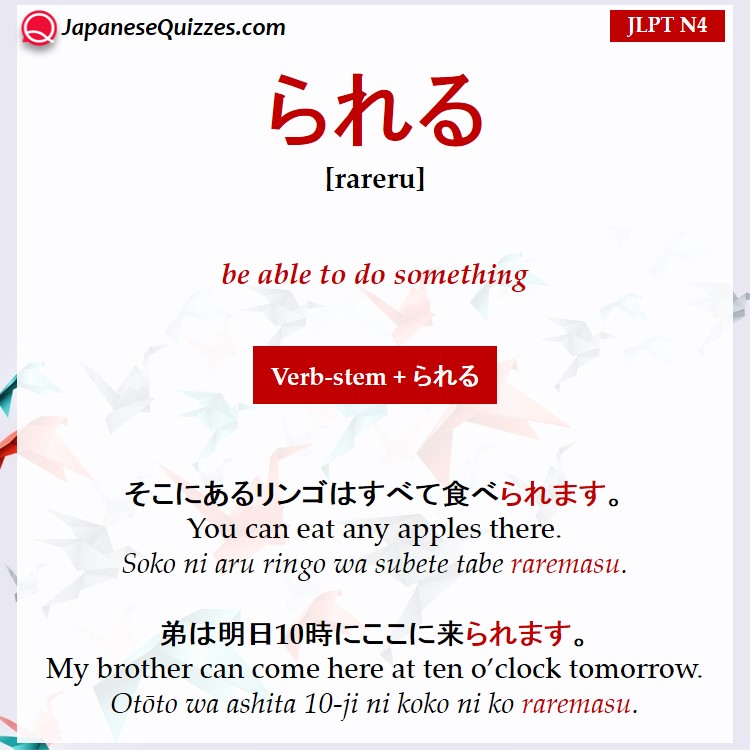
Formations
Verb-stem + られる
Examples
そこにあるリンゴはすべて食べられます。
Soko ni aru ringo wa subete tabe raremasu.
You can eat any apples there.
弟は明日10時にここに来られます。
Otōto wa ashita jyuu-ji ni koko ni ko raremasu.
My brother can come here at ten o’clock tomorrow.
私の街の図書館では、マンガも借りられる。
Watashi no machi no toshokande wa, manga mo karirareru.
You can also borrow manga at the library in my town.
私たちはなんとかその困難を乗り越えられた。
Watashitachi wa nantoka sono kon’nan o norikoe rareta.
We managed to overcome that difficulty.
その日、忙しすぎて、私は昼ご飯を食べられなかった。
Sonohi, isogashi sugite, watashi wa hiru gohan o tabe rarenakatta.
On that day, I was too busy, I could not eat lunch.
その試験に合格したことを私は信じられなかった。
Sono shiken ni gōkaku shita koto o watashi wa shinji rarenakatta.
I could not believe that I passed the exam.
山田さんは泳げますか。
Yamada san wa oyogemasu ka.
Mr. Yamada, can you swim?
この大学の学生だと, 映画がただで見られます。
Kono daigaku no gakusei da to, eiga ga tada de miraremasu.
If you are a student in this college, you can watch the movie for free.
ホテルの部屋でインターネットができますか。
Hoteru no heya de Intānetto ga dekimasu ka.
Can I access the Internet in the room of the hotel?
ここで講義を受けられますか。
Koko de kōgi o ukeraremasu ka.
Can we take the lecture course here?
「ここで写真が撮れますか。 」「いいえ,撮れません。」
“Koko de shashin ga toremasu ka.” “Iie, toremasen.”
“Can I take a photo here?” “No, you cannot.”
See also


Formations
Verb-stem + 終わる
Examples
私はクッキーを作り終わった。
Watashi wa kukkī o tsukuri owatta.
I finished making cookies.
彼女はトランクを詰め終わりました。
Kanojo wa toranku o tsume owarimashita.
She finished packing her trunk.
彼女は午前中に3キロ泳ぎ終わりました。
Kanojo wa gozen-chū ni san-kiro oyogi owarimashita.
She finished swimming 3 kilometers in the morning.
昨日、私は手紙を書き終わった。
Kinō, watashi wa tegami o kaki owatta.
Yesterday, I finished writing a letter.
三週間前に、私はその小説を読み終わりました。
San-shūkan mae ni, watashi wa sono shōsetsu o yomi owarimashita.
Three weeks ago, I finished reading the novel.
聞き終わった時、彼は愕然としていた。
Kiki owatta toki, kare wa gakuzen to shite ita.
He looked thunderstruck when he’d finished listening.
コーヒーが飲み終わったら、少し散歩しましょう。
Kōhī ga nomi owattara, sukoshi sanpo shimashou.
Let’s walk a little after we finish drinking coffee.
原稿は来週書き終わります。
Genkō wa raishū kakiowarimasu. (= kakioemasu)
I’ll finish writing the manuscript next week.
この本は面白かったのですぐに読み終わりました。
Kono hon wa omoshirokatta node sugu ni yomiowarimashita. (= yomioemashita)
I read this book fast because it was interesting.
See also