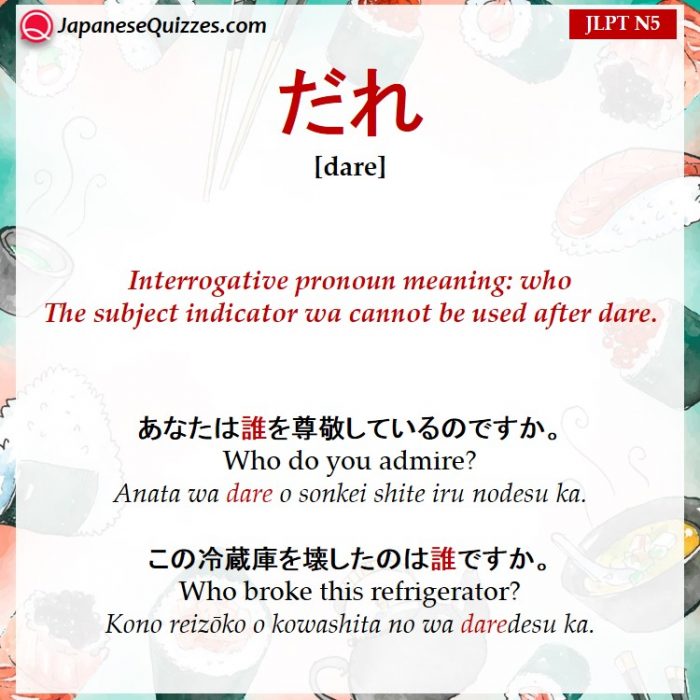
Interrogative pronoun meaning: who
The subject indicator wa cannot be used after dare.

Examples
あなたは誰を探しているのか。
Anatahadare o sagashite iru no ka.
Who are you looking for?
あなたは駅で誰に会ったのか。
Anata wa eki de dare ni atta no ka.
Who did you meet at the station?
あなたは誰を尊敬しているのですか。
Anatahadare o sonkei shite iru no desu ka.
Who do you admire?
この冷蔵庫を壊したのは誰ですか。
Kono reizōko o kowashita no wa dare desu ka.
Who broke this refrigerator?
あの席に座っているのは誰か。
Ano seki ni suwatte iru no wa dare ka.
Who is sitting in that seat?
あなたは誰が議長に選ばれると思うか。
Anatahadare ga gichō ni eraba reru to omou ka.
Who do you think would be elected chairman?
See also

Formations
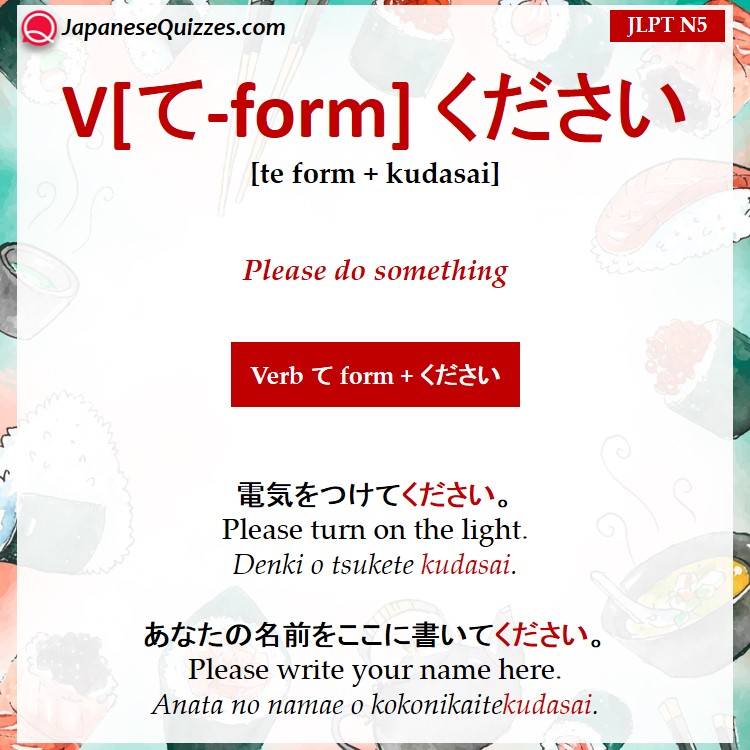
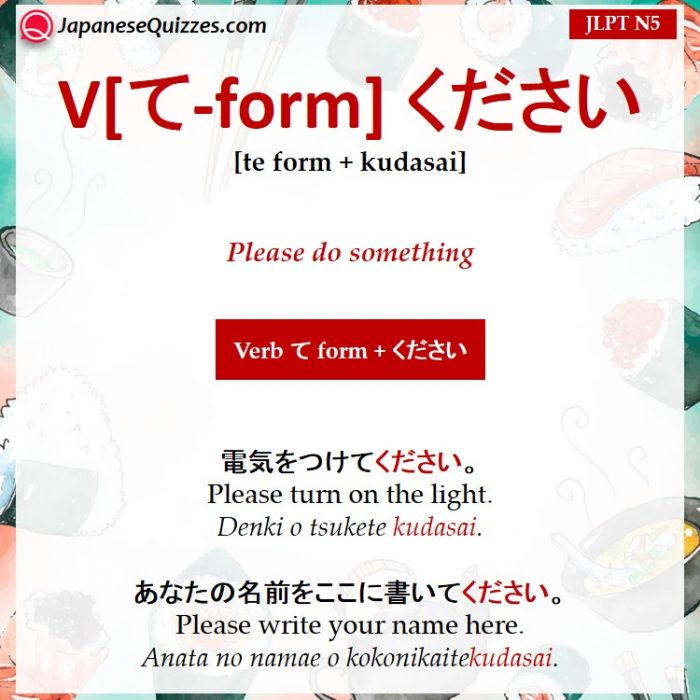
Verb てform (te form) + ください (kudasai)
Examples
電気をつけてください。
Denki o tsukete kudasai.
Please turn on the light.
2年生は手をあげてください。
Ni-Nensei wa te o agete kudasai.
Sophomores, please raise your hand.
家族の写真を見せてください。
Kazoku no shashin o misete kudasai.
Please show me your family picture.
あなたの名前をここに書いてください。
Anata no namae o kokonikaitekudasai.
Please write your name here.
あなたの電子辞書を私に貸してください。
Anata no denshijijo o watashi ni kashite kudasai.
Please lend me your electronic dictionary.
その質問に答えてください。
Sono shitsumon ni kotaete kudasai.
Please answer the question.
See also

Formations
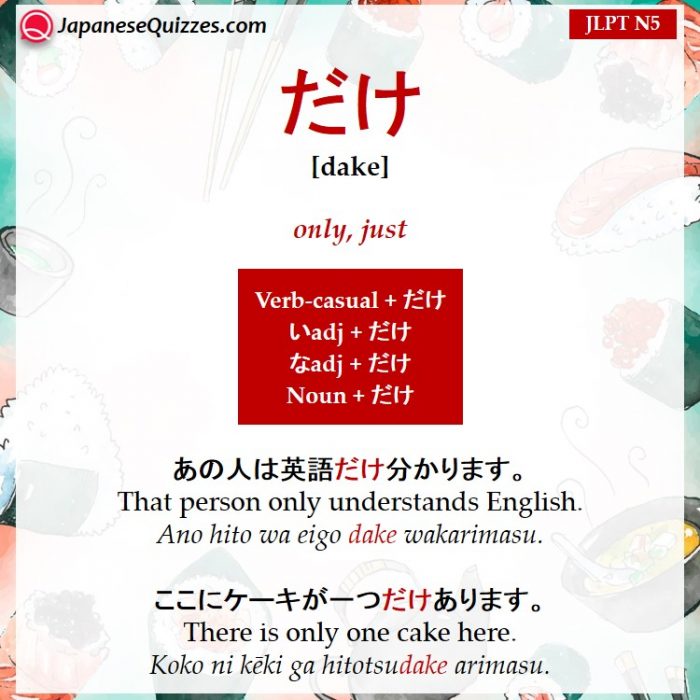
Verb-casual + だけ
いadj + だけ
なadj + だけ
Noun + だけ
Examples
私は肉だけ食べます。
Watashi wa niku dake tabemasu.
I only eat meat.
私は水だけ飲みます。
Watashi wa mizu dake nomimasu.
I only drink water.
あの人は英語だけ分かります。
Ano hito wa eigo dake wakarimasu.
That person only understands English.
私たちの先生は日本人だけです。
Watashi tachi no sensei wa Nihonjin dake desu.
Our teachers are only Japanese.
ここにケーキが一つだけあります。
Kokoni Ke-ki ga hitotsu dake arimasu.
There is only one cake here.
彼は行きたくないだけです。
Kare wa ikitakunai dake desu.
He just doesn’t want to go.
彼は眠っているだけです。
Kare wa nemutteiru dake desu.
He is only sleeping.
See also
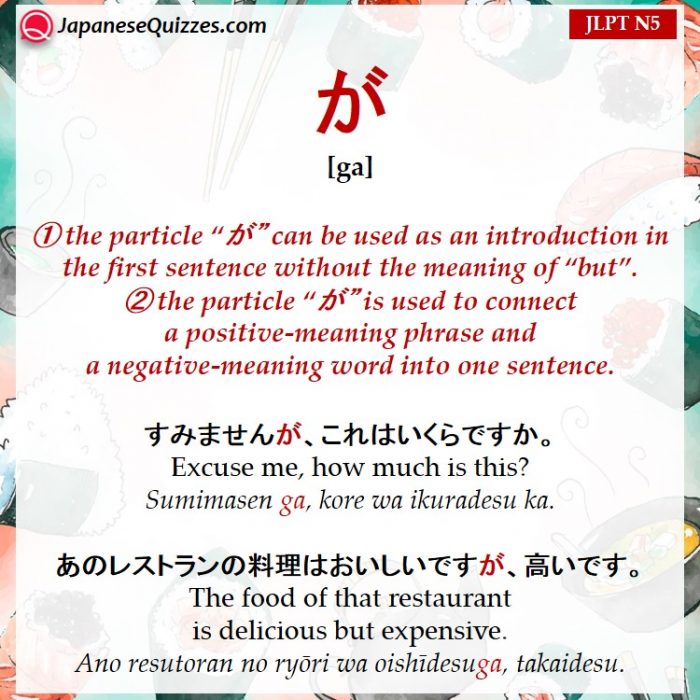
① the particle “が” can be used as an introduction in the first sentence without the meaning of “but”.
②the particle “が” is used to connect a positive-meaning phrase and a negative-meaning word into one sentence.

Examples
すみませんが、これはいくらですか。
Sumimasen ga, kore wa ikura desu ka.
Excuse me, how much is this?
すみませんが、トイレはどこですか。
Sumimasen ga, toire wa doko desu ka.
Excuse me, where is the toilet?
もしもし、田中ですが、山田さんはいますか。
Moshimoshi, tanaka desu ga, yamada san wa imasu ka.
Hello, this is Tanaka speaking, is Mr Yamada around? (May I speak to Mr Yamada?)
あそこに高いビルが見えますが、あれは何ですか。
Asoko ni takai biru ga miemasu ga, are wa nan desu ka.
We can see a tall building over there, what is that building?
先生、ここが分からないのですが、教えてください。
Sensei, koko ga wakaranai no desu ga, oshiete kudasai.
Teacher, I don’t understand this part (in the textbook), please teach me.
あのレストランの料理はおいしいですが、高いです。
Ano resutoran no ryouri wa oishii desu ga, takai desu.
The food of that restaurant is delicious but expensive.
See also

why
なぜ is a counterpart to “why” in English.
However, the formality is different as shown below.
You can choose one of them depending on the situation.

Formations
Formal: なぜ
Neutral: どうして
Casual: なんで (only in speaking)
Examples
彼はなぜ猫が嫌いなのですか。
Kare wa naze neko ga kiraina no desuka.
Why does he dislike cats?
あなたはなぜ怒っているのですか。
Anata wa naze okotte iru no desuka.
Why are you angry?
あなたはなぜ日本語を勉強するのか。
Anata wa naze nihongo o benkyō suru no ka.
Why are you studying Japanese?
部長はなぜ、オフィスにいないのか。
Buchō wa naze, ofisu ni inai no ka.
Why is the director not at the office?
あなたは、なぜその仕事を選んだのか。
Anata wa, naze sono shigoto o eranda no ka.
Why did you choose that job?
あなたはなぜ、昨日の会議に出席しなかったのか。
Anata wa naze, kinō no kaigi ni shusseki shinakatta no ka.
Why didn’t you attend the meeting yesterday?
See also

It’d be better to not do something

Formations
Verb ない form + ほうがいい
structure : (nai-form) + ほうがいいです / hou ga ii desu.
Examples
そんな映画は観ないほうがいい。
Son’na eiga wa minai hō ga ī.
It is better for me not to see such a movie.
安物は買わないほうがいい。
Yasumono wa kawanai hō ga ī.
It would be better for you not to buy cheap articles.
コーヒーを飲まないほうがいい。
Kōhī o nomanai hō ga ī.
You had better not drink coffee.
約束を忘れないほうがいいです。
Yakusoku o wasurenai hō ga ī desu.
You’d better not forget your promise.
他人の物を勝手に使わないほうがいい。
Tanin no mono o katte ni tsukawanai hō ga ī.
You’d better not touch other people’s stuff without permission.
そこへは行かないほうがいいです。
Soko e wa ikanai hō ga ī desu.
It really would be better for you not to go there.
See also