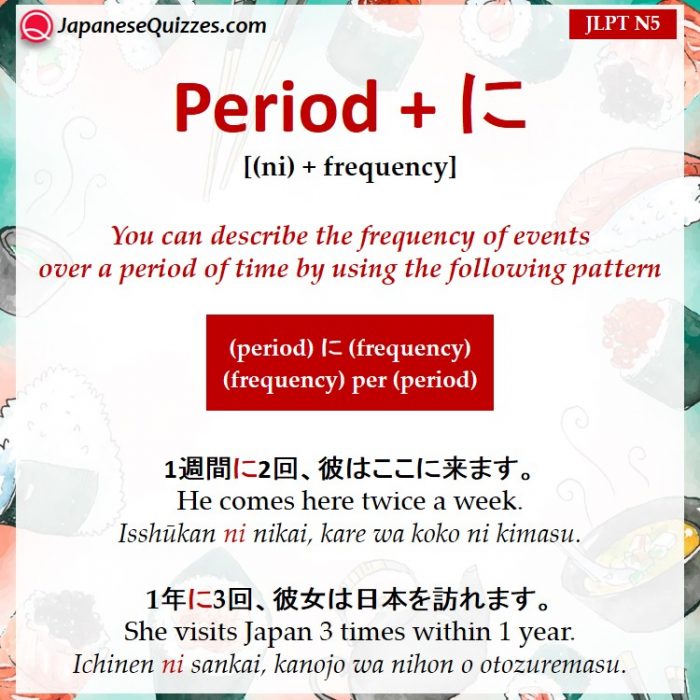
You can describe the frequency of events over a period of time by using the following pattern

Formations
(period) に (frequency)
(frequency) per (period)
Examples
1週間に5回、私は子供たちに英語を教えます。
Isshūkan ni go-kai, watashi wa kodomo-tachi ni eigo o oshiemasu.
I teach children English 5 times a week.
1週間に2回、私は彼に歴史を教えます。
Isshūkan ni ni-kai, watashi wa kare ni rekishi o oshiemasu.
I teach him history twice a week.
1週間に2回、彼はここに来ます。
Isshūkan ni ni-kai, kare wa koko ni kimasu.
He comes here twice a week.
1ヶ月に4回、私は図書館に行きます。
Ikkagetsu ni yon-kai, watashi wa toshokan ni ikimasu.
I visit a library 4 times a month.
1年に3回、彼女は日本を訪れます。
Ichi-Nen ni san-kai, kanojo wa Nihon o otozuremasu.
She visits Japan 3 times within 1 year.
See also
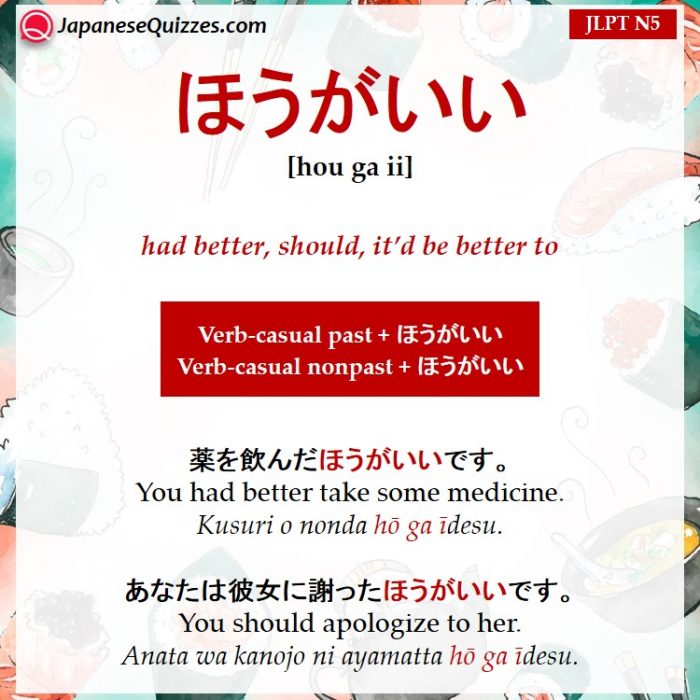
had better, should, it’d be better to

Formations
Verb-casual past + ほうがいい
Verb-casual nonpast + ほうがいい
Examples
今日は傘を持って行ったほうがいい。
Kyō wa kasa o motte itta hō ga ī.
You had better take along an umbrella today.
気をつけたほうがいい。
Ki o tsuketa hō ga ī.
You’d better be careful.
ゆっくり休んだほうがいい。
Yukkuri yasunda hō ga ī.
You should get some rest.
薬を飲んだほうがいいです。
Kusuri o nonda hō ga ī desu.
You had better take some medicine.
ご飯の後で歯を磨いたほうがいい。
Gohan no ato de ha o migaita hō ga ī.
It’s better to brush your teeth after a meal..
あなたは彼女に謝ったほうがいいです。
Anata wa kanojo ni ayamatta hō ga ī desu.
You should apologize to her.
See also

while; during; as
Two actions occur at the same time. This represents two actions occurring at the same time. The first verb uses the ます- form. The second verb represents the tense of the entire sentence.

Formations
Verb-ますstem + ながら
Examples
彼はいつも食事をしながらゲームをします。
Kare wa itsumo shokuji o shinagara gēmu o shimasu.
He is always playing a game while having a meal.
山田さんは コーヒーを飲みながら、アニメを見ている。
Yamada-san wa kōhī o nominagara, anime o mite iru.
Mr. Yamada is watching anime while drinking coffee.
留学生は いつも アルバイトしながら、大学で勉強する。
Ryūgakusei wa itsumo arubaito shinagara, daigaku de benkyō suru.
The international students always do a part-time job while studying at university.
私は歌いながら運転した。
Watashi wa utainagara unten shita.
I drove my car while singing.
昨晩、私はカラオケで歌いながら踊った。
Sakuban, watashi wa karaoke de utainagara odotta.
Last night, I danced while singing at Karaoke.
私は富士山を見ながら、その絵を描きたいです。
Watashi wa fujisan o minagara, sono e o kakitai.
I want to draw Mt. Fuji while looking at it.
See also


Formations
When… V dictionary form とき、…
V ない-form とき、…
い-adj とき、…
な-adj な とき、…
N の とき、…
Examples
時間があるとき、銀行に行きます。
Jikan ga aru toki, ginkou ni ikimasu.
I will go to the bank when I have time.
鈴木さんがいないとき、山田さんはこの仕事をする。
Suzukisan ga inai toki, Yamadasan wa kono shigoto wo suru.
When Mr. Suzuki is not here, Mr. Yamada will take over this job.
暇なとき、 インターネットで買い物をする。
Himana toki, intaanetto de kaimono wo suru.
When I have time, I do shopping online.
若いとき、たくさんの国に行きました。
Wakai toki, takusan no kuni ni ikimasu.
I went to a lot of countries when I was young.
学生のとき、よく公園へ花を見に行った。
Gakusei no toki, yoku kouen e hana wo miniitta.
I often went to a park to see flowers when I was a student.
See also
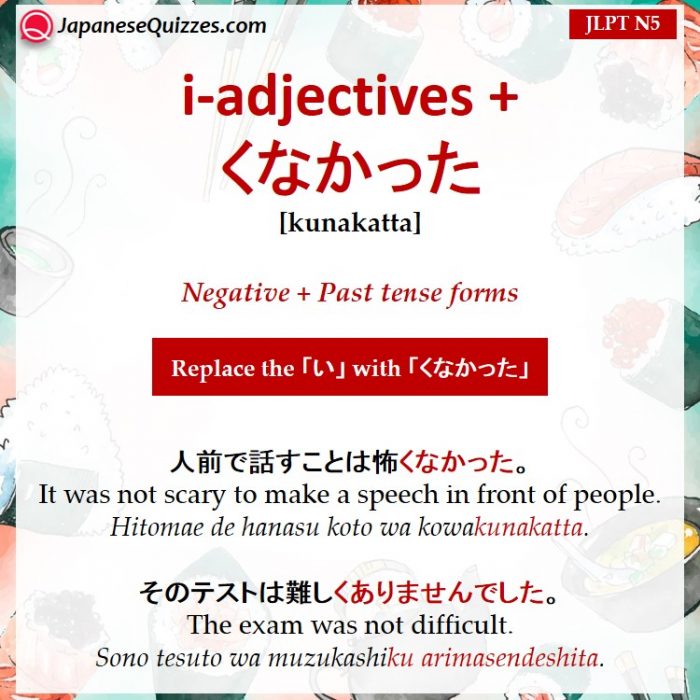
Negative+Past tense forms

Formations
Replace the 「い」 with 「くなかった」
Examples
あの家の屋根は赤くなかった。
Ano ie no yane wa akaku nakatta.
The roof of that house was not red.
人前で話すことは怖くなかった。
Hito mae de hanasu koto wa kowaku nakatta.
It was not scary to make a speech in front of people.
そのテストは難しくありませんでした。
Sono tesuto wa muzukashiku arimasendeshita.
The exam was not difficult.
その建物は新しくなかった。
Sono tatemono wa atarashiku nakatta.
The building was not new.
昨日の会社のパーティーは楽しくなかった。
Kinou no kaisya no paatii wa tanoshiku nakatta.
The company party yesterday was not enjoyable.
See also
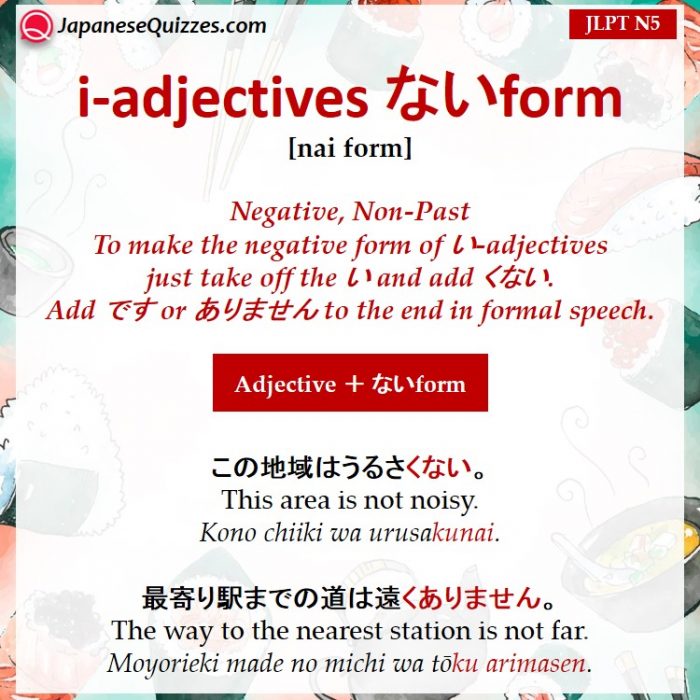
Negative, Non-Past
To make the negative form of い-adjectives just take off the い (i) and add くない (kunai). Add です (desu) or ありません(arimasen) to the end in formal speech.

Formations
Adjective+ないform(Negative, Non-Past)
Examples
その山は高くない。
Sono yama wa takakunai.
The mountain is not high.
あの魚は安くない。
Ano sakana wa yasukunai.
That fish is not cheap.
この地域はうるさくない。
Kono chiiki wa urusakunai.
This area is not noisy.
私の職場は広くない。
Watashi no shokuba wa hirokunai.
My office is not spacious.
最寄り駅までの道は遠くありません。
Moyorieki made no michi wa tōku arimasen.
The way to the nearest station is not far.
See also