■んだ (nda) group
読む(よむ) → 読んだ(よんだ)
■った (tta) group
走る(はしる) → はしった(はしった)
■the Rest of the group
The rest of the rules are all dependent on the ending syllables す, く, and ぐ.
— す verb conjugation: Replace す with した.
話す(はなす) → 話した(はなした)
—く verb conjugation: Replace く with いた。
書く(かく) → 書いた(かいた)
— ぐ verb conjugation: Replace ぐ with いだ.
泳ぐ(およぐ) → 泳いだ(およいだ)
 Examples
私は弟と学校で話した。
Watashi wa otōto to gakkō de hanashita.
I talked to my younger brother at the school.
弟は同じ漢字を10回書いた。
Otōto wa onaji kanji o 10-kai kaita.
My younger brother wrote the same kanji 10 times.
兄は駅まで5分ほど歩いた。
Ani wa eki made 5-bu hodo aruita.
My elder brother walked for about five minutes to the station.
兄は1時間ほどプールで泳いだ。
Ani wa ichi-jikan hodo pūru de oyoida.
My brother swam in the pool for about an hour.
姉は胃薬を飲んだ。
Ane wa igusuri o nonda.
My sister drank stomach medicine.
姉は雑誌を読んだ。
Ane wa zasshi o yonda.
My older sister read a magazine.
妹はデパートで白い鞄を買った。
Imōto wa depāto de shiroi kaban o katta.
My sister bought a white bag at the department store.
妹は弁当を持った。
Imōto wa bentō o motta.
My sister had a lunch box.
See also

To change a ru-verb from the dictionary form into the past tense, you simply drop the 「る」 and add 「た」

Formations
る → た
Examples
今日、私は早く起きた。
Kyou watashi wa hayaku okita.
Today I got up early.
昨晩、私は早く寝た。
Sakuban, watashi wa hayaku neta.
Last night I went to bed early.
私は最近、タバコをやめた。
Watashi wa saikin tabako o yameta.
I stopped smoking recently.
彼は家に帰った。
Kare wa ie ni kaetta.
He has gone home.
今日の私の仕事は終わった。
Kyou no watashi no shigoto wa owatta.
I finished my work for today.
See also
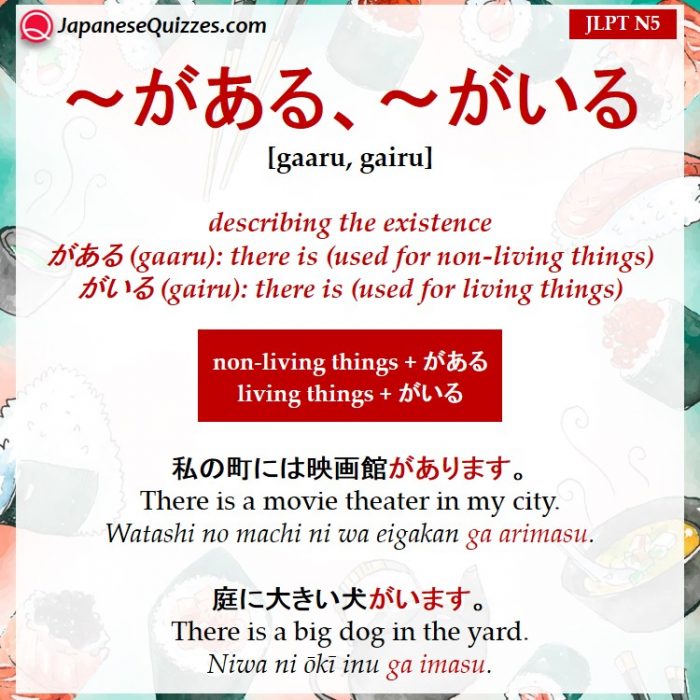
describing the existence
がある (ga aru): there is (used for non-living things)
がいる (ga iru): there is (used for living things)

Formations
non-living thing + がある
living thing + がいる
Examples
居間にテレビがある。
Imani telebi ga aru.
There is a TV set in the living room.
図書館に古い新聞がある。
Tosyokan ni hurui shinbun ga aru.
There are old newspapers in the library.
私の町には映画館があります。
Watashi no machi niwa eigakan ga arimasu.
There is a movie theater in my city.
教室に男の子がいる。
Kyoushitu ni otoko no ko ga iru.
There are boys in the classroom.
庭に大きい犬がいます。
Niwa ni okii inu ga imasu.
There is a big dog in the yard.
公園に白い鳥がいる。
Kouen ni shiroi tori ga iru.
There are white birds in the park.
See also
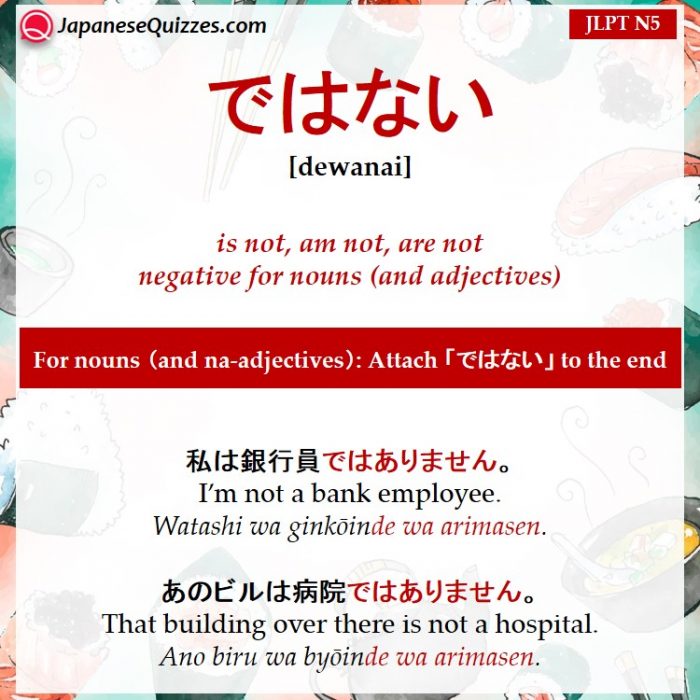
is not, am not, are not
Negative for nouns (and adjectives)

Formations
For nouns ( and na-adjectives): Attach 「ではない」 to the end
Examples
私は銀行員ではありません。
Watashi wa ginkou in dewa arimasen.
I’m not a bank employee.
これは東京駅ではない。
Kore wa tokyo eki dewa nai.
This is not Tokyo Station.
あのビルは病院ではありません。
Ano biru wa byouin dewa arimasen.
That building over there is not a hospital.
ネルソンさんは外交官ではない。
Neluson san wa gaikoukan dewa nai.
Mr. Nelson is not a diplomat.
あの鉛筆はジェフのものではない。
Ano enpitu wa jefu no mono dewa nai.
That pencil is not Jeff’s.
私たちは佐野先生の学生ではない。
Watashi tachi wa Sano sennsei no gakusei dewa nai.
We are not professor Sano’s students.
See also

Formations
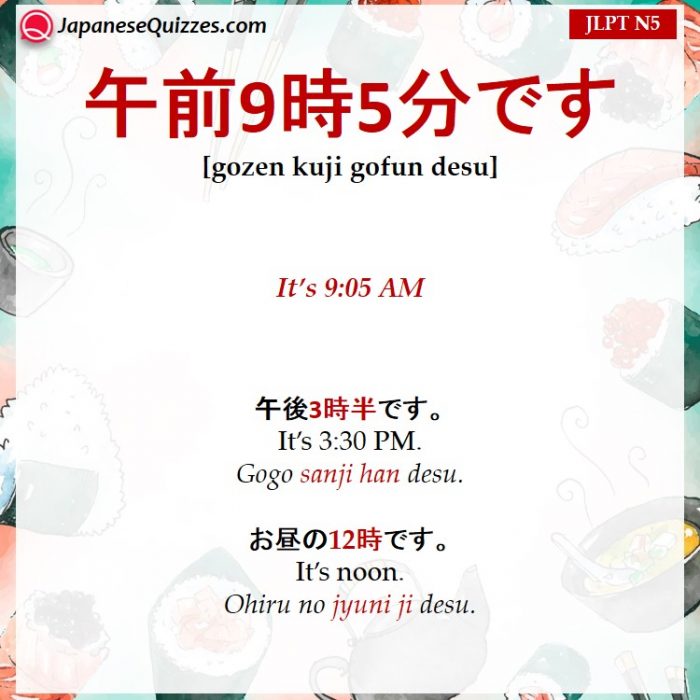
~時~分
Examples
午前9時5分です。
Gozen kuji gofun desu.
It’s 9:05 AM.
午前8時10分です。
Gozen hachi ji jyuppun desu.
It’s 8:10 AM.
午前11時26分です。
Gozen jyuu ichi ji nijyu roppun desu.
It’s 11:26 AM.
お昼の12時です。
Ohiruno jyuni ji desu.
It’s noon.
午後3時半です。
Gogo sanji han desu.
It’s 3:30 PM.
午後7時38分です。
Gogo shichiji sanju happun desu.
It’s 7:38 PM.
See also

Formations
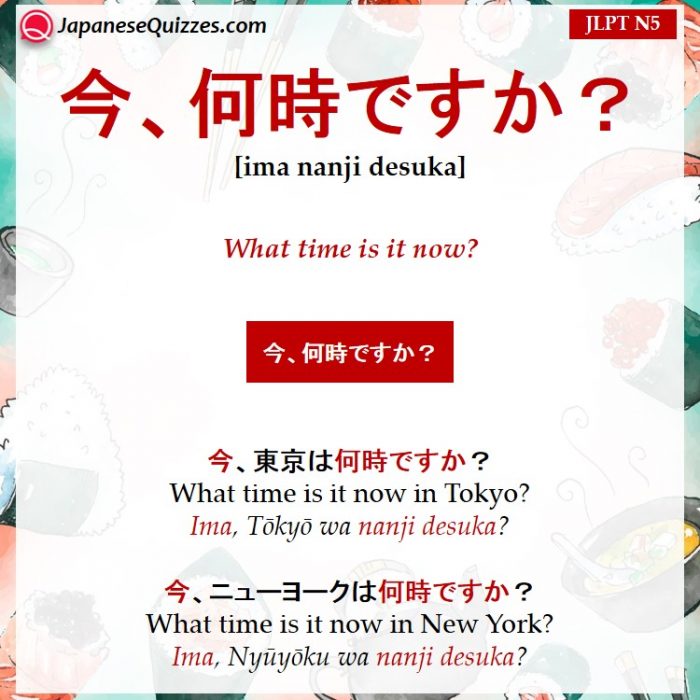
今、何時ですか?
Examples
今、何時ですか?
Ima nanji desu ka.
What time is it now?
今、東京は何時ですか?
Ima Tokyo wa nanji desuka.
What time is it now in Tokyo?
今、イギリスは何時ですか?
Ima Igilisu wa nanji desuka.
What time is it now in the UK?
今、香港は何時ですか?
Ima Hong Kong wa nanji desuka.
What time is it now in Hong Kong?
今、ニューヨークは何時ですか?
Ima Nyuu Yoku wa nanji desuka.
What time is it now in New York?
See also

 Examples