to express ongoing actions, repeated actions, and resultant states + negative

Formations
Verb-てform + いない
Examples
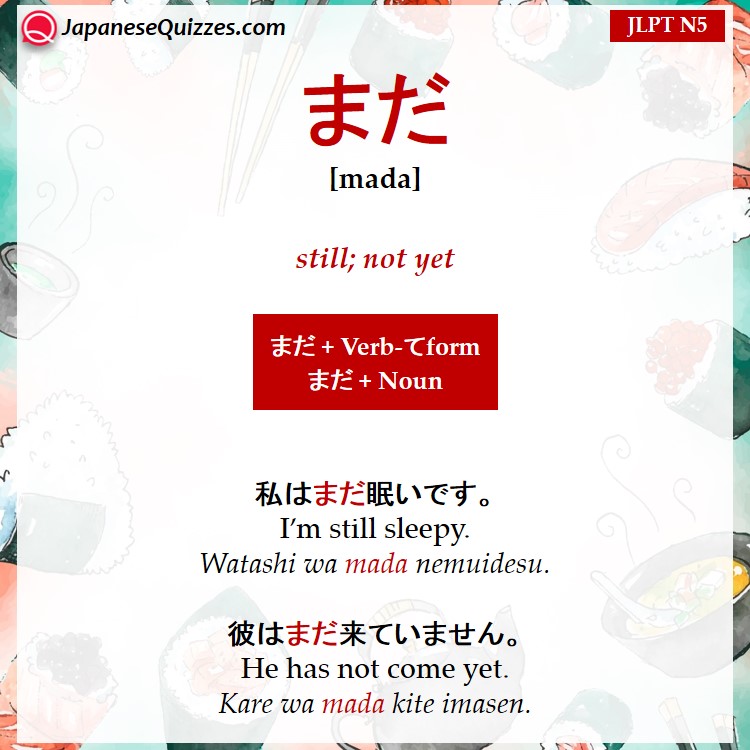
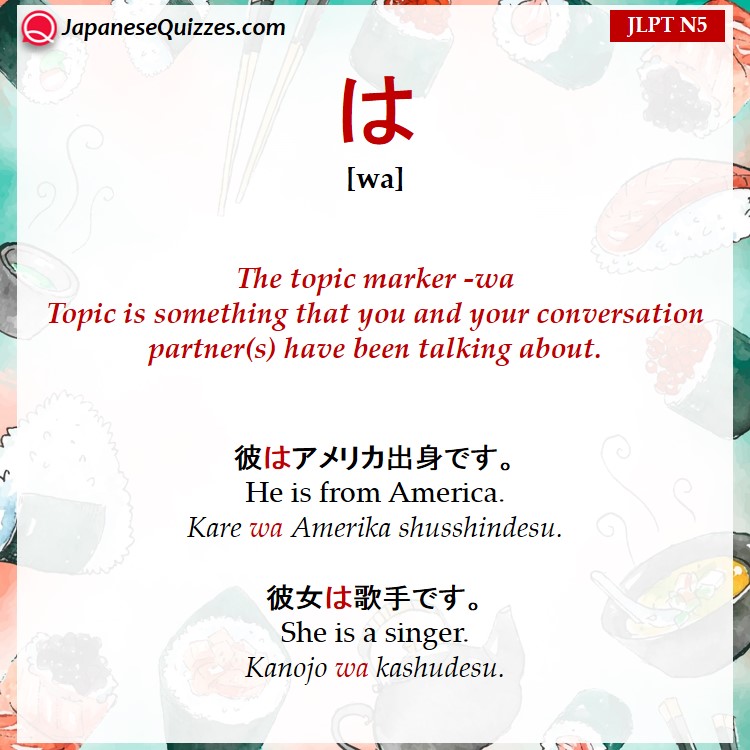
私はジョンを待っていない。
Watashi wa Jon o matte inai.
I am not waiting for John.
雨は降っていません。
Ame wa futte imasen.
It is not raining.
彼女は結婚していません。
Kanojo wa kekkon shite imasen.
She is not married.
その熊は太っていない。
Sono kuma wa futotte inai.
The bear is not fat.
私の娘は風邪をひいていない。
Watashi no musume wa kaze o hīte inai.
My daughter doesn’t have a cold.
See also

Formations
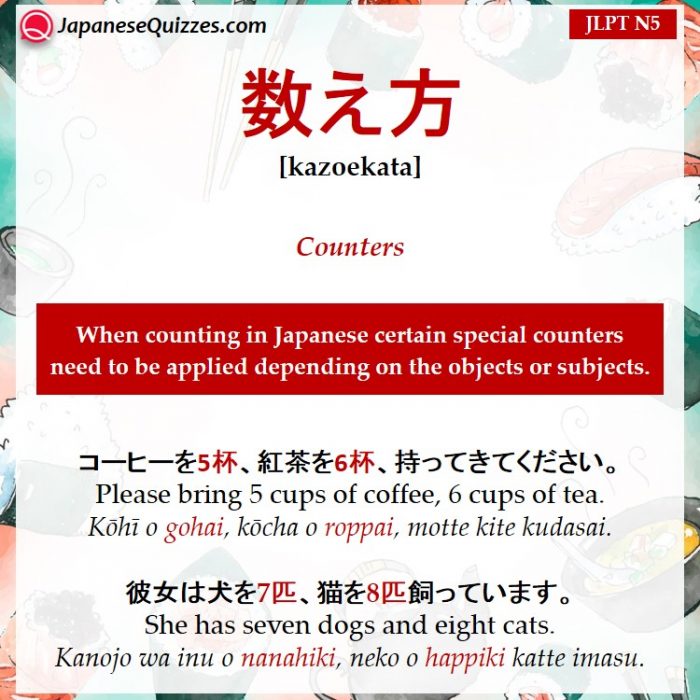
When counting in Japanese certain special counters need to be applied depending on the objects or subjects.
Examples
彼女は教科書を1冊、マンガ本を2冊持っている。
Kanojo wa kyōkasho o issatsu, manga bon o ni-satsu motte iru.
She has one textbook and two comics.
その駅の前にはビルが3軒、民家が4軒ある。
Sono Eki no mae ni wa biru ga san-ken, minka ga yon-ken aru.
There are 3 buildings and 4 private houses in front of the station.
コーヒーを5杯、紅茶を6杯、持ってきてください。
Kōhī o go-hai, kōcha o roppai, motte kite kudasai.
Please bring 5 cups of coffee, 6 cups of tea.
彼女は犬を7匹、猫を8匹飼っています。
Kanojo wa inu o nana hiki, neko o happiki katte imasu.
She has seven dogs and eight cats.
彼の娘は9歳で、息子は10歳だ。
Kare no musume wa kyuu-sai de, musuko wa jyussai da.
His daughter is nine years old and his son is ten years old.
私は会社に週5回行き、ジムに週3回通っている。
Watashi wa kaisha ni shū gokai iki, jimu ni shū san kai kayotte iru.
I go to work five times a week and go to the gym three times a week.
See also

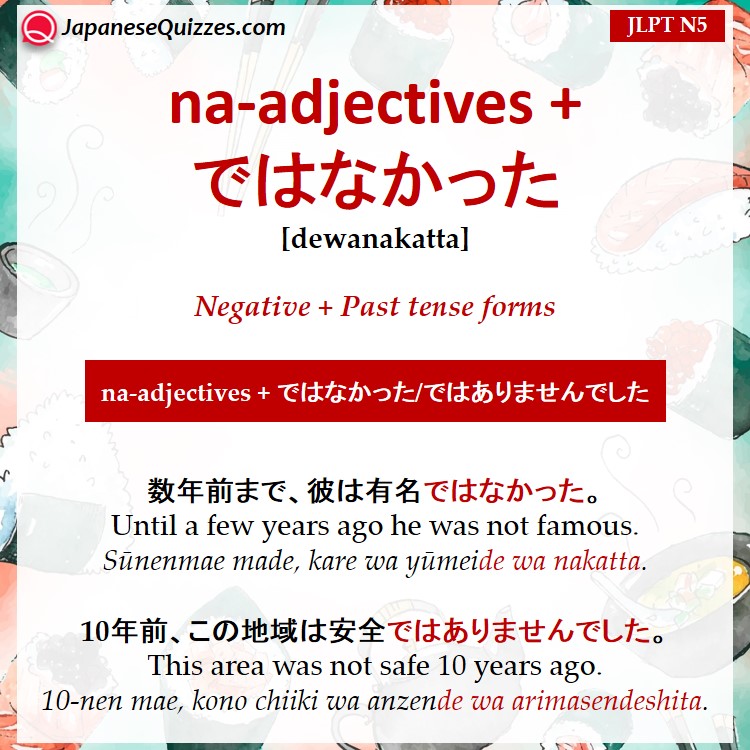
Past-negative tense for all verbs

Formations
To change verbs into the past-negative tense
Change the verb to the negative and replace the 「い」 with 「かった」
Examples
先週、私はラーメンを食べなかった。
Senshū, watashi wa rāmen o tabenakatta.
I didn’t eat ramen last week.
おととい、私は日本語を勉強しなかった。
Ototoi, watashi wa nihongo o benkyō shinakatta.
I didn’t study Japanese the day before yesterday.
昨日、私の父は買物に行かなかった。
Kinō, watashino chichi wa kaimono ni ikanakatta.
My father didn’t go shopping yesterday.
午前中、私の母はテニスをしなかった。
Gozen-chū, watashino haha wa tenisu o shinakatta.
My mother didn’t play tennis in the morning.
二日前、私の弟はテレビを見なかった。
Futsuka mae, watashi no otōto wa terebi o minakatta.
My brother didn’t watch TV two days ago.
See also
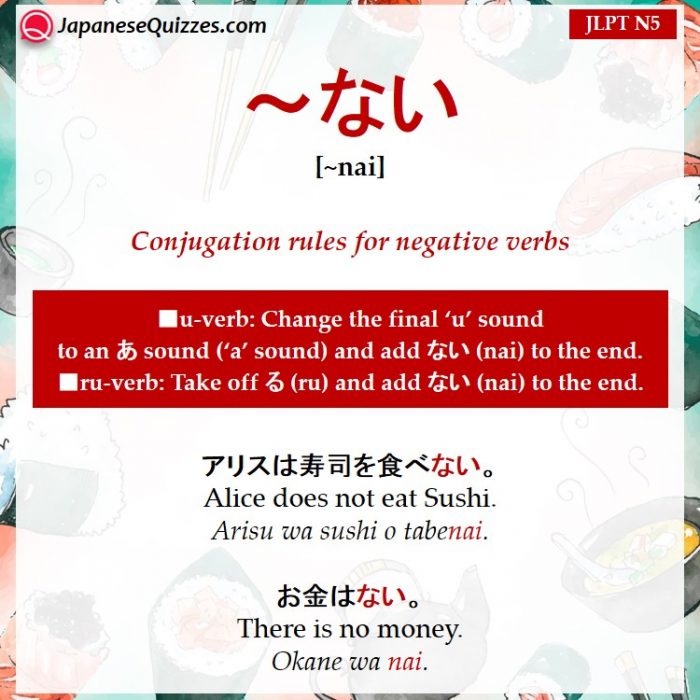
Conjugation rules for negative verbs

Formations
■u-verb
To change an u-verb from affirmative to negative form:
Change the final ‘u’ sound to an あ sound (‘a’ sound) and add ない (nai)to the end.
■ru-verb
To change a -verb (ru-verb) from affirmative to negative:
Take off る (ru) and add ない (nai) to the end.
Examples
ジムはお土産を買わない。
Jim wa omiyage o kawa nai.
Jim does not buy souvenirs.
ボブは日本語を学ばない。
Bob wa nihongo o manaba nai.
Bob does not study Japanese.
アリスは寿司を食べない。
Yamada san wa kimono o ki nai.
Alice does not eat Sushi.
山田さんは着物を着ない。
Arisu wa sushi o tabe nai.
Mr. Yamada does not wear kimono.
お金はない。
Okane wa nai.
There is no money.
猫はいない。
Neko wa i nai.
There is no cat.
See also


Formations
Verb-てform + いる
Examples
私は教科書を読んでいます。
Watashi wa kyoukasho wo yondeimasu.
I am reading a textbook.
私の友達はお昼ご飯を食べている。
Watashi no tomodachi wa ohiru gohan wo tabeteiru.
My friends are eating lunch.
彼女は猫を飼っています。
Kanojo wa neko wo katteimasu.
She keeps a cat.
その犬は痩せている。
Sono inu wa yaseteiru.
The dog is skinny. (lit: Dog is in state of having gotten skinny.)
私は風邪をひいている。
Watashi wa kaze wo hiiteiru.
I have a cold.
See also

する(do) → した(did)
来る(come) → 来た(came)
行く(go) → 行った(went) * exceptions particular to this conjugation

Examples
私は家で宿題をした。
Watashi wa ie de shukudai o shita.
I did my homework at home.
私は学校で野球をした。
Watashi wa gakkō de yakyū o shita.
I played baseball at school.
弟は図書館に来た。
Otōto wa toshokan ni kita.
My brother came to the library.
昨日、友達は東京駅に来た。
Kinō, tomodachi wa Tōkyō Eki ni kita.
My friend came to Tokyo station yesterday.
昨日、私は学校に行った。
Kinō, watashi wa gakkō ni itta.
I went to school yesterday.
先週、私は銀行に行った。
Senshū, watashi wa ginkō ni itta.
I went to the bank last week.
See also