JLPT N3 Grammar List
have a feeling that…, think that… .

Formations
Verb-casual + (ような)気がする
Noun + (のような)気がする
いadj + (ような)気がする
なadj + (な/のような)気がする
Examples
私は旅に出かけたいような気がします。
Watashi wa tabi ni dekaketai yōna ki ga shimasu.
I feel like going on a trip.
私は彼にどこかで会ったような気がします。
Watashi wa kare ni doko ka de atta yōna ki ga shimasu.
I have a feeling I met him somewhere before.
私の人生には何か欠けているものがあるような気がします。
Watashi no jinsei ni wa nani ka kakete iru mono ga aru yōna ki ga shimasu.
I have a feeling that something is lacking in my life.
See also

JLPT N3 Grammar List
although, rather, unexpectedly
You use わりに to talk about an unexpected feeling.
.
Formations
Verb-casual + わりに
いadj + わりに
なadj + なわりに
Noun + のわりに
Examples
祖父は、年のわりには若く見えます。
Sofu wa,-toshi no wari ni wa wakakumiemasu.
Considering his age, my grandfather looks pretty young.
このピザは安いわりにはおいしいです。
Kono piza wa yasui warini wa oishīdesu.
Considering that its price is cheap, this pizza is rather delicious.
高級そうなレストランのわりに、食べ物がおいしくないです。
Kō kyuu-souna resutoran no wari ni, tabe mono ga oishikunaidesu.
Considering a luxurious looking restaurant, the food is unexpectedly not delicious.
See also

JLPT N3 Grammar List
Meaning 1: must not, cannot afford to, can’t very well
Meaning 2: must, have no choice but to .
Formations
Verb-casual, non-past + わけにはいかない
Verb-ないform + わけにはいかない
Examples
私は、この仕事を終えるまでは、帰宅するわけにはいきません。
Watashi wa, kono shigoto o oeru made wa, kitaku suru wake ni wa ikimasen.
Until I can finish that work, I cannot get back home.
私は妹のことを心配しないわけにはいきません。
Watashi wa imōto no koto o shinpai shinai wake ni wa ikimasen.
I can`t help feeling anxious about my younger sisiter.
私は、そんな話を聞くと笑わないわけにはいきません。
Watashi wa, son’na hanashiwokiku to warawanai wake ni wa ikimasen.
I cannot help laughing to hear such a story.
See also

JLPT N3 Grammar List

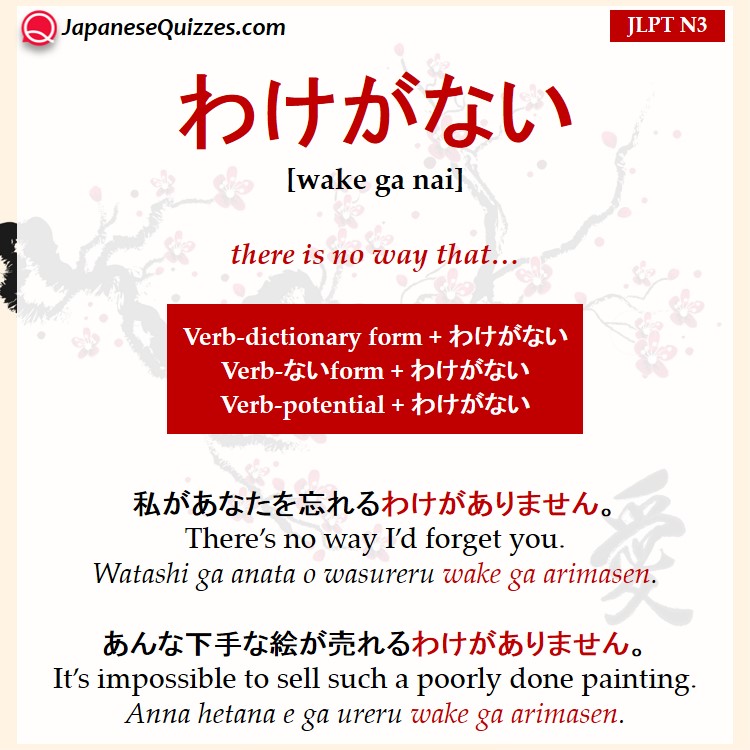
Formations
Verb-dictionary form + わけがない
Verb-ないform + わけがない
Verb-potential + わけがない
Examples
私があなたを忘れるわけがありません。
Watashi ga anata o wasureru wake ga arimasen.
There’s no way I’d forget you.
あんな下手な絵が売れるわけがありません。
Anna hetana e ga ureru wake ga arimasen.
It’s impossible to sell such a poorly done painting.
こんなやさしい仕事が君にできないわけがありません。
Konna yasashī shigoto ga kimi ni dekinai wake ga arimasen.
There’s no reason why you can’t do such an easy job.
See also

JLPT N3 Grammar List
it doesn’t mean that; it is not the case that; I don’t mean that; it is not true that .

Formations
Verb-casual + わけではない
いadjective + わけではない
なadjective + なわけではない
Noun + であるわけではない
Examples
あなたの作文は全部ダメだというわけではありません。
Anata no sakubun wa zenbu dameda to iu wakede wa arimasen.
Your composition is not altogether bad.
私はあなたの権利を奪おうとしているわけではありません。
Watashi wa anata no kenri o ubaou to shite iru wakede wa arimasen.
I’m not trying to deprive you of your rights.
この学校の生徒の全員が大学に進学するわけではありません。
Kono gakkō no seito no zen’in ga daigaku ni shingaku suru wakede wa arimasen.
Not all the students of this school go on to university.
See also

JLPT N3 Grammar List
the fact is, for that reason, as you’d expect, as you know,no wonder .

Formations
Verb-casual + わけだ
いadjective + わけだ
なadjective + なわけだ/だったわけだ
Noun + である/だった/であった + わけだ
Examples
道理で彼は成功するわけだ。
Dōri de kare wa seikō suru wakeda.
It is no wonder that he should succeed.
道理で彼女はこの秘密を知っているわけだ。
Dōri de kanojo wa kono himitsu o shitte iru wakeda.
It is no wonder that she knows this secret.
ご存知のように、言語を短期間で習得するのは難しいわけだ。
Gozonji no yō ni, gengo o tankikan de shūtoku suru no wa muzukashī wakeda.
As you know, it is difficult to master the language in a short time.
See also