なさい (nasai)

JLPT N4 Grammar List

command/order somebody to do something

 Formations 

Verb-stem + なさい

 Examples  

答えを紙に書きなさい
Kotae o kami ni kakinasai.
Write your answers on the paper.

早く しなさい
Hayaku shinasai.
Hurry up!

目を閉じなさい
Me wo tojinasai.
Close your eyes.

よく聞きなさい
Yoku kiki nasai.
Listen carefully.

目を閉じなさい
Me o toji nasai.
Close your eyes.

靴を脱いでください
Kutsu o nuide kudasai.
Take off your shoes.

メモを取りなさい
Memo o tori nasai.
You should make notes.

電源を入れなさい
Dengen o ire nasai.
Turn on the power.

3つ目の角を右に曲がってください
Mittsu-me no kado o migi ni magatte kudasai.
Turn right at the third corner.

See also


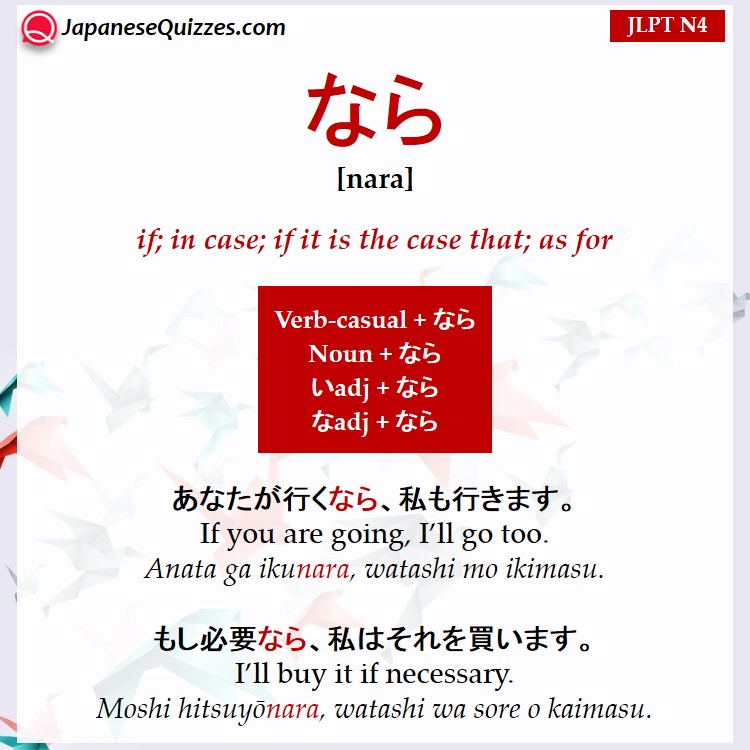
なら (nara)

JLPT N4 Grammar List

if; in case; if it is the case that; as for

 Formations 

Verb-casual + なら
Noun + なら
いadj + なら
なadj + なら

 Examples  

あなたが行くなら、私も行きます。
Anata ga ikunara, watashi mo ikimasu.
If you are going, I’ll go too.

もし必要なら、私はそれを買います。
Moshi hitsuyōnara, watashi wa sore o kaimasu.
I’ll buy it if necessary.

それならなぜやめないんですか。
Sore nara naze yamenai n desu ka.
If that’s the case, why don’t you stop?

ならそんなものは買いません。
Watashi nara sonna mono wa kaimasen.
If it were me, I would not buy such a thing.

彼女なら喜んでしてくれるでしょう。
Kanojo nara yorokonde shite kureru deshō.
Certainly, she’d be happy to do it for you.

お金なら要りません。
Okane nara irimasen.
If it’s money (you’re offering), I don’t need it.

英語なら話せます。
Eigo nara hanasemasu.
If it’s English (you need), I can speak it.

歴史的な街なら京都がいい。
Rekishiteki na machi nara Kyōto ga ii.
As for historical cities, Kyoto is nice.

結婚まだ相手がいません。
Kekkon nara mada aite ga imasen.
If you’re talking about my marriage, I have no partner yet.

「先生はどこですか。 」「先生なら図書館にいらっしゃいますよ。 」
“Sensei wa doko desu ka.” “Sensei nara toshokan ni irasshaimasu yo.”
“Where is the teacher?” “If you’re looking for your teacher, he/she is in the
library.”

「トイレに行きたいんですが。 」「トイレなら二階にありますよ。 」
“Toire ni ikitai n desu ga.” “Toire nara ni kai ni arimasu yo.”
“I want to go to a restroom.” “If you’re looking for a restroom, it’s on the
second floor.”

来週までなら出来上がります。
Raishū made nara dekiagarimasu.
I will be able to complete it by next week (if you can wait till then).

ちゃんと返してくれる(の) なら貸してあげましょう。
Chanto kaeshite kureru (no) nara kashite agemashō.
On condition that you return it to me without fail, I will lend it to you.

そんなに安い (ん)なら買います。
Sonna ni yasui (n) nara kaimasu.
If it is so cheap, I’ll buy it.

あなたができない (の) なら私がしましょう。
Anata ga dekinai (no) nara watashi ga shimashō.
If you cannot do it, I will do it for you.

欲しかった (の) なら言ってくれればよかったのに。
Hoshikatta (no) nara itte kurereba yokatta no ni.
If you wanted it, you should have told me so.

東京にいらっしゃいます (の) なら, 是非うちにお寄りください。
Tōkyō ni irasshaimasu (no) nara, zehi uchi ni oyori kudasai.
If you are coming to Tokyo, please come to visit our house.

See also


なくてもいい (nakute mo ii)

JLPT N4 Grammar List

don’t have to

 Formations 

Verb-ないform (remove い) + くて(も)いい
Noun + じゃなくて(も)いい
いadjective (remove い) + くて(も)いい
なadjective + じゃなくて(も)いい

 Examples  

あなたは入院しなくていいです。
Anata wa nyūin shinakute ī desu.
You don’t have to stay in the hospital.

あなたはこの本を戻さなくていいです。
Anata wa kono-pon o modosanakute ī desu.
You don’t have to return this book.

そんなに急いでやらなくてもいいです。
Sonna ni isoide yaranakutemo ii desu.
You need not do it so hastily.

電話をしてくれればわざわざ来なくてもよかったですよ。
Denwa o shite kurereba wazawaza konakutemo yokatta desu yo.
If you had given me a call, you need not have come all this way.

これは書かなくてもいいですか。
Kore wa kakanakutemo ii desu ka.
Is it all right if I don’t write this?

車は動けば新しくなくてもよいです。
Kuruma wa ugokeba atarashiku nakutemo yoi desu.
As long as the car moves, it needn’t be new.
(The car needn’t be new; it just has to run.)

お気に入りの車なら新車じゃなくてもいいです。
Okiniiri no kuruma nara shinsha ja nakute mo ii desu.
It does not have to be a brand new car if it’s my favorite car.

返事は今日でなくてもいいです。
Henji wa kyō de nakutemo ii desu.
A reply does not need to be made today.

文法の説明は完全でなくてもよい
Bunpō no setsumei wa kanzen de nakutemo yoi.
The explanation of grammar does not need to be perfect.

See also


なくてはいけない/なくてはならない (nakutewa ikenai/nakutewa naranai)

JLPT N4 Grammar List

must do, have to do

 Formations 

Verb-ないform (-い) + くてはいけない/くてはならない

 Examples  

あなたにさようならを言わなくてはいけません
Anata ni sayōnara o iwanakute wa ikemasen.
I have to say goodbye to you.

私たちは今度の試合に絶対に勝たなくてはなりません
Watashitachi wa kondo no shiai ni zettai ni katanakute wa narimasen.
We must win this match at all costs.

この漢字は覚えなくてはいけませんよ。
Kono kanji wa oboenakutewa ikemasen yo.
You need to memorize this kanji.

明日ボストンに行かなくてはいけません
Ashita Bosuton ni ikanakutewa ikemasen.
I need to go to Boston tomorrow.

ピザは熱くなくてはいけません
Piza wa atsukunakutewa ikemasen.
Pizzas must be hot.

あの大学に入るには数学の成績がよくなくてはいけません
Ano daigaku ni hairu ni wa sūgaku no seiseki ga yokunakute wa ikemasen.
In order to enter that college, you must have a good grade in math.

寝室は静かでなくてはいけません
Shinshitsu wa shizuka de nakutewa ikemasen.
Bedrooms have to be quiet.

朝ごはんは日本食でなくてはいけません。
Asagohan wa nihonshoku de nakutewa ikemasen.
My breakfast has to be Japanese-style.

See also


なければいけない/なければならない (nakereba ikenai/nakereba naranai)

JLPT N4 Grammar List

must do something; have to do something

 Formations 

Verb-ないform (remove い) + ければならない

 Examples  

私は彼に感謝しなければなりません
Watashi wa kare ni kansha shinakereba narimasen.
I must be grateful toward him.

友人は助け合わなければいけません
Yuujin wa tasuke awanakereba ikemasen.
Friends should help one another.

もっと勉強しなければいけない
Motto benkyō shinakereba ikenai.
You must study harder.

「私も行かなければいけませんか。 」「いえ,けっこうです。 」
“Watashi mo ikanakereba ikemasen ka.” “Ie, kekkō desu.”
“Do I have to go, too?” “No, you don’t need to.”

九時までに会社に行かなければなりません。
Kuji made ni kaisha ni ikanakereba narimasen.
I have to go to the company by nine o’clock.

もっと単語を覚えなければなりません
Motto tango o oboenakereba narimasen.
I have to learn more words.

荷物はもっと軽くなければいけません。
Nimotsu wa motto karuku nakereba ikemasen.
The luggage needs to be lighter.

アパートは駅にもっと近くなければならない。
Apāto wa eki ni motto chikaku nakereba naranai.
The apartment house needs to be much closer to the train station.

辞書は便利でなければいけない
Jisho wa benri de nakereba ikenai.
Dictionaries must be convenient.

高齢者に親切でなければいけません
Kōreisha ni shinsetsu de nakereba ikemasen.
You must be kind to old people.

話は論理的でなければならない。
Hanashi wa ronriteki de nakereba naranai.
The speech needs to be logical.

See also


ないで (naide)

JLPT N4 Grammar List

without doing…; don’t

The difference between ないで and なくて: なくて is usually used to explain the reason why something happens, while ないで means without doing something.

 Formations 

Verb-ないform + で

 Examples  

諦めないでください。
Akirame naide kudasai.
Don’t give up!

私は何もしないで一年が過ぎました。
Watashi wa nanimoshi naide ichinen ga sugimashita.
The year passed without me doing anything.

勝手に写真を撮らないで下さい。
Katte ni shashin o toranai de kudasai.
Please don’t take a photo of me without my permission.

宿題をしないで何をしているの。
Shukudai o shinai de nani o shite iru no.
What are you doing not doing your homework?

朝食を食べて出勤しますか。それとも食べないで出勤しますか。
Chōshoku o tabete shukkin shimasu ka. Soretomo tabenai de shukkin shimasu ka.
Do you go to work after eating breakfast? Or do you go to work without
eating breakfast?

しゃべりながら食べますか。しゃべらないで食べますか。
Shaberi nagara tabemasu ka. Shaberanai de tabemasu ka.
Do you eat while talking? Or do you eat without talking?

今日はテレビを見ないで宿題をした方がいい。
Kyō wa terebi o minai de shukudai o shita hō ga ii.
It’s better to do your homework without watching TV today.

これ以上お金を使わないでおきます。
Kore ijō okane o tsukawanai de okimasu.
I’ll stop using more money. (I will keep money without using it.)

言いたいことを言わないでおくのを「言わぬが花。 」という
Iitai koto o iwanai de oku no o “Iwanuga hana.” to iu.
Leaving unsaid what one would rather say is expressed as “No word is a
flower [beautiful].”

まだ本当のことを知らせないでいるんですか。
Mada hontō no koto o shirasenai de iru n desu ka.
You still haven’t let (him) know the truth?

See also