Negative, Non-Past
To change a な-adjective to negative form, replace the “だ”(plain) or “です” (polite) with “ではない”(plain), “ではありません” (polite) at the end of the sentence.

Formations
な-adjです → な-adjではない / ではありません (polite)
Examples
このホテルはきれいではない。
Kono hoteru wa kireide wanai.
This hotel is not beautiful.
この猫は静かではない。
Kono neko wa shizukade wanai.
This cat is not quiet.
この時間のレストランは、にぎやかではありません。
Kono-jikan no resutoran wa, nigiyaka dewa arimasen.
This restaurant is not busy for these hours.
ボブは親切ではない。
Bobu wa shinsetsude wanai.
Bob is not a kind person.
その地域は安全ではない。
Sono chiiki wa anzende wanai.
The area is not safe.
See also

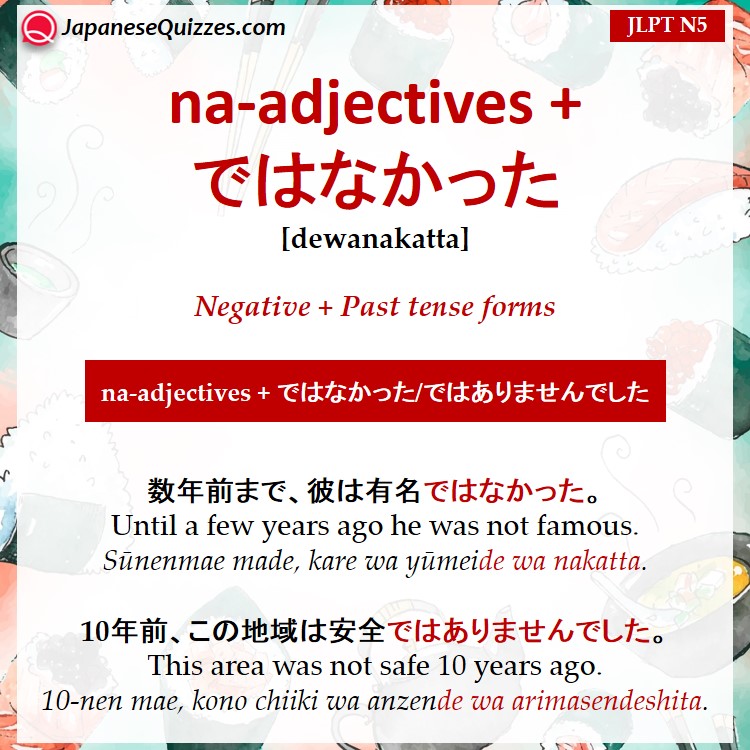
Negative+Past tense forms ~ではなかった

Formations
na-adjectives + ではなかった/ではありませんでした
Examples
数年前まで、彼は有名ではなかった。
Sūnenmae made, kare wa yūmeide wa nakatta.
Until a few years ago he was not famous.
10年前、この地域は安全ではありませんでした。
Jyuu-Nen mae, kono chiiki wa anzende wa arimasendeshita.
This area was not safe 10 years ago.
昨日、私の娘は元気ではなかった。
Kinō, watashi no musume wa genkide wa nakatta.
Yesterday my daughter did not feel well.
2日前、その食堂は静かではなかった。
Futsuka mae, sono shokudō wa shizukade wa nakatta.
2 days ago the restaurant was not quiet.
5年前、この商店街は便利ではなかった。
Go-Nen mae, kono shōten gai wa benride wa nakatta.
5 years ago, this shopping area was not convenient.
See also

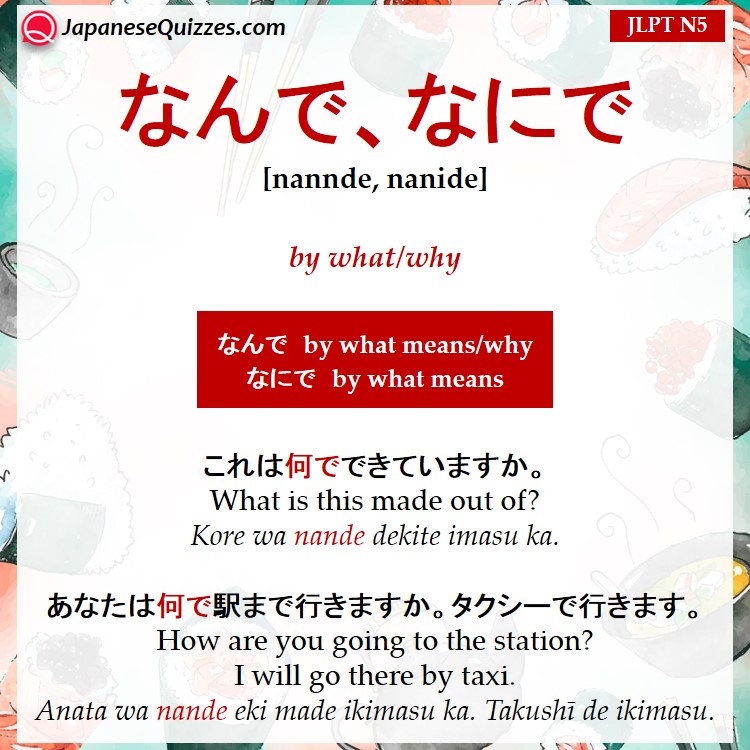
by; for; in; using; with
The particle で can be used to indicate means, method, or instruments. It translates into “by”, “with”, “in,” “by means of”, etc.

Formations
Noun + で
Examples
私は電車で会社に行きます。
Watashi wa densha de kaisha ni ikimasu.
I go to office by train.
弟はバスで学校に行く。
Otōto wa basu de gakkō ni iku.
My younger brother goes to school by bus.
妹は箸でご飯を食べます。
Imōto wa hashi de gohanwo tabemasu.
My younger sister eats the meal with the chopsticks.
私は鉛筆で日記をつける。
Watashi wa enpitsu de nikkiwotsukeru.
I keep a diary with the pencil.
弟は英語で作文を書く。
Otōto wa eigo de sakubun o kaku.
My younger brother writes a composition in English.
兄は日本語で計画書を作る。
Ani wa nihongo de kaikakusho o tsukuru.
My elder brother makes a planning document in Japanese.
See also
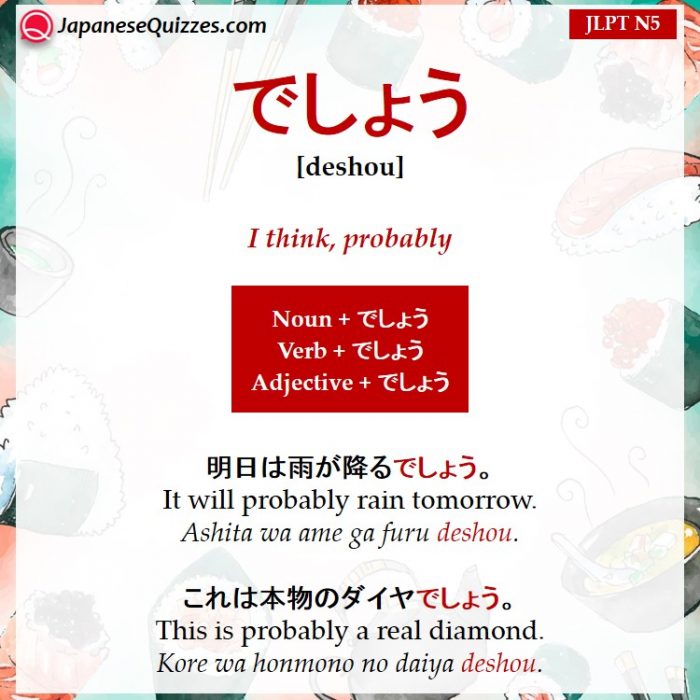
I think, probably
「でしょう」 is used to express a level of some certainty

Formations
Noun + でしょう
Verb + でしょう
Adjective + でしょう
Examples
明日は晴れでしょう。
Ashita wa haredeshou.
It will probably be sunny tomorrow.
明日は雨が降るでしょう。
Ashita wa amegafurudeshou.
It will probably rain tomorrow.
今夜は風が強いでしょう。
Kon’ya wa kaze ga tsuyoideshou.
The wind will be strong tonight.
これは本物のダイヤでしょう。
Kore wa honmono no daiyadeshou.
This is probably a real diamond.
あの人は田中さんでしょう。
Ano hito wa Tanaka-sandeshou.
I guess that person is Ms. Tanaka.
今日、アリスはたぶんここに来ないでしょう。
Kyō, Arisu wa tabun koko ni konaideshou.
Alice probably will not come here Today.
See also

Formations
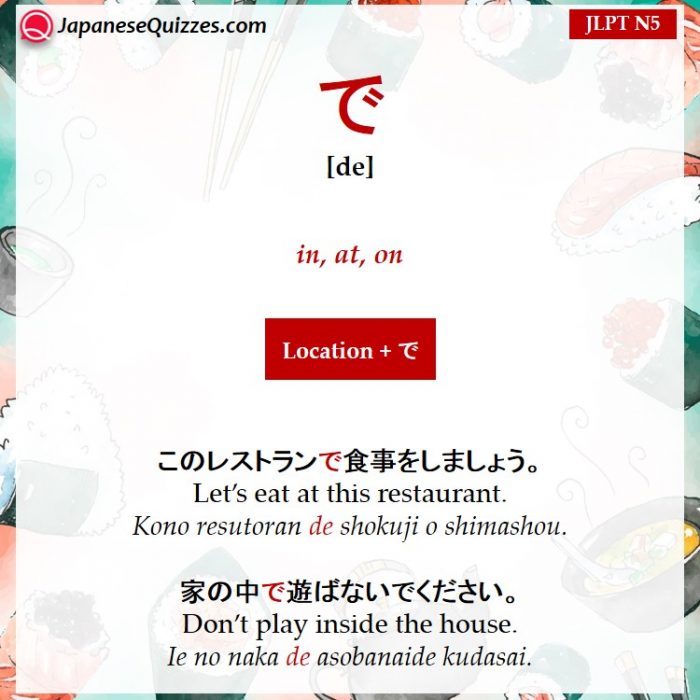
Location + で
Examples
私はいつも図書館で本を読む。
Watashi wa itsumo toshokan de hon wo yomu.
I always read books at the library.
このレストランで食事をしましょう。
Kono resutoran de shokuji o shimashou.
Let’s eat at this restaurant.
この帽子はどこで買ったのか?
Kono bōshi wa doko de katta no ka?
Where did you buy this hat?
どこで日本語を勉強しているのか?
Doko de nihongo o benkyō shite iru no ka?
Where are you studying Japanese?
家の中で遊ばないでください。
Uchinonaka de asobanaide kudasai.
Don’t play inside the house.
プールで泳いだ。
Pūru de oyoida.
I swam in the pool.
See also

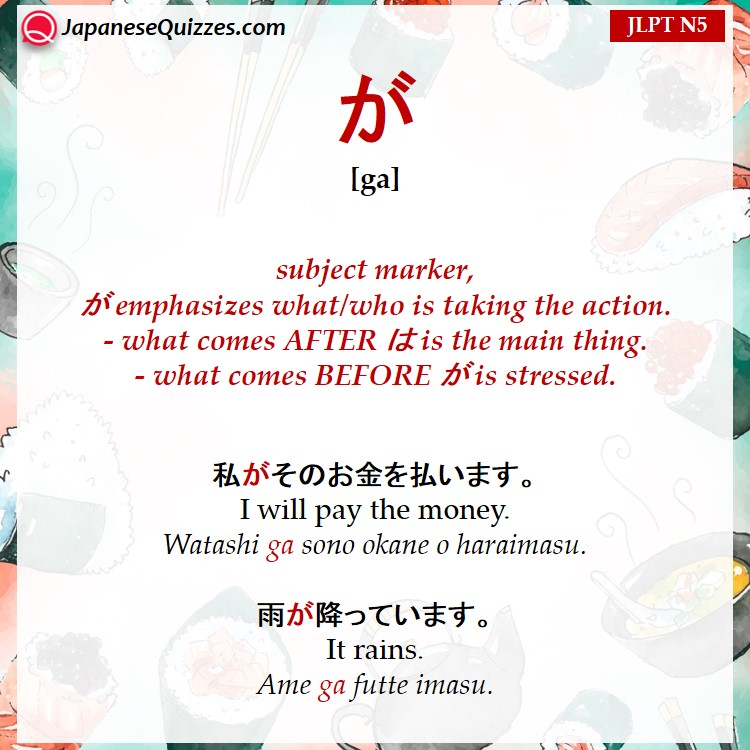
subject marker,
が emphasizes what/who is taking the action.
– what comes AFTER は is the main thing.
– what comes BEFORE が is stressed.

Examples
太郎が郵便局に行く。
Tarō ga yūbinkyoku ni iku.
Taro is the one who went to the post office. (not someone else)
私がそのお金を払います。
Watashi ga sono o kanewoharau.
will pay the money. (only I and not anyone else)
雨が降っています。
Ame ga futte iru.
It rains. (and not any other weathers)
私がアメリカ人だ。
Watashi ga amerikahitoda.
I am an American. (and not any other nationalities)
天ぷらが美味しい。
Tenpura ga oishī.
Tempra is delicious. (and not anything else)
彼女は英語が話せる。
Kanojo wa eigo ga hanaseru.
She can speak English. (not any other languages)
See also