
Formations
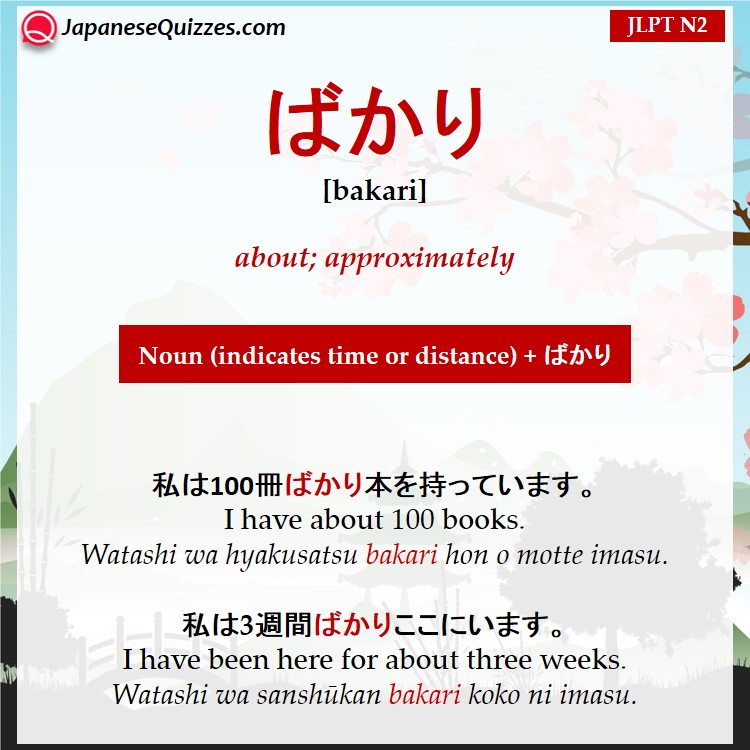
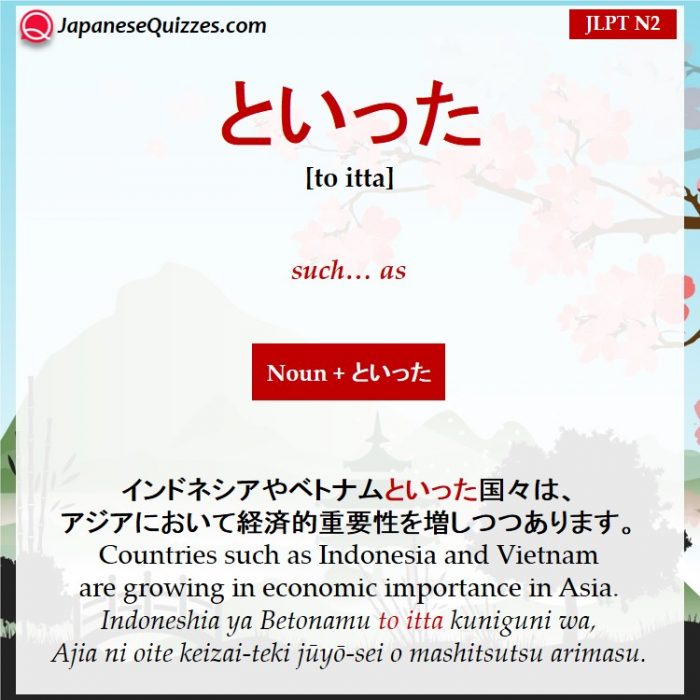
Noun + といった
Examples
ノボルはファヒータやエンチラーダといったテクス・メクス料理が大好きだ / 大好きです。
Noboru wa fahīta ya enchirāda to itta tekusu mekusu ryōri ga daisuki da/ daisuki desu.
Noboru loves Tex-Mex dishes such as fajitas and enchiladas.
彼はスペイン語の「こんにちは」「ようこそ」といった簡単な言葉を覚えている / 覚えています。
Kare wa Supeingo no `kon’nichiwa’`yōkoso’ to itta kantan’na kotoba o oboete iru/ oboete imasu.
He remembers simple phrases such as “hello” or “welcome” in Spanish.
多くの人々が人工知能や仮想現実といった新しい技術に注目している / 注目しています。
Ōku no hitobito ga jinkō chinō ya kasō genjitsu to itta atarashī gijutsu ni chūmoku shite iru/ chūmoku shite imasu.
Many people are paying attention to new technologies such as artificial intelligence and virtual reality.
私たちは外出の際、携帯電話や財布といったものを持てば、あまり困らない / 困りません。
Watashitachiha gaishutsu no sai, geitaidenwa ya saifu to itta mono o moteba, amari komaranai/ komarimasen.
When going out, if we bring something like a cell phone or wallet, we are not too bothered.
日本の小中高生は、筆箱や消しゴムといった文房具で時々個性を表現しようとする / 表現しようとします。
Nihon no ko chūkōsei wa, fudebako ya keshigomu to itta bunbōgu de tokidoki kosei o hyōgen shiyou to suru/ hyōgen shiyou to shimasu.
Elementary, junior, and high school students in Japan sometimes try to express personality with stationery such as pencil case and eraser.
インドネシアやベトナムといった国々は、アジアにおいて経済的重要性を増しつつある / 増しつつあります。
Indoneshia ya Betonamu to itta kuniguni wa, Ajia ni oite keizai-teki jūyō-sei o mashitsutsu aru/ mashitsutsu arimasu.
Countries such as Indonesia and Vietnam are growing in economic importance in Asia.
See also
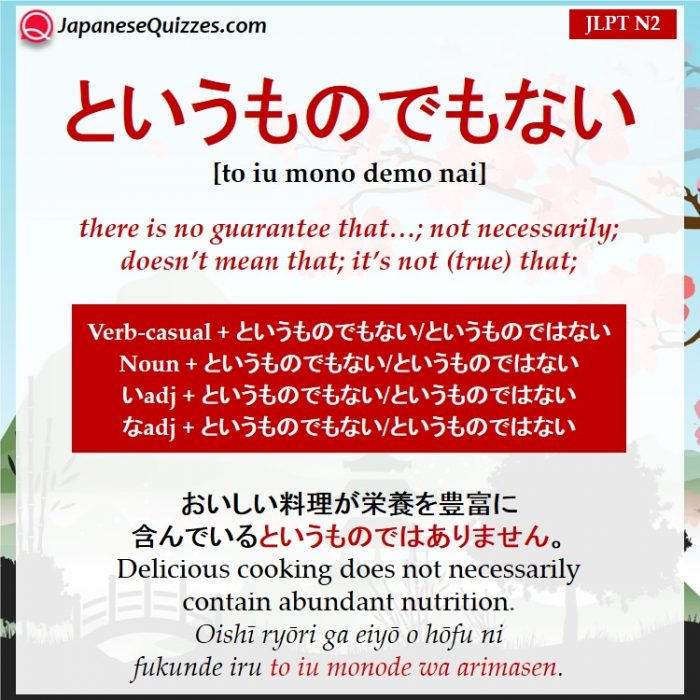
there is no guarantee that…; not necessarily; Doesn’t mean that; It’s not (true) that

Formations
Verb-casual + というものでもない/というものではない
Noun + というものでもない/というものではない
いadj + というものでもない/というものではない
なadj + というものでもない/というものではない
Examples
偉大な学者が良い先生というものでもない / よい先生というものでもありません。
Idaina gakusha ga yoi sensei to iu monode mo nai/ yoi sensei to iu monode mo arimasen.
A great scholar is not necessarily a good teacher.
円高が日本経済に有利というものでもない / 有利というものでもありません。
Endaka ga nipponkeizai ni yūri to iu monode mo nai/ yūri to iu monode mo arimasen.
The strong yen is not necessarily good for Japan’s economy.
大きな家が住み心地がよいというものでもない / 住み心地がよいというものでもありません。
Ōkina ie ga sumigokochi ga yoi to iu monode mo nai/ sumigokochi ga yoi to iu monode mo arimasen.
Large houses are not necessarily comfortable to live in.
高価な商品が質がよいというものではない / 質がよいというものではありません。
Kōkana shōhin ga shitsu ga yoi to iu monode wanai/ shitsu ga yoi to iu monode wa arimasen.
Expensive products are not necessarily good.
お金があれば幸せになれるというものではない / 幸せになれるというものではありません。
Okane ga areba shiawase ni nareru to iu monode wanai/ shiawase ni nareru to iu monode wa arimasen.
There’s no guarantee that you’ll be happy when you’re rich.
おいしい料理が栄養を豊富に含んでいるというものではない / 含んでいるというものではありません。
Oishī ryōri ga eiyō o hōfu ni fukunde iru to iu monode wanai/ fukunde iru to iu monode wa arimasen.
Delicious cooking does not necessarily contain abundant nutrition.
See also

something like…; something called…

Formations
Verb-dictionary form + というものだ
Noun + というものだ
いadj + というものだ
なadj + というものだ
Examples
玄関で靴を脱ぐことは、伝統的な日本の習慣というものだ / 習慣というものです。
Genkan de kutsu o nugu koto wa, dentō-tekina Nihon no shūkan to iu monoda/ shūkan to iu monodesu.
Taking off your shoes at the entrance is a traditional Japanese custom.
能力と適正に応じて社員に役割を与える、それが適材適所というものだ / 適材適所というものです。
Nōryoku to tekisei ni ōjite shain ni yakuwari o ataeru, sore ga tekizai tekisho to iu monoda/ tekizai tekisho to iu monodesu.
Giving a role to employees according to abilities and aptitudes is something called right person for the right job.
良質なお手本をまねること、それが学習の第一歩というものだ / 第一歩というものです。
Ryōshitsuna otehon o maneru koto, sore ga gakushū no daiippo to iu monoda/ daiippo to iu monodesu.
Imitating a good example model is something called the first step of learning.
あなたが毎日していること、それが習慣というものだ / 習慣というものです。
Anata ga mainichi shite iru koto, sore ga shūkan to iu monoda/ shūkan to iu monodesu.
What you do everyday is something like an habitual practice.
無断で他人の日記を読むこと、それはプライバシーの侵害というものだ / 侵害というものです。
Mudan de tanin no nikki o yomu koto, soreha puraibashī no shingai to iu monoda/ shingai to iu monodesu.
Reading other people’s diaries without their permission is something called invasion of privacy.
相手の立場に立って考えることのできる人、それが大人というものだ / 大人というものです。
Aite no tachiba ni tatte kangaeru koto no dekiru hito, sore ga otona to iu monoda/ otona to iu monodesu.
A person who can put yourself in other people’s shoes is someone called an adult.
See also

that is to say; so that means

Formations
Clause 1 + ということは + clause 2
Examples
物価が上昇した。ということは、やりくりが難しくなる / 難しくなります。
Bukka ga jōshō shita. To iu koto wa, yarikuri ga muzukashiku naru/ muzukashiku narimasu.
Prices rose. So that means, it is getting harder to get by.
夫がこっそりとタバコをまた吸っていた。ということは、彼は私に嘘をついたことになる / 嘘をついたことになります。
Otto ga kossori to tabako o mata sutte ita. To iu koto wa, kare wa watashi ni uso o tsuita koto ni naru/ uso o tsuita koto ni narimasu.
My husband secretly smoked again. That means he lied to me.
夫が3位に入賞した。ということは、彼は来年のレースでシード権を獲得したことを意味する / 意味します。
Otto ga 3-i ni nyūshō shita. To iu koto wa, kare wa rainen no rēsu de shīdo-ken o kakutoku shita koto o imi suru/ imi shimasu.
My husband won the 3 rd place. So that means, he will be seeded in next year’s race.
例外があるということは規則があるということだ / 規則があるということです。
Reigai ga aru to iu koto wa kisoku ga aru to iu kotoda/ kisoku ga aru to iu kotodesu.
The exception proves the rule.
企業が社会に貢献するということは、それを構成する社員全員が社会に貢献していることと同じだ / 同じです。
Kigyō ga shakai ni kōken suru to iu koto wa, sore o kōsei suru shain zen’in ga shakai ni kōken shite iru koto to onajida/ onajidesu.
A company making contributions to society means that all employees, who are members of the company, are making contributions to society.
ある人が私と同じ通りに住んでいるということは、その人が私の友人だということではない / 友人だということではありません。
Aru hito ga watashi to onaji tōri ni sunde iru to iu koto wa, sono hito ga watashi no yūjinda to iu kotode wanai/ yūjinda to iu kotode wa arimasen.
The fact that a man lives on the same street with me does not mean he is my friend.
See also
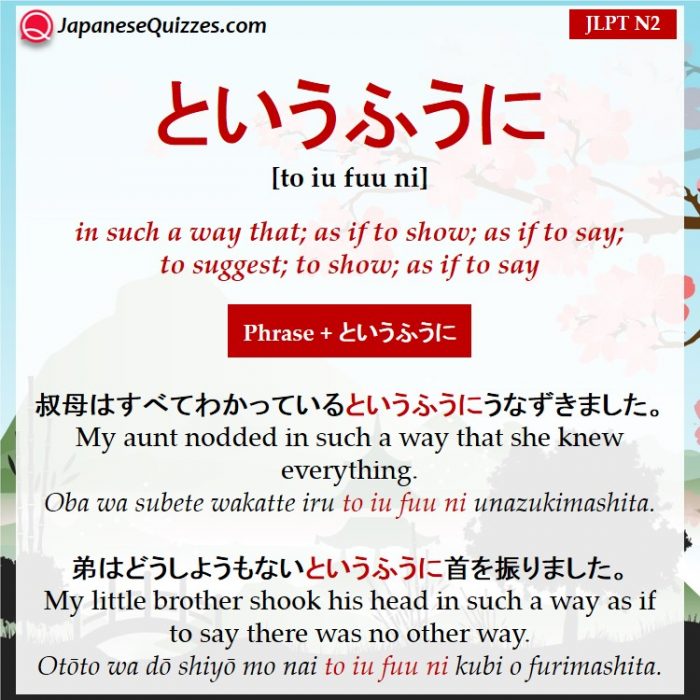
in such a way that; as if to show; as if to say; to suggest; to show; as if to say

Formations
Phrase + というふうに
Examples
叔母はすべてわかっているという風にうなずいた / うなずきました。
Oba wa subete wakatte iru to iu fuu ni unazuita/ unazukimashita.
My aunt nodded in such a way that she knew everything.
妹はその事実が信じられないという風に首を振った / 首を振りました。
Imōto wa sono jijitsu ga shinji rarenai to iu fuu ni kubi o futta/ kubi o furimashita.
My younger sister shook her head as if she could not believe the fact.
弟はどうしようもないという風に首を振った / 首を振りました。
Otōto wa dō shiyō mo nai to iu fuu ni kubi o futta/ kubi o furimashita.
My little brother shook his head in such a way as if to say there was no other way.
個人的に、私はその案は検討に値するという風に考えている / 考えています。
Kojin-teki ni, watashi wa sono an wa kentō ni ataisuru to iu fuu ni kangaete iru/ kangaete imasu.
Personally, I think that the idea is worth considering.
多くの人々はデイヴィッドのことを優秀なプログラマーだという風に認識している / 認識しています。
Ōku no hitobito wa deivu~iddo no koto o yūshūna puroguramāda to iu fuu ni ninshiki shite iru/ ninshiki shite imasu.
Many people recognize David as an excellent programmer.
See also
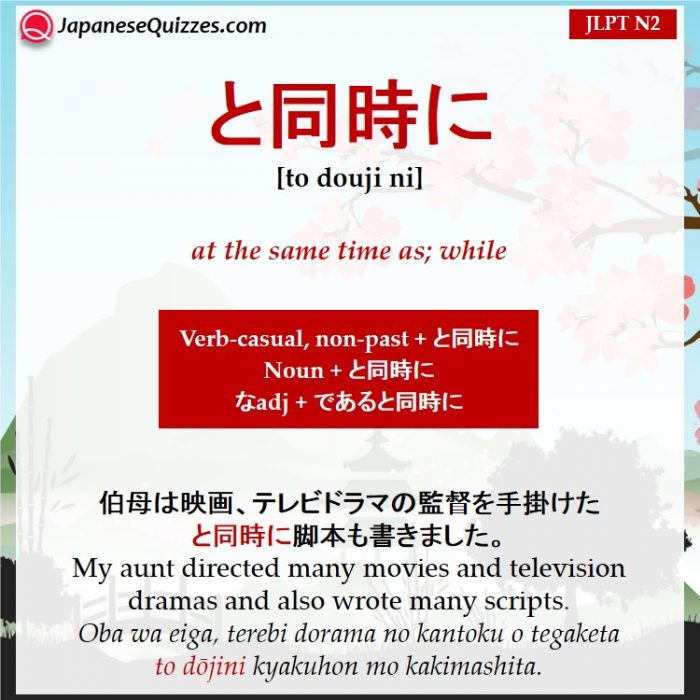
at the same time as; while

Formations
Verb-casual, non-past + と同時に
Noun + と同時に
なadj + であると同時に
Examples
私は大学入学と同時に大阪に引っ越した / 引っ越しました。
Watashi wa daigaku nyūgaku todōjini Ōsaka ni hikkoshita/ hikkoshimashita.
I moved to Osaka at the same time that I entered university.
目覚めると同時に彼女はコーヒーマシーンのスイッチをつけた / スイッチをつけました。
Mezameru to dōjini kanojo wa kōhīmashīn no suitchi o tsuketa/ suitchi o tsukemashita.
At the same time she woke up she switched on the coffee machine.
東京駅に着くと同時に伯母は食事のできる場所を探し始めた / 探し始めました。
Tōkyō Eki ni tsuku to dōjini oba wa shokuji no dekiru basho o sagashi hajimeta/ sagashi hajimemashita.
He is serious and has a good sense of humor.
伯母は映画、テレビドラマの監督を手掛けたと同時に脚本も書いた / 書きました。
Oba wa eiga, terebi dorama no kantoku o tegaketa to dōjini kyakuhon mo kaita/ kakimashita.
Noboru is in charge of public relations at the company and also teaches Japanese at the weekend.
ノボルは企業で広報を担当していると同時に週末に日本語を教えている / 教えています。
Noboru wa kigyō de kōhō o tantō shite iruto dōjini shūmatsu ni nihongo o oshiete iru/ oshiete imasu.
The moment my aunt arrived at Tokyo Station, she began to look for a place to eat.
彼は真面目であると同時にユーモアのセンスを持っている / 持っています。
Kare wa majimedearu to dōjini yūmoa no sensu o motte iru/ motte imasu.
My aunt directed many movies and television dramas and also wrote many scripts.
See also