not doing something properly

Formations
ろくに + Verb-ないform
Examples
妹はろくに英語を話せない / 話せません。
Imōto wa rokuni eigo o hanasenai/ hanasemasen.
My younger sister can’t speak English very well.
妹はろくに文法を知らない / 知りません。
Imōto wa rokuni bunpō o shiranai/ shirimasen.
My younger sister does not know grammar well.
昨晩、私はろくに寝なかった / 寝ませんでした。
Sakuban, watashi wa rokuni nenakatta/ nemasendeshita.
I did not sleep well last night.
兄はろくに朝ご飯を食べなかった / 食べませんでした。
Ani wa rokuni asa gohan o tabenakatta/ tabemasendeshita.
My elder brother could hardly eat breakfast.
私はろくに彼女と話をする暇もない / 暇もありません。
Watashi wa rokuni kanojo to hanashi o suru hima mo nai/ hima mo arimasen.
I have hardly enough time to talk with her.
兄はこの国の文化をまだろくに知らない / 知りません。
Ani wa kono kuni no bunka o mada rokuni shiranai/ shirimasen.
My elder brother has hardly known the culture of this country yet.
See also
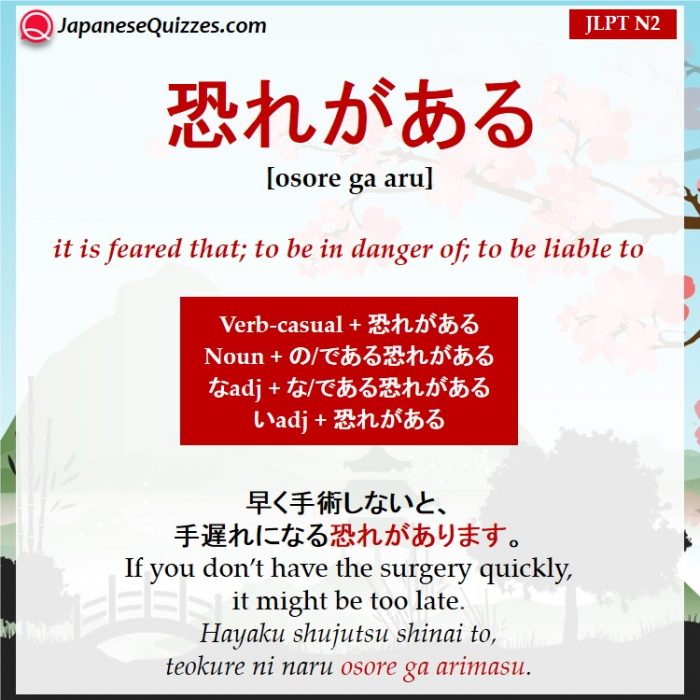
it is feared that; to be in danger of; to be liable to

Formations
Verb-casual + 恐れがある
Noun + の/である恐れがある
なadj + な/である恐れがある
いadj + 恐れがある
Examples
暴風雨になる恐れがある / 恐れがあります。
Bōfūu ni naru osoregāru/ osore ga arimasu.
It is likely that we will have stormy weather.
台風が来る恐れがある / 恐れがあります。
Taifū ga kuru osoregāru/ osore ga arimasu.
It is likely that a typhoon will come.
この販売方法は法律に触れる恐れがある / 恐れがあります。
Kono hanbai hōhō wa hōritsu ni fureru osoregāru/ osore ga arimasu.
This method of sale has the likelihood of violating the law.
この販売方法は他社に真似される恐れがある / 恐れがあります。
Kono hanbai hōhō wa tasha ni mane sa reru osoregāru/ osore ga arimasu.
There is a fear that this sales method can be imitated by other companies.
早く手術しないと、手遅れになる恐れがある / 恐れがあります。
Hayaku shujutsu shinai to, teokure ni naru osoregāru/ osore ga arimasu.
If you don’t have the surgery quickly, it might be too late.
大雨が降ると、あの橋は壊れる恐れがある / 恐れがあります。
Dai amegafuru to, ano hashi wa kowareru osoregāru/ osore ga arimasu.
If it rains heavily, there are fears that that bridge will be damaged.
See also

perhaps; likely; probably; I dare say

Formations
おそらく + phrase
Examples
明日はおそらく天気になるだろう / 天気になるでしょう。
Ashita wa osoraku tenki ni narudarou/ tenki ni narudeshou.
It is likely to be fine tomorrow.
明後日はおそらく雨になるだろう / 雨になるでしょう。
Asatte wa osoraku ame ni narudarou/ ame ni narudeshou.
It will probably rain the day after tomorrow.
社長はおそらく辞任するだろう / 辞任するでしょう。
Shachō wa osoraku jinin surudarou/ jinin surudeshou.
The president is likely to resign.
妻はおそらく混乱するだろう / 混乱するでしょう。
Tsuma wa osoraku konran surudarou/ konran surudeshou.
My wife will probably get confused.
大人たちはおそらく私たちの計画に賛成するだろう / 賛成するでしょう。
Otona-tachi wa osoraku watashitachi no keikaku ni sansei surudarou/ sansei surudeshou.
The adults are likely to agree to our plan.
子供たちはおそらく私たちの計画に反対するだろう / 反対するでしょう。
Kodomo-tachi wa osoraku watashitachi no keikaku ni hantai surudarou/ hantai surudeshou.
The children probably oppose our plan.
See also

to make matters worse; besides; in addition

Formations
Phrase + おまけに
Examples
昨日は寒かった。おまけに風も強かった。
Kinō wa samukatta. Omake ni kaze mo tsuyokatta.
It was cold yesterday, and, in addition, it was windy.
私は疲れていた。おまけに眠かった。
Watashi wa tsukarete ita. Omake ni nemukatta.
I was tired and, what is worse, I was sleepy.
この部屋は私には大きすぎる。おまけに家賃が高すぎる。
Kono heya wa watashiniha ōki sugiru. Omake ni yachin ga taka sugiru.
This room is too big for me, and what is more, the rent is too expensive.
この服は縮んで、おまけに色褪せてしまった。
Kono fuku wa chidjinde, omake ni iroasete shimatta.
This dress shrank, and what’s more it faded.
その試合は展開が遅くて、おまけに退屈だった。
Sono shiai wa tenkai ga osokute, omake ni taikutsudatta.
The game was slow, and it was also boring.
兄は事業に失敗しただけでなくて、おまけに病気になった。
Ani wa jigyō ni shippaishita dakedenakute, omake ni byōki ni natta.
My older brother not only failed in business, but also fell ill.
See also

Formations
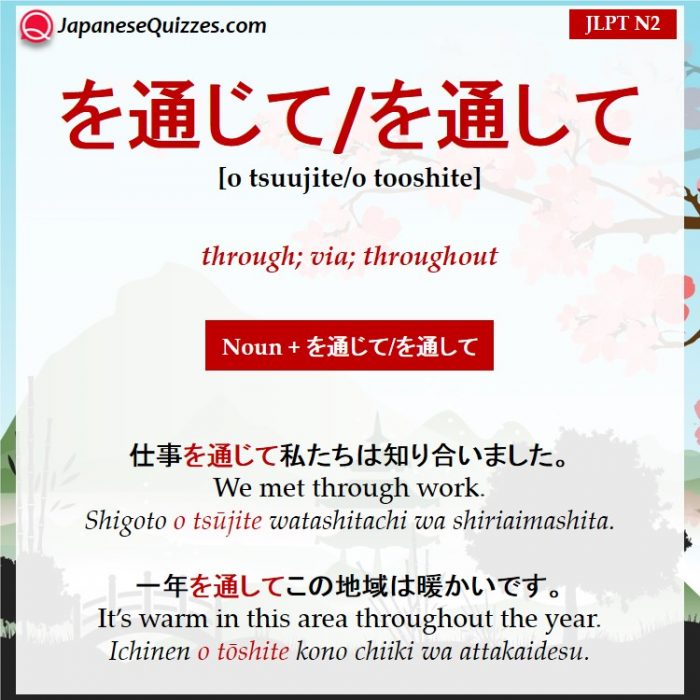
Noun + を通じて/を通して
Examples
仕事を通じて私たちは知り合った / 知り合いました。
Shigoto o tsūjite watashitachi wa shiriatta/ shiriaimashita.
We met through work.
友人を通じて弟は彼の奥さんと知り合った / 知り合いました。
Yūjin o tsūjite otōto wa kare no okusan to shiriatta/ shiriaimashita.
My younger brother met his wife through a friend.
読書を通じて私たちは多くの言葉を習得する / 習得します。
Dokusho o tsūjite watashitachi wa ōku no kotoba o shūtoku suru/ shūtoku shimasu.
We acquire many words through reading.
一年を通してこの地域は暖かい / 暖かいです。
Ichinen o tōshite kono chiiki wa attakai/ attakaidesu.
It’s warm in this area throughout the year.
インターネットを通して本を注文した / 注文しました。
Intānetto o tōshite hon o chūmon shita/ chūmon shimashita.
I ordered a book through the Internet.
テレビのニュースを通して夫はその事件を知った / 知りました。
Terebi no nyūsu o tōshite otto wa sono jiken o shitta/ shirimashita.
My husband knew the incident through the news on TV.
See also


Formations
Noun + を問わず
Examples
年齢を問わず人々はこの歌が好きだ / 好きです。
Nenrei o towazu hitobito wa kono uta ga sukida/ sukidesu.
People of all ages like this song.
経験を問わず、私たちは募集している / 募集しています。
Keiken o towazu, watashitachi wa boshū shite iru/ boshū shite imasu.
We’re recruiting regardless of experience.
季節を問わず、この公園では、美しい花を見ることができる / 見ることができます。
Kisetsu o towazu, kono kōende wa, utsukushī hana o miru koto ga dekiru/ miru koto ga dekimasu.
We can see beautiful flowers in this park all seasons.
昼夜を問わず猫は寝ている / 寝ています。
Chūya o towazu neko wa nete iru/ nete imasu.
My cat is sleeping night and day.
影響力のある人は、年齢を問わず幅広い人脈を持つ / 持っています。
Eikyō-ryoku no aru hito wa, nenrei o towazu habahiroi jinmyaku o motsu/ motte imasu.
People with influence have a wide range of contacts regardless of age.
生活環境を問わず、私たちは誰でも簡単にインターネットを利用できるようにしたい / 利用できるようにしたいです。
Seikatsu kankyō o towazu, watashitachi wa dare demo kantan ni intānetto o riyō dekiru yō ni shitai/ riyō dekiru yō ni shitaidesu.
Regardless of the living environment, we want to make it easy for anyone to use the Internet.
See also