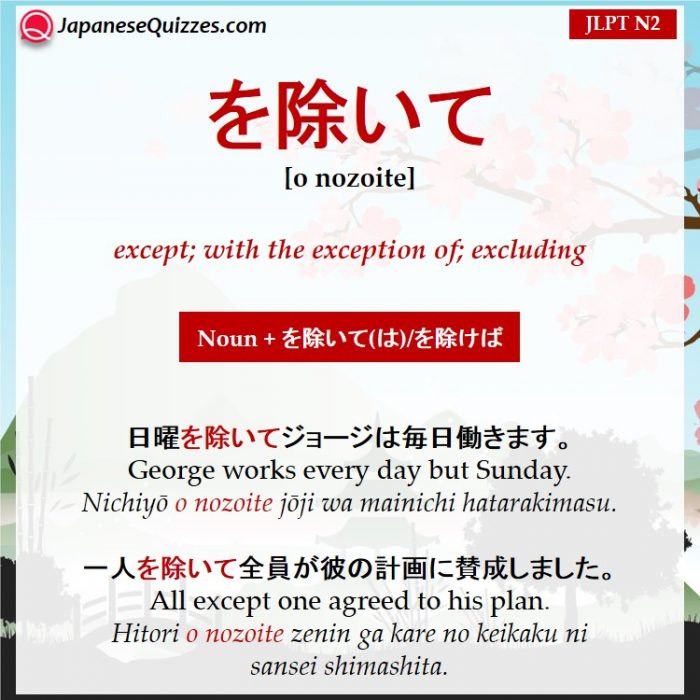
except; with the exception of; excluding

Formations
Noun + を除いて(は)/を除けば
Examples
日曜を除いてジョージは毎日働く / 働きます。
Nichiyō o nozoite jōji wa mainichi hataraku/ hatarakimasu.
George works every day but Sunday.
彼を除いて全員パーティーに来た / 来ました。
Kare o nozoite zen’in pātī ni kita/ kimashita.
Everybody except him came to the party.
一人を除いて全員が彼の計画に賛成した / 賛成しました。
Hitori o nozoite zen’in ga kare no keikaku ni sansei shita/ sansei shimashita.
All except one agreed to his plan.
営業部長を除いて全員会議に出た / 出ました。
Eigyō buchō o nozoite zen’in kaigi ni deta/ demashita.
Everyone except the sales manager went to the meeting.
営業部長を除けば、だれも急いでいなかった / 急いでいませんでした。
Eigyō buchō o nozokeba, dare mo isoide inakatta/ isoide imasendeshita.
None of us was in a hurry, except for the sales manager.
少しの綴り間違いを除けば、それはよい論文だ / よい論文です。
Sukoshi no tsudzuri machigai o nozokeba, wa sore wa yoi ronbunda/ yoi ronbundesu.
It’s a good paper, apart from a few spelling mistakes.
See also

Formations
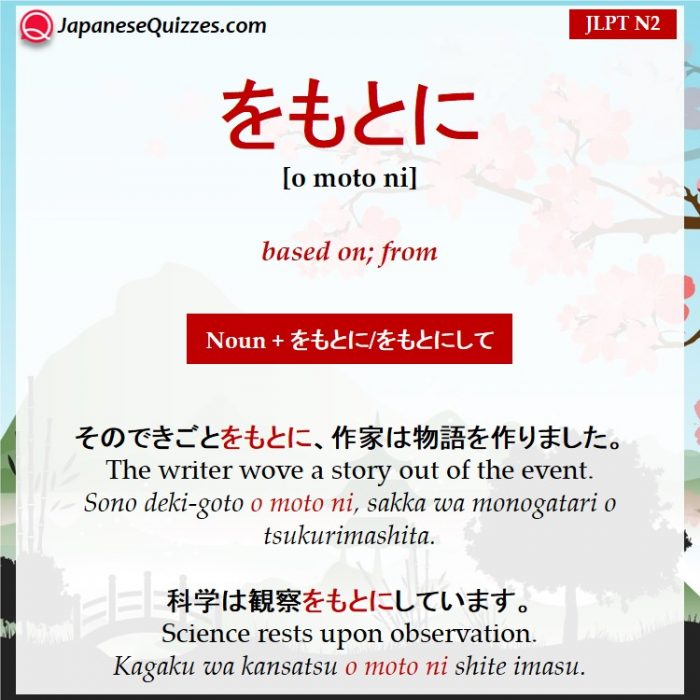
Noun + をもとに/をもとにして
Examples
統計情報をもとに、私はこれから話をする / 話をします。
Tōkei jōhō o moto ni, watashi wa korekara hanashi o suru/ hanashi o shimasu.
I will talk from now on the basis of statistical information.
試験の結果をもとに、私たちはクラス分けを行う / 行います。
Shiken no kekka o moto ni, watashitachiha kurasu-wake o okonau/ okonaimasu.
We’ll divide the class based on the test results.
そのできごとをもとに、作家は物語を作った / 作りました。
Sono deki-goto o moto ni, sakka wa monogatari o tsukutta/ tsukurimashita.
The writer wove a story out of the event.
科学は観察をもとにしている / もとにしています。
Kagaku wa kansatsu o moto ni shite iru/ moto ni shite imasu.
Science rests upon observation.
この映画は小説をもとにしている / もとにしています。
Kono eiga wa shōsetsu o moto ni shite iru/ moto ni shite imasu.
This film is an adaptation of a novel.
ユーザーの声をもとにして、私たちは新しいアプリを開発中だ / 開発中です。
Yūzā no koe o moto ni shite, watashitachi wa atarashī apuri o kaihatsu-chūda/ kaihatsu-chūdesu.
Based on the voice of the user, we are developing a new application.
See also

Formations
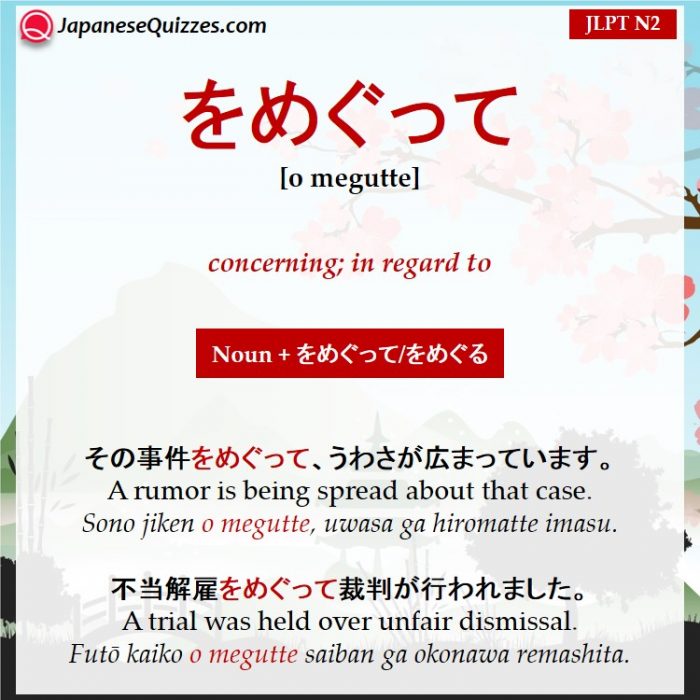
Noun + をめぐって/をめぐる
Examples
新しい文化政策をめぐって私たちは衝突した / 衝突しました。
Atarashī bunka seisaku o megutte watashitachiha shōtotsu shita/ shōtotsu shimashita.
We clashed over the new culture policies.
町の再開発をめぐって住民が争った / 争いました。
Machi no sai kaihatsu o megutte jūmin ga arasotta/ arasoimashita.
The residents were quarreling over the redevelopment of the town.
その事件をめぐって、うわさが広まっている / 広まっています。
Sono jiken o megutte, uwasa ga hiromatte iru/ hiromatte imasu.
A rumor is being spread about that case.
不当解雇をめぐって裁判が行われた / 行われました。
Futō kaiko o megutte saiban ga okonawa reta/ okonawa remashita.
A trial was held over unfair dismissal.
来年の経済政策をめぐって会議が開かれた / 開かれました。
Rainen no keizai seisaku o megutte kaigi ga aka reta/ aka remashita.
A meeting was held over next year’s economic policy.
欧州連合からの離脱をめぐってイギリスで国民投票が行われた / 行われました。
Ōshūrengō kara no ridatsu o megutte Igirisu de kokumin tōhyō ga okonawa reta/ okonawa remashita.
A national referendum took place in the UK over leaving the European Union.
See also
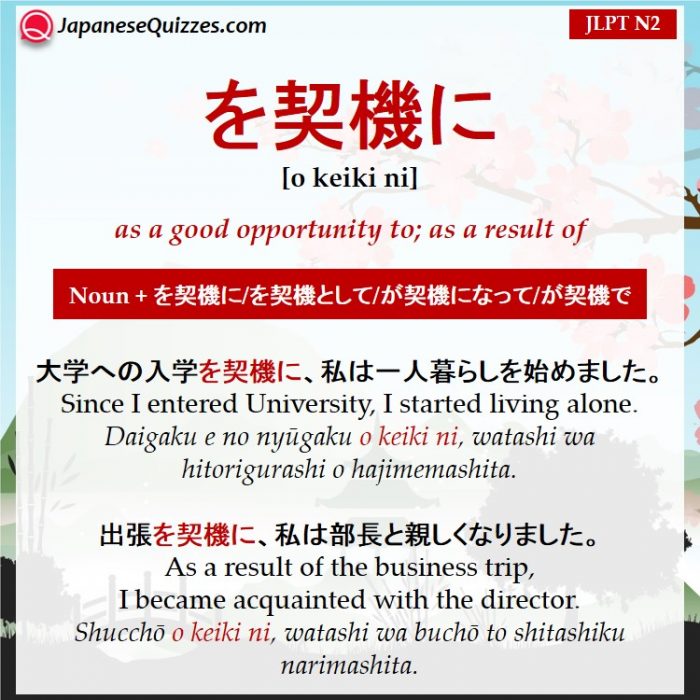
as a good opportunity to; as a result of

Formations
Noun + を契機に/を契機として/が契機になって/が契機で
Examples
退職を契機に、妹は茶道を始めた / 始めました。
Taishoku o keiki ni, imōto wa sadō o hajimeta/ hajimemashita.
My younger sister took the opportunity of retirement to begin studying tea ceremony.
大学への入学を契機に、私は一人暮らしを始めた / 始めました。
Daigaku e no nyūgaku o keiki ni, watashi wa hitorigurashi o hajimeta/ hajimemashita.
Since I entered University, I started living alone.
出張を契機に、私は部長と親しくなった / 親しくなりました。
Shutchō o keiki ni watashi wa buchō to shitashiku natta/ shitashiku narimashita.
As a result of the business trip, I became acquainted with the director.
両親の離婚を契機に、子供たちは転校した / 転校しました。
Ryōshin no rikon o keiki ni, kodomo-tachi wa tenkō shita/ tenkō shimashita.
As a result of their parents’ divorce, the children went to another school.
リーマンショックを契機として多くの企業が倒産した / 倒産しました。
Rīmanshokku o keiki to shite ōku no kigyō ga tōsan shita/ tōsan shimashita.
As a result of the Lehman collapse, many companies went bankrupt.
アメリカの参戦を契機としてヨーロッパの状況は変わった / 変わりました。
Amerika no sansen o keiki to shite yōroppa no jōkyō wa kawatta/ kawarimashita.
As a result of America’s involvement in the war, the situation in Europe has changed.
See also
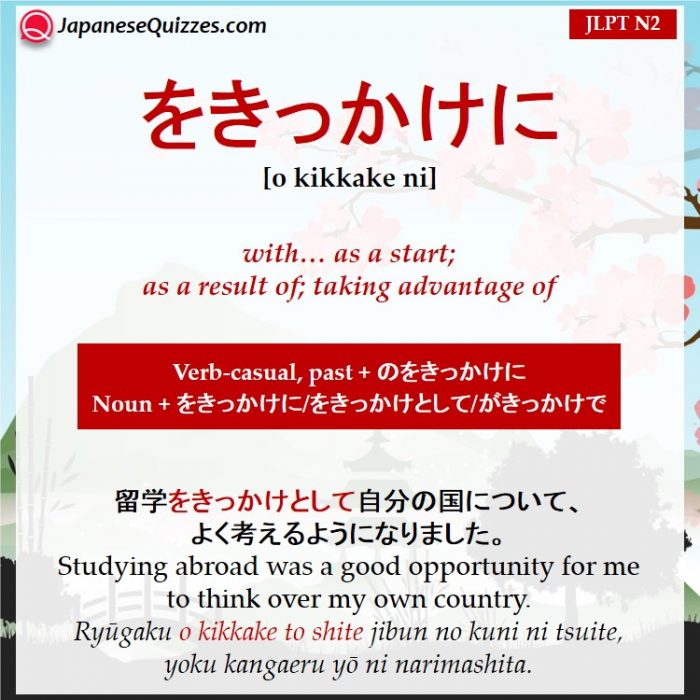
with… as a start; as a result of; taking advantage of

Formations
Verb-casual, past + のをきっかけに
Noun + をきっかけに/をきっかけとして/がきっかけで
Examples
病気をきっかけに、彼女の夫は酒をやめた / やめました。
Byōki o kikkake ni, kanojo no otto wa sake o yameta/ yamemashita.
As a result of an illness, her husband quit drinking.
子供が生まれたのをきっかけに彼女の夫はタバコをやめた / やめました。
Kodomo ga umareta no o kikkake ni kanojo no otto wa tabakowoyameta/ yamemashita.
As a result of my child’s birth, her husband quit smoking.
彼の発言をきっかけに事件の真相が明らかになった / 明らかになりました。
Kare no hatsugen o kikkake ni jiken no shinsō ga akiraka ni natta/ akiraka ni narimashita.
As a result of his statement, the truth about the case became clear.
このホームステイをきっかけに私は日本語に興味を持った / 持ちました。
Kono hōmusutei o kikkake ni watashi wa nihongo ni kyōmi o motta/ mochimashita.
This homestay caused me to have an interest in Japanese.
留学をきっかけとして自分の国について、よく考えるようになった / 考えるようになりました。
Ryūgaku o kikkake to shite jibun no kuni ni tsuite, yoku kangaeru yō ni natta/ kangaeru yō ni narimashita.
Studying abroad was a good opportunity for me to think over my own country.
この出来事をきっかけとして彼女は会社を起こす決心をした / 決心をしました。
Kono dekigoto o kikkake to shite kanojo wa kaisha o okosu kesshin o shita/ kesshin o shimashita.
This event prompted her to decide to set up a company.
See also

Formations
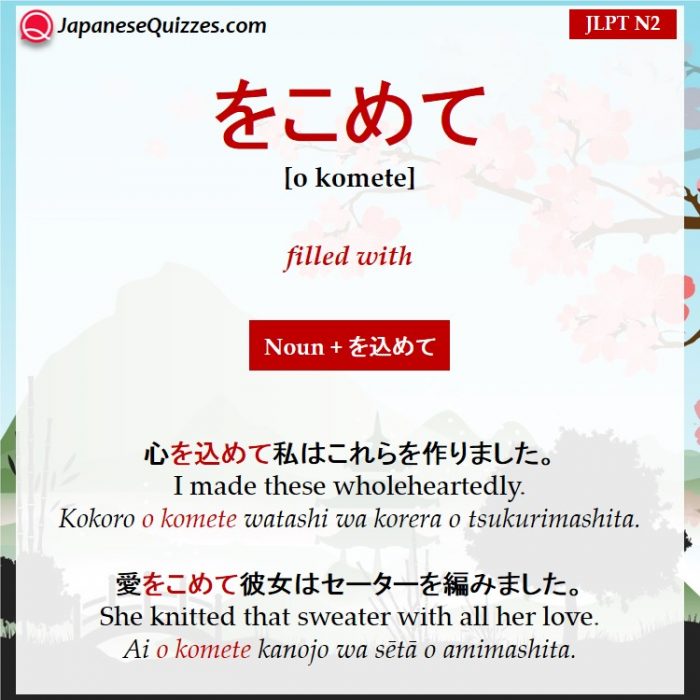
Noun + を込めて
Examples
心を込めて私はこれらを作った / 作りました。
Kokoro wo komete watashi wa korera o tsukutta/ tsukuri mashita.
I made these wholeheartedly.
愛をこめて彼女はセーターを編んだ / 編みました。
Ai o komete kanojo wa sētā o anda/ amimashita.
She knitted that sweater with all her love.
憎しみをこめて彼女は彼を見た / 見ました。
Nikushimi o komete kanojo wa kare o mita/ mimashita.
She looked at him with hatred.
決意をこめて私はその事実を告白した / 告白しました。
Ketsui o komete watashi wa sono jijitsu o kokuhaku shita/ kokuhaku shimashita.
I confessed the fact with decision.
皮肉を込めて夫はそれを私に言った / 言いました。
Hiniku o komete otto wa sore o watashi ni itta/ iimashita.
My husband said that sarcastically to me.
明日、心からの感謝を込めて私はこれらの花を母に送る / 送ります。
Ashita, kokoro kara no kansha o komete watashi wa korera no hana o haha ni okuru/ okurimasu.
I will send my mother these flowers with my hearty thanks tomorrow.
See also