
Formations
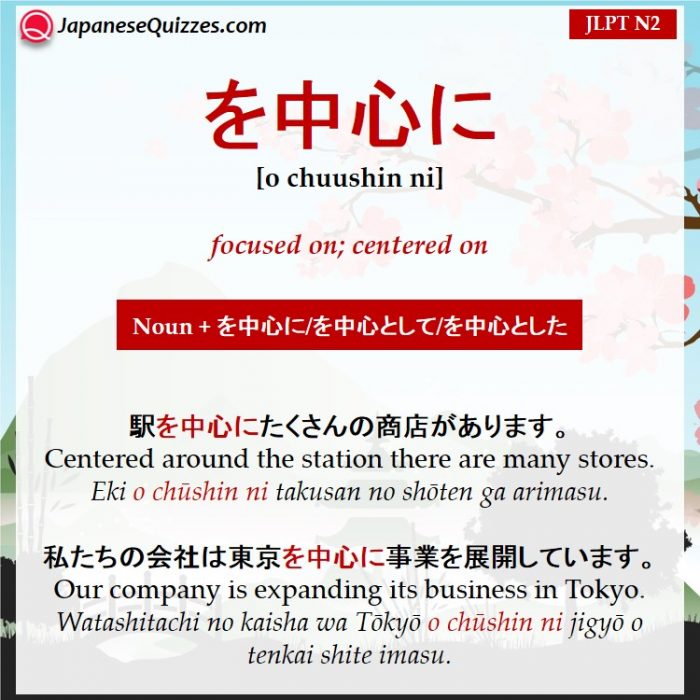
Noun + を中心に/を中心として/を中心とした
Examples
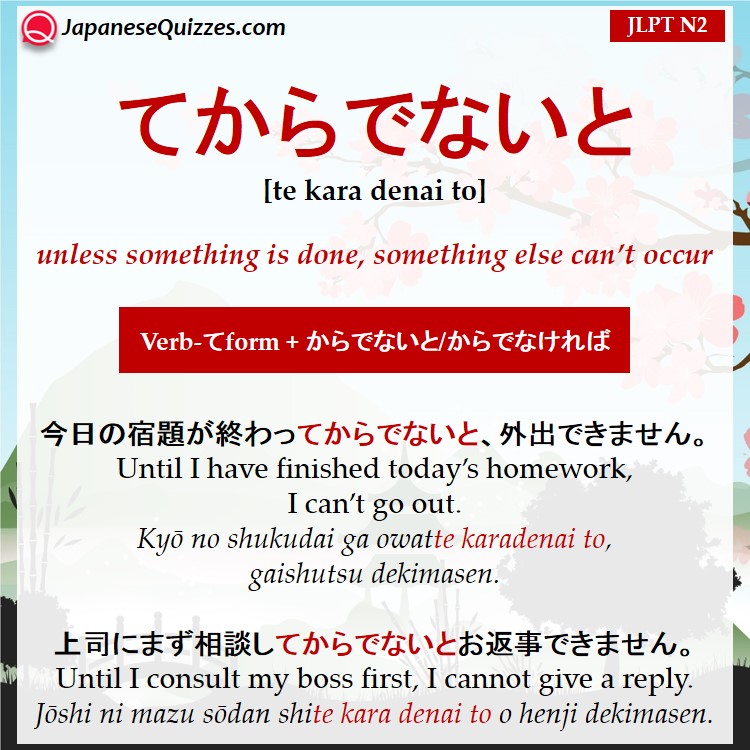
駅を中心にたくさんの商店がある / 商店があります。
Eki o chūshin ni takusan no shōten ga aru/ shōten ga arimasu.
Centered around the station there are many stores.
私たちは次のレッスンで会話を中心に勉強する / 勉強します。
Watashitachi wa tsugi no ressun de kaiwa o chūshin ni benkyō suru/ benkyō shimasu.
We’ll focus on learning speaking skills in the next lesson.
私たちの会社は東京を中心に事業を展開している / 展開しています。
Watashitachi no kaisha wa Tōkyō o chūshin ni jigyō o tenkai shite iru/ tenkai shite imasu.
Our company is expanding its business in Tokyo.
この作家の小説は若い女性を中心に読まれている / 読まれています。
Kono sakka no shōsetsu wa wakai josei o chūshin ni yoma rete iru/ yoma rete imasu.
This author ’s novels are mostly read by young women.
その物語は不思議な冒険を中心としている / 中心としています。
Sono monogatari wa fushigina bōken o chūshin to shite iru/ chūshin to shite imasu.
The story centers around a mysterious adventure.
この店はサッカー用品を中心としたスポーツ専門店だ / スポーツ専門店です。
Kono mise wa sakkā yōhin o chūshin to shita supōtsu senmon-tenda/ supōtsu senmon-tendesu.
This sport store specializes in soccer equipment.
See also

Formations
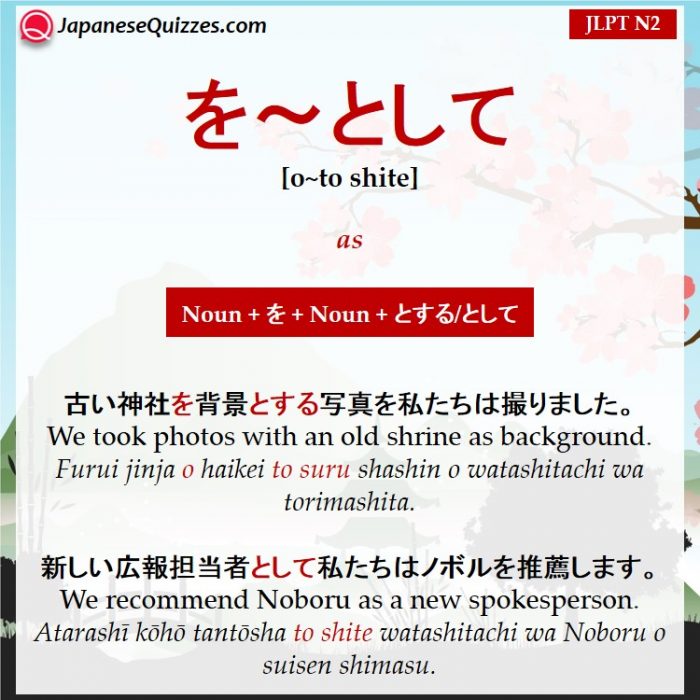
Noun + を + Noun + とする/として
Examples
古い神社を背景とする写真を私たちは撮った / 撮りました。
Furui jinja o haikei to suru shashin o watashitachiha totta/ torimashita.
We took photos with an old shrine as background.
投票の結果、安倍氏を総理大臣とすることに決定した / 決定しました。
Tōhyō no kekka, Abe-shi o sōri daijin to suru koto ni kettei shita/ kettei shimashita.
Following the voting results, Mr.Abe has been chosen as the Prime Minister.
私はニンジンを新しい料理のための食材として試した / 試しました。
Watashi wa ninjin o atarashī ryōri no tame no shokuzai to shite tameshita/ tameshimashita.
I tried a carrot as an ingredient for a new cuisine.
新しい広報担当者として私たちはノボルを推薦する / 推薦します。
Atarashī kōhō tantōsha to shite watashitachiha Noboru o suisen suru/ suisen shimasu.
We recommend Noboru as a new spokesperson.
その製薬会社は新しい営業部長として弟を任命した / 任命しました。
Sono seiyakukaisha wa atarashī eigyō buchō to shite otōto o ninmei shita/ ninmei shimashita.
The pharmaceutical company appointed my younger brother as a new sales manager.
エバンさんを先生として、私たちは英語の勉強会を開いた / 開きました。
Eban-san o sensei to shite, watashitachiha eigo no benkyō-kai o hiraita/ hirakimashita.
We opened an English study group with Evan as the teacher.
See also
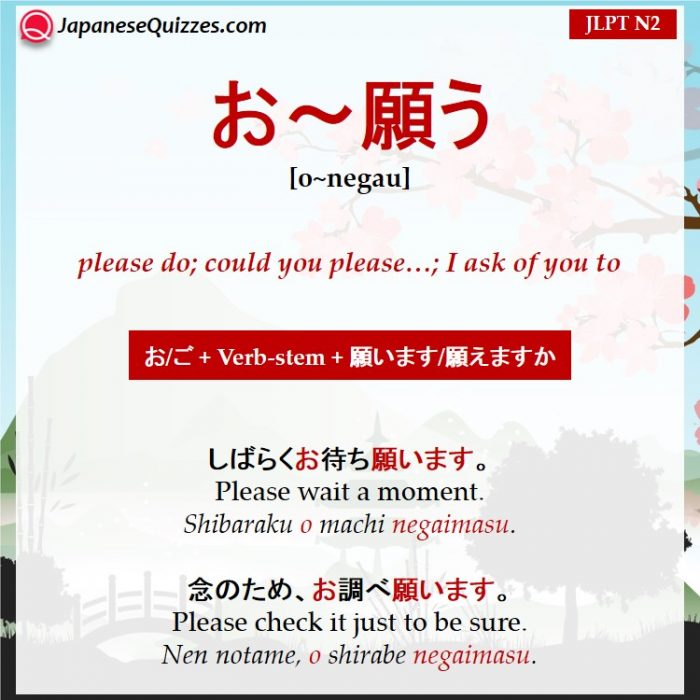
please do; could you please…; I ask of you to

Formations
お/ご + Verb-stem + 願います/願えますか
Examples
しばらくお待ち願います。
Shibaraku omachi negaimasu.
Please wait a moment.
念のため、お調べ願います。
Nen’notame, o shirabe negaimasu.
Please check it just to be sure.
ご都合をお聞かせ願います。
Gotsugō o o kikase negaimasu.
Please let me know if this is convenient for you.
こちらでのタバコはおやめ願います。
Kochira de no tabako wa o yame negaimasu.
Please stop smoking here.
図書館では小さな声でお話し願います。
Toshokande wa chīsana koe de ohanashi negaimasu.
Please speak in a small voice in the library.
ご自分のシートベルトが安全にかかっているかお確かめ願います。
Go jibun no shītoberuto ga anzen ni kakatte iru ka o tashikame negaimasu.
Please make sure that your seatbelt is securely fastened.
See also
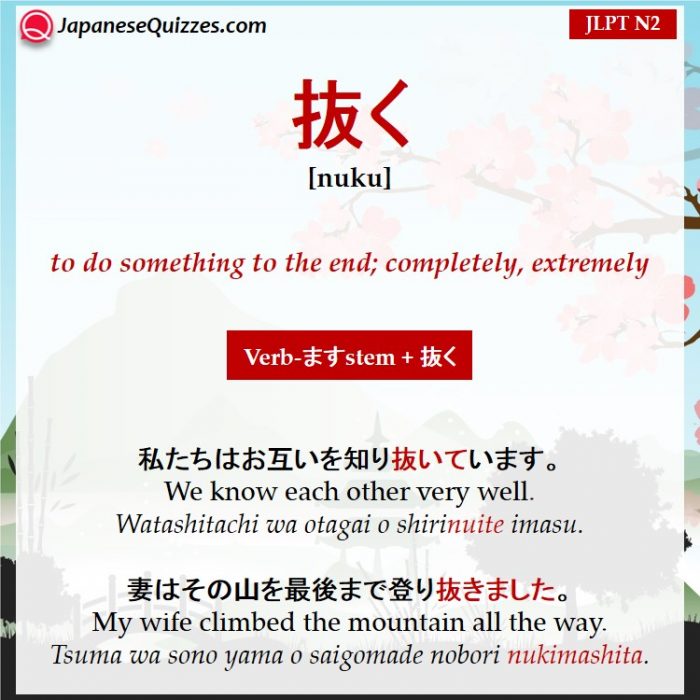
to do something to the end; completely, extremely

Formations
Verb-ますstem + 抜く
Examples
あなたはその仕事を最後までやり抜くべきだ / やり抜くべきです。
Anata wa sono shigoto o saigomade yari nukubekida/ yari nukubekidesu.
You should carry the task through to the end.
あなたはその歴史小説を最後まで読み抜くべきだ / 読みぬくべきです。
Anata wa sono rekishi shōsetsu o saigomade yomi nukubekida/ yomi nukubekidesu.
You should read through the history novel till the end.
私たちはお互いを知り抜いている / 知り抜いています。
Watashitachiha otagai o shirinuite iru/ shirinuite imasu.
We know each other very well.
妻はその山を最後まで登り抜いた / 登り抜きました。
Tsuma wa sono yama o saigomade nobori nuita/ nobori nukimashita.
My wife climbed the mountain all the way.
そのピッチャーは決勝戦で最後まで投げ抜いた / 投げ抜きました。
Sono pitchā wa kesshōsen de saigomade nage nuita/ nage nukimashita.
That pitcher threw to the end in the final match.
ゴールキーパーとして、息子はその試合で相手チームを無得点に抑え抜いた / 抑え抜きました。
Gōrukīpā to shite, musuko wa sono shiai de aite chīmu o mutokuten ni osae nuita/ osae nukimashita.
As a goalkeeper, my son shut out the opposing team until the end in the match.
See also
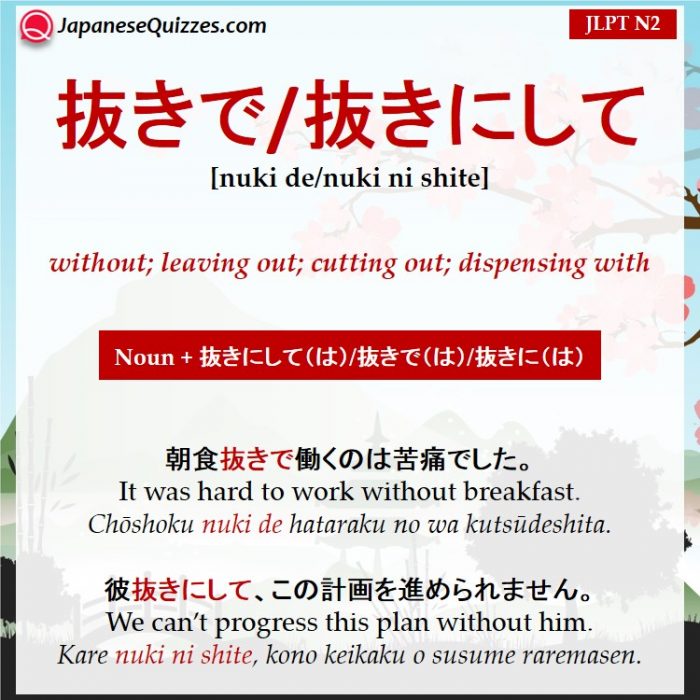
without; leaving out; cutting out; dispensing with

Formations
Noun + 抜きにして(は)/抜きで(は)/抜きに(は)
Examples
朝食抜きで働くのは苦痛だった / 苦痛でした。
Chōshoku nuki de hataraku no wa kutsūdatta/ kutsūdeshita.
It was hard to work without breakfast.
お世辞抜きで、あなたの日本語はかなり上手だ / 上手です。
Oseji nuki de, anata no nihongo wa kanari jōzuda/ jōzudesu.
Without flattery, your Japanese is pretty good.
税抜きで今期の利益を計算してください。
Zei nuki de konki no rieki o keisan shite kudasai.
Please calculate the profit for this term without tax.
社長抜きで私たちはそんな重要な決定はできない / できません。
Shachō nuki de watashitachi wa son’na jūyōna kettei wa dekinai/ dekimasen.
We can’t make such an important decision without the president.
彼抜きにして、この計画を進められない / 進められません。
Kare nuki ni shite, kono keikaku o susume rarenai/ susume raremasen.
We can’t progress this plan without him.
詳細抜きにして、私はすぐ結論に入る / 入ります。
Shōsai nuki ni shite, watashi wa sugu ketsuron ni hairu/ hairimasu.
I will omit the details and come to the conclusion at once.
See also
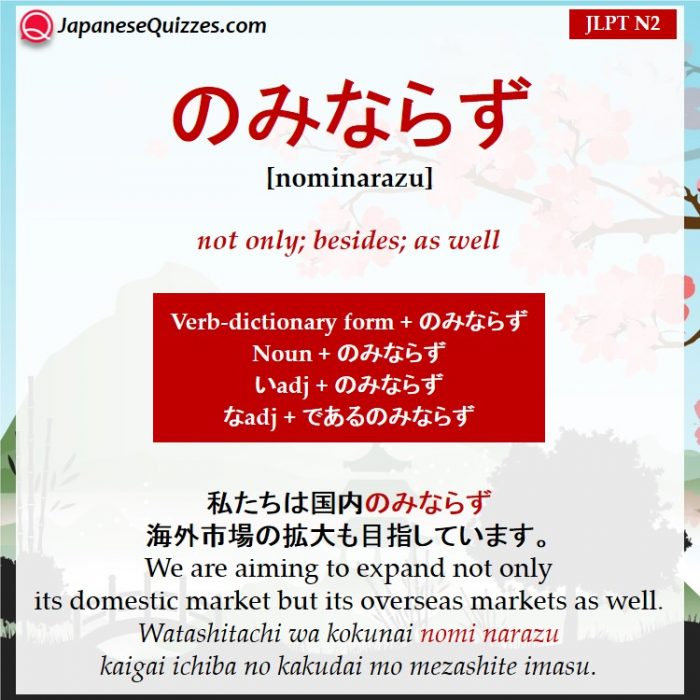
not only; besides; as well

Formations
Verb-dictionary form + のみならず
Noun + のみならず
いadj + のみならず
なadj + であるのみならず
Examples
妹は英語のみならずスペイン語も話すことができる / 話すことができます。
Imōto wa eigo nomi narazu Supeingo mo hanasu koto ga dekiru/ hanasu koto ga dekimasu.
My younger sister can speak not only English but also Spanish.
妹のみならず彼女の娘たちも幸せだった / 幸せでした。
Imōto nomi narazu kanojo no musume-tachi mo shiawasedatta/ shiawasedeshita.
My younger sister’s daughters, as well as she, were happy.
彼は日本のみならず、世界においても有名なフクロウ研究者だ / フクロウ研究者です。
Kare wa Nihon nomi narazu, sekai ni oite mo yūmeina fukurō kenkyūshada/ fukurō kenkyūshadesu.
He is a famous owl researcher not only in Japan but in the world.
私たちは国内のみならず海外市場の拡大も目指している / 目指しています。
Watashitachiha kokunai nomi narazu kaigai ichiba no kakudai mo mezashite iru/ mezashite imasu.
We are aiming to expand not only its domestic market but its overseas markets as well.
彼は探検家であるのみならず、政治家でもある / 政治家でもあります。
Kare wa tanken-kadearu nomi narazu, seijikade mo aru/ seijika demo arimasu.
He is not only an explorer but also a politician.
そのレストランの料理はおいしいのみならず値段も安い / 安いです。
Sono resutoran no ryōri wa oishī nomi narazu nedan mo yasui/ yasuidesu.
The restaurant’s cuisine is not only delicious but also cheap.
See also