
Formations
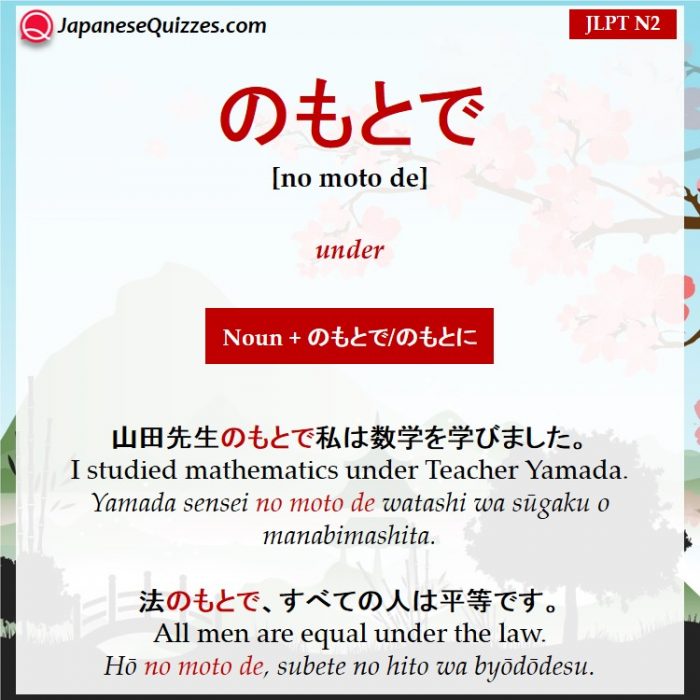
Noun + のもとで/のもとに
Examples
弟は困難な状況のもとで働いた / 働きました。
Otōto wa kon’nan’na jōkyō no moto de hataraita/ hatarakimashita.
My younger brother worked under difficult conditions.
山田先生のもとで私は数学を学んだ / 学びました。
Yamada senjō no moto de watashi wa sūgaku o mananda/ manabimashita.
I studied mathematics under Teacher Yamada.
法のもとで、すべての人は平等だ / 平等です。
Hou no moto de, subete no hito wa byōdōda/ byōdōdesu.
All men are equal under the law.
新経営陣のもとで、姉は昇進した / 昇進しました。
Shin keiei-jin no moto de, ane wa shōshin shita/ shōshin shimashita.
My elder sister was promoted under the new management team.
その医師の指導のもとで、救援活動が続いた / 続きました。
Sono ishi no shidō no moto de, kyūen katsudō ga tsudzuita/ tsudzukimashita.
The rescue operation continued under the guidance of the doctor.
トランプ政権のもとでアメリカの政局が麻痺状態になっている / 麻痺状態になっています。
Toranpu seiken no moto de Amerika no seikyoku ga mahi jōtai ni natte iru/ mahi jōtai ni natte imasu.
America’s political situation has become paralyzed under Trump administration.
See also
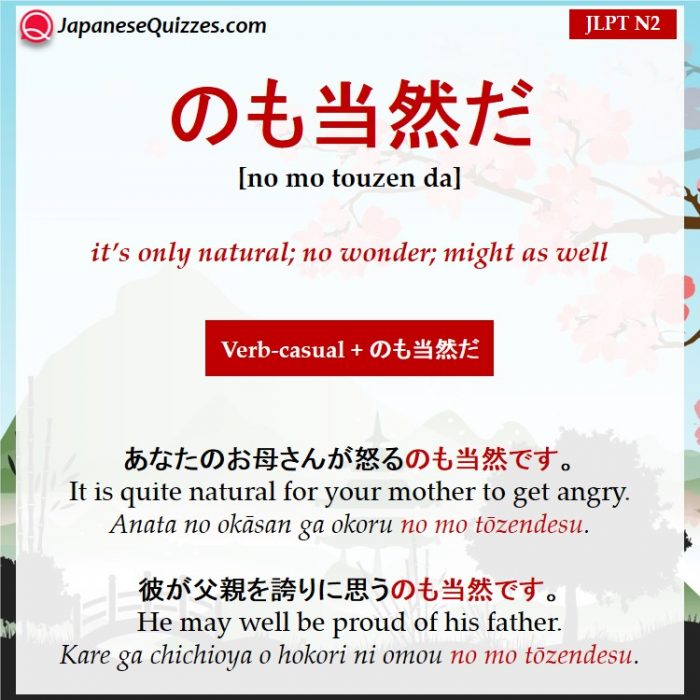
it’s only natural; no wonder; might as well

Formations
Verb-casual + のも当然だ
Examples
あなたのお母さんが怒るのも当然だ / 当然です。
Anata no okāsan ga okoru no mo tōzenda/ tōzendesu.
It is quite natural for your mother to get angry.
彼が父親を誇りに思うのも当然だ / 当然です。
Kare ga chichioya o hokori ni omou no mo tōzenda/ tōzendesu.
He may well be proud of his father.
弟が罰せられるのも当然だ / 当然です。
Otōto ga basse rareru no mo tōzenda/ tōzendesu.
It natural that my younger brother should be punished.
彼が人気があるのも当然だ / 当然です。
Kare ga ninki ga aru no mo tōzenda/ tōzendesu.
He is deservedly popular.
あの女の子が君のことをよく思わないのも当然だ / 当然です。
Ano on’nanoko ga kimi no koto o yoku omowanai no mo tōzenda/ tōzendesu.
The girl may well think ill you.
あの怠け者が試験に落第するのも当然だ / 当然です。
Ano namakemono ga shiken ni rakudai suru no mo tōzenda/ tōzendesu.
It is natural that such an idle fellow should fail in his examination.
See also
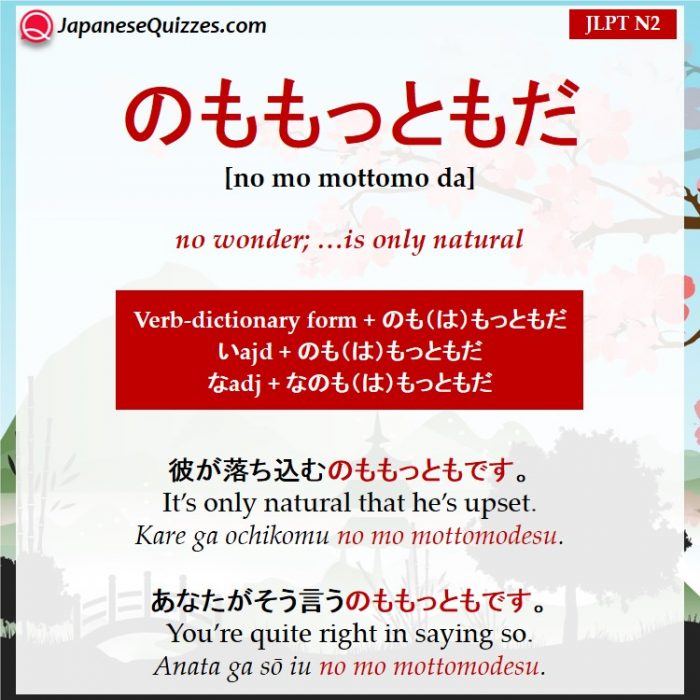
no wonder; …is only natural

Formations
Verb-dictionary form + のも(は)もっともだ
いajd + のも(は)もっともだ
なadj + なのも(は)もっともだ
Examples
彼が落ち込むのももっともだ / もっともです。
Kare ga ochikomu no mo mottomoda/ mottomodesu.
It’s only natural that he’s upset.
あなたがそう言うのももっともだ / もっともです。
Anata ga sō iu no mo mottomoda/ mottomodesu.
You’re quite right in saying so.
彼は自分の給料について不平を言うのももっともだ / もっともです。
Kare wa jibun no kyūryō ni tsuite fuheiwoiu no mo mottomoda/ mottomodesu.
He may well complain about his salary.
彼がその計画に反対するのももっともだ / もっともです。
Kare ga sono keikaku ni hantai suru no mo mottomoda/ mottomodesu.
He has good reason to be against the plan.
彼女がその成功を喜ぶのももっともだ / もっともです。
Kanojo ga sono seikō o yorokobu no mo mottomoda/ mottomodesu.
She may well be pleased with the success.
彼が私たちの要求を拒絶したのももっともだ / もっともです。
Kare ga watashitachi no yōkyū o kyozetsu shita no mo mottomoda/ mottomodesu.
It’s natural that he should have refused our request.
See also
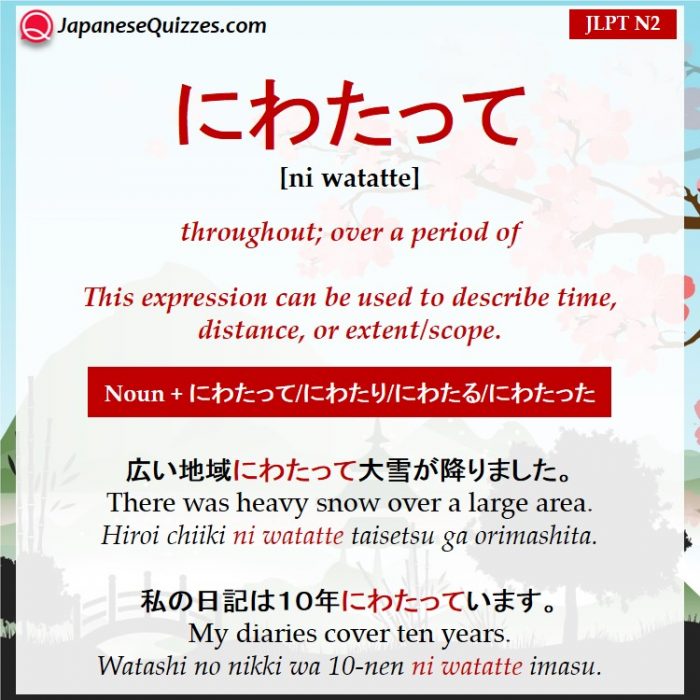
throughout; over a period of
This expression can be used to describe time, distance, or extent/scope.

Formations
Noun + にわたって/にわたり/にわたる/にわたった
Examples
広い地域にわたって大雪が降った / 降りました。
Hiroi chiiki ni watatte taisetsu ga futta/ orimashita.
There was heavy snow over a large area.
東京から千葉にわたって地震があった / 地震がありました。
Tōkyō kara Chiba ni watatte jishin ga atta/ jishin ga arimashita.
There was an earthquake which extended from Tokyo to Chiba.
その男は4年にわたってその国を支配した / 支配しました。
Sono otoko wa yo-nen ni watatte sono kuni o shihai shita/ shihai shimashita.
The man controlled the country for 4 years.
インドは長年にわたって英国に統治されていた / 統治されていました。
Indo wa naganen ni watatte Igirisu ni tōchi sa rete ita/ tōchi sa rete imashita.
India was governed by Great Britain for many years.
彼の研究は広範囲にわたっている / わたっています。
Kare no kenkyū wa kōhan’i ni watatte iru/ watatte imasu.
His study covers a wide area.
私の日記は10年にわたっている / わたっています。
Watashinonikki wa jyuu-nen ni watatte iru/ watatte imasu.
My diaries cover ten years.
See also


Formations
Verb-dictionary form + には
Noun + には
Examples
動物園に行くには、上野駅で電車を降りるべきだ / 降りるべきです。
Dōbu~tsuen ni iku ni wa, Ueno-eki de densha o orirubekida/ orirubekidesu.
You should get off the train at Ueno Station to go to the zoo.
待つには3年は長い時間だ / 長い時間です。
Matsu ni wa san-nen wa nagai jikanda/ nagai jikandesu.
Three years is a long time to wait.
その国に行くには、あなたはビザを取得する必要がある / 必要があります。
Sono kuni ni iku ni wa, anata wa biza o shutoku suruhitsuyōgāru/ hitsuyō ga arimasu.
In order to go to that country, you need to get a visa.
外国語を話すには、センテンス・パターンを音読することが効果的だ / 効果的です。
Gaikoku-go o hanasu ni wa, sentensu patān o ondoku suru koto ga kōka-tekida/ kōka-tekidesu.
In order to speak a foreign language, it is effective to read sentence patterns aloud.
健康な生活を送るには、あまり食べ過ぎないようにすることが大切だ / 大切です。
Kenkōna seikatsu o okuru ni wa, amari tabe suginai yō ni suru koto ga taisetsuda/ taisetsudesu.
To live a healthy life, it is important not to eat too much.
失敗から学ぶには、まず行動することが必要だ / 必要です。
Shippai kara manabu ni wa, mazu kōdō suru koto ga hitsuyōda/ hitsuyōdesu.
To learn from your failures, it is necessary to act first.
See also
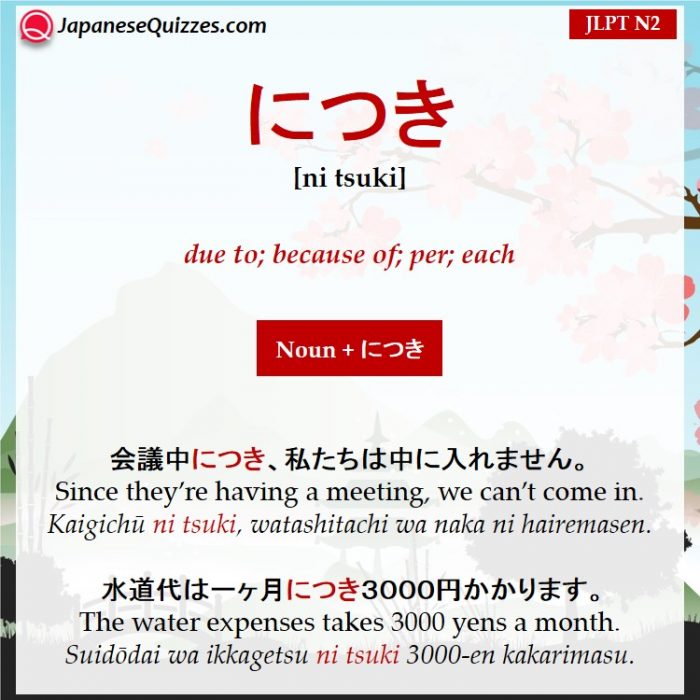
due to; because of; per; each

Formations
Noun + につき
Examples
会議中につき、私たちは中に入れない / 入れません。
Kaigi-chū ni tsuki, watashitachiha-chū ni hairenai/ iremasen.
Since they’re having a meeting, we can’t come in.
祭日につき、私たちは休業する / 休業します。
Saijitsu ni tsuki, watashitachiha kyūgyō suru/ kyūgyō shimasu.
Due to the holiday, we’re closed today.
彼女は1日につき30ドル稼ぐ / 稼ぎます。
Kanojo wa ichi-nichi ni tsuki san jyu doru kasegu/ kasegimasu.
She earns 30 dollars a day.
水道代は一ヶ月につき3000円かかる / かかります。
Suidō-dai wa ichi-kagetsu ni tsuki san zen-en kakaru/ kakarimasu.
The water expenses takes 3000 yens a month.
その村には医師1人につき患者が50人いた / 50人いました。
Sono mura ni wa ishi hitori ni tsuki kanja ga go jyu nin ita/ go jyu nin imashita.
There were 50 patients per doctor in the village.
1日につき少なくとも7時間私たちは眠らなければならない / 眠らなければなりません。
Ichi-nichi ni tsuki sukunakutomo siti-jikan watashitachi wa nemuranakereba naranai/ nemuranakereba narimasen.
We must sleep at least seven hours a day.
See also