Formations
いよいよ + phrase
Examples
いよいよその祭りが始まる / 始まります。
Iyoiyo sono matsuri ga hajimaru/ hajimarimasu.
That festival is going to start at last.
いよいよ来週、講演会が開催される / 開催されます。
Iyoiyo raishū, kōen-kai ga kaisai sa reru/ kaisai sa remasu.
Next week, the lecture will be held at last.
いよいよ彼女の番になった / 番になりました。
Iyoiyo kanojo no ban ni natta/ ban ni narimashita.
It was her turn at last.
いよいよ今日で3月が終わりだ / 終わりです。
Iyoiyo kyō de 3 tsuki ga owarida/ owaridesu.
Today’s finally the end of March.
私は探していたものをいよいよ見つけた / 見つけました。
Watashi wa sagashite ita mono o iyoiyo mitsuketa/ mitsukemashita.
I finally found what I’ve been looking for.
私たちのベトナム旅行はいよいよ明日だ / 明日です。
Watashitachi no Betonamu ryokō wa iyoiyo ashitada/ ashitadesu.
Our Vietnam trip is going to start tomorrow at last.
See also

with the exception of; excepting

Formations
Noun + 以外
Examples
私以外みんな忙しい / 忙しいです。
Watashi igai min’na isogashī/ isogashīdesu.
Everybody is busy except me.
アキラとナオミ以外誰もパーティーに来なかった / 来ませんでした。
Akira to Naomi igai dare mo pātī ni konakatta/ kimasendeshita.
No one came to the party except Akira and Naomi.
ヒロシ以外全員が来た / 来ました。
Hiroshi igai zen’in ga kita/ kimashita.
All but Hiroshi came.
叔母は日本語以外喋れない / 喋れません。
Oba wa nihongo igai shaberenai/ shaberemasen.
My aunt cannot speak a language other than Japanese.
兄は仕事以外に興味がない / 興味がありません。
Ani wa shigotoigai ni kyōmi ga nai/ kyōmi ga arimasen.
My older brother has no interests, apart from his work.
私はその音以外何も聞こえなかった / 聞こえませんでした。
Watashi wa sono oto igai nani mo kikoenakatta/ kikoemasendeshita.
I couldn’t hear anything other than that sound.
See also

Formations
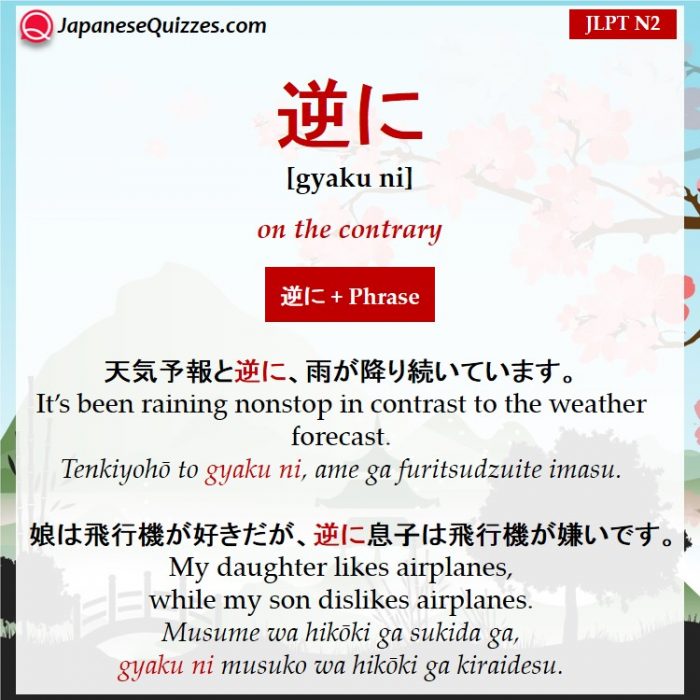
逆に + phrase
Examples
天気予報と逆に、雨が降り続いている / 降り続いています。
Tenkiyohō to gyaku ni, ame ga furitsudzuite iru/ furitsudzuite imasu.
It’s been raining nonstop in contrast to the weather forecast.
私たちの期待とは逆に、今年の売り上げは増えなかった / 増えませんでした。
Watashitachi no kitai to wa gyaku ni, kotoshi no uriage wa fuenakatta/ fuemasendeshita.
Contrary to our expectations, sales didn’t go up this year.
娘は飛行機が好きだが、逆に息子は飛行機が嫌いだ / 嫌いです。
Musume wa hikōki ga sukida ga, gyaku ni musuko wa hikōki ga kiraida/ kiraidesu.
My daughter likes airplanes, while my son dislikes airplanes.
大阪の夏はひどく湿気が多い。逆に冬は乾燥する。
Ōsaka no natsu wa hidoku shikke ga ōi. Gyaku ni fuyu wa kansō suru.
It gets very humid in Osaka in summer. On the other hand, it gets very dry there in winter.
幸せだから笑うのではない。逆に、笑うから幸せなのです。
Shiawasedakara warau node wanai. Gyaku ni, waraukara shiawasena nodesu.
You’re not happy because you laugh a lot, it’s because you laugh a lot that you’re happy.
ストレスがたまると私は食欲がなくなるのではなく、逆に食欲が増す / 増します。
Sutoresu ga tamaru to watashi wa shokuyoku ga nakunaru node wa naku, gyaku ni shokuyoku ga masu/ mashimasu.
I don’t lose my appetite when I get stressed, rather I have an increased appetite.
See also
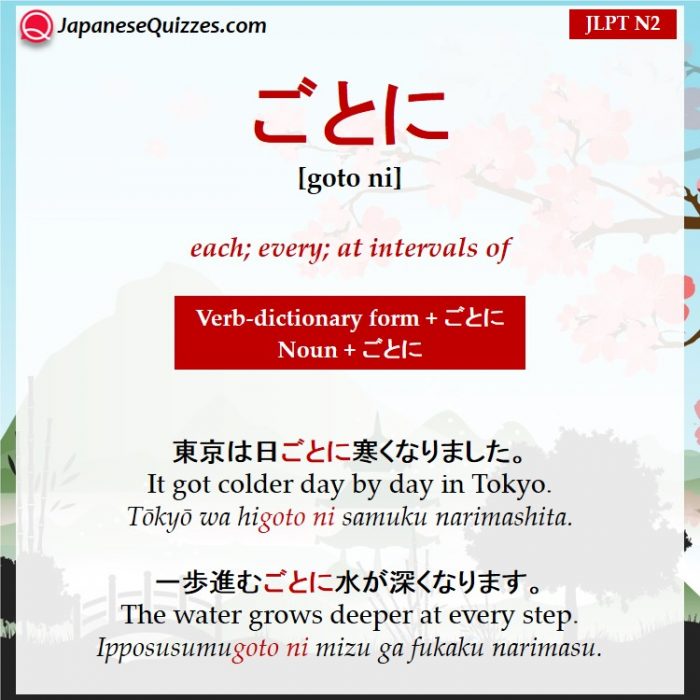
each; every; at intervals of

Formations
Verb-dictionary form + ごとに
Noun + ごとに
Examples
東京は日ごとに寒くなった / 寒くなりました。
Tōkyō wa higoto ni samuku natta/ samuku narimashita.
It got colder day by day in Tokyo.
あの国の経済状態は日ごとに変化する / 変化します。
Ano kuni no keizai jōtai wa hi-goto ni henka suru/ henka shimasu.
That country’s economic situation changes from day to day.
彼は3日ごとにここへ来る / 来ます。
Kare wa mikka-goto ni koko e kuru/ kimasu.
He comes here every three days.
オリンピック大会は4年ごとに開催されている / 開催されています。
Orinpikku taikai wa yo-nen-goto ni kaisai sa rete iru/ kaisai sa rete imasu.
The Olympic Games are held every 4 years.
一歩進むごとに水が深くなる / 深くなります。
Ippo susumu-goto ni mizu ga fukaku naru/ fukaku narimasu.
The water grows deeper at every step.
ザックは地下への階段を一段降りるごとに心拍が速まるのを感じた / 感じました。
Zakku wa chika e no kaidan o ichidan oriru goto ni shinpaku ga hayamaru no o kanjita/ kanjimashita.
Zac felt his heart rate increasing with each downward step into the basement.
See also
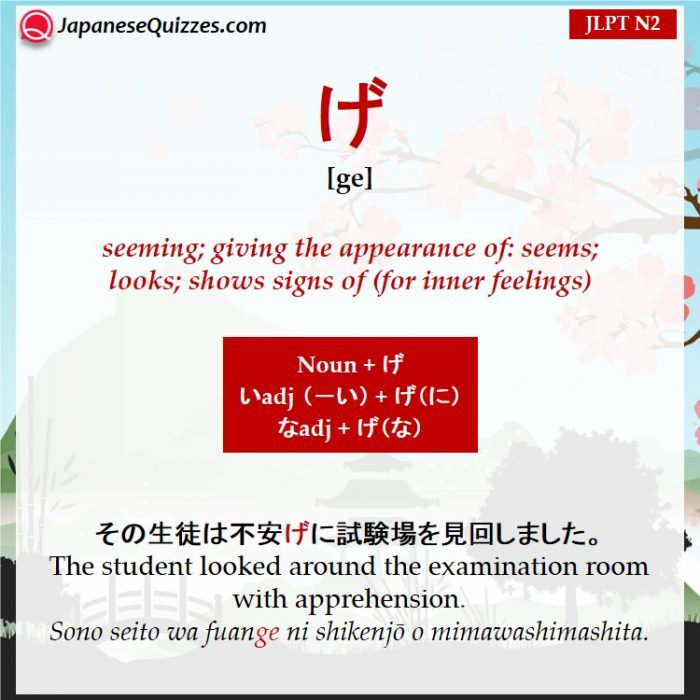
seeming; giving the appearance of: seems;looks; shows signs of (for inner feelings)

Formations
Noun + げ
いadj (-い) + げ(に)
なadj + げ(な)
Examples
彼女は疑わしげに私の顔を見つめた / 見つめました。
Kanojo wa utagawa shige ni watashinokao o mitsumeta/ mitsumemashita.
She looked doubtfully on my face.
叔父は忙しげにオフィスに向かっていた / 向かっていました。
Oji wa isogashi-ge ni ofisu ni mukatte ita/ mukatte imashita.
My uncle was hastily heading for the office.
母親たちは楽しげにおしゃべりしていた / おしゃべりをしていました。
Hahaoya-tachi wa tanoshi-ge ni oshaberi shite ita/ oshaberi o shite imashita.
The mothers chatted away cheerfully.
彼女は眠たげな子猫のようにあくびをした / あくびをしました。
Kanojo wa nemu tagena koneko no yō ni akubi o shita/ akubi o shimashita.
She yawned, looking like a sleepy kitten.
その生徒は不安げに試験場を見回した / 見回しました。
Sono seito wa fuan-ge ni shikenjō o mimawashita/ mimawashimashita.
The student looked around the examination room with apprehension.
その悲しいニュースを聞いたとき、彼は苦しげな表情を見せた / 表情を見せた。
Sono kanashī nyūsu o kiita toki, kare wa kurushi-gena hyōjō o miseta/ hyōjō o miseta.
When he heard the sad news, he showed a painful expression.
See also
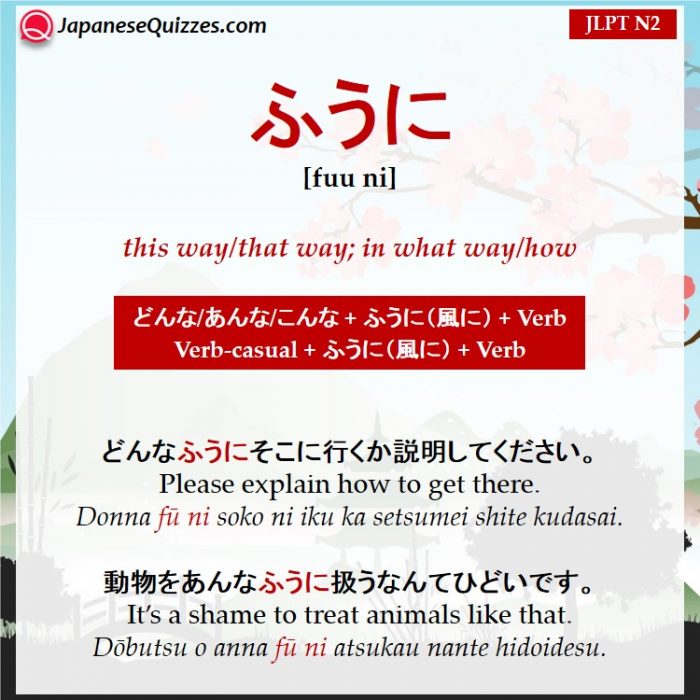
this way/that way; in what way/how

Formations
どんな/あんな/こんな + ふうに(風に) + Verb
Verb-casual + ふうに(風に) + Verb
Examples
どんなふうにあなたは彼女を好きになったのか / 好きになったのですか。
Don’na fū ni anata wa kanojo o suki ni natta no ka/ suki ni natta nodesu ka.
How did you come to love her?
どんなふうにそこに行くか説明して / 説明してください。
Don’na fū ni soko ni iku ka setsumei shite/ setsumei shite kudasai.
Please explain how to get there.
動物をあんなふうに扱うなんてひどい / ひどいです。
Dōbutsu o an’nafūni atsukau nante hidoi/ hidoidesu.
It’s a shame to treat animals like that.
こんな風に私たちは結論に達した / 結論に達しました。
Kon’nafūni watashitachiha ketsuron ni tasshita/ ketsuron ni tasshimashita.
This is how we reached the conclusion.
年月は人をいろんな風に変えていく / 変えていきます。
Nengetsu wa hito o iron’na fū ni kaete iku/ kaete ikimasu.
The years change people in many ways.
こんな風に、私たちは多くの時間を無駄にする / 無駄にします。
Kon’nafūni, watashitachi wa ōku no jikan o mudanisuru/ muda ni shimasu.
In this way, we waste a lot of time.
See also