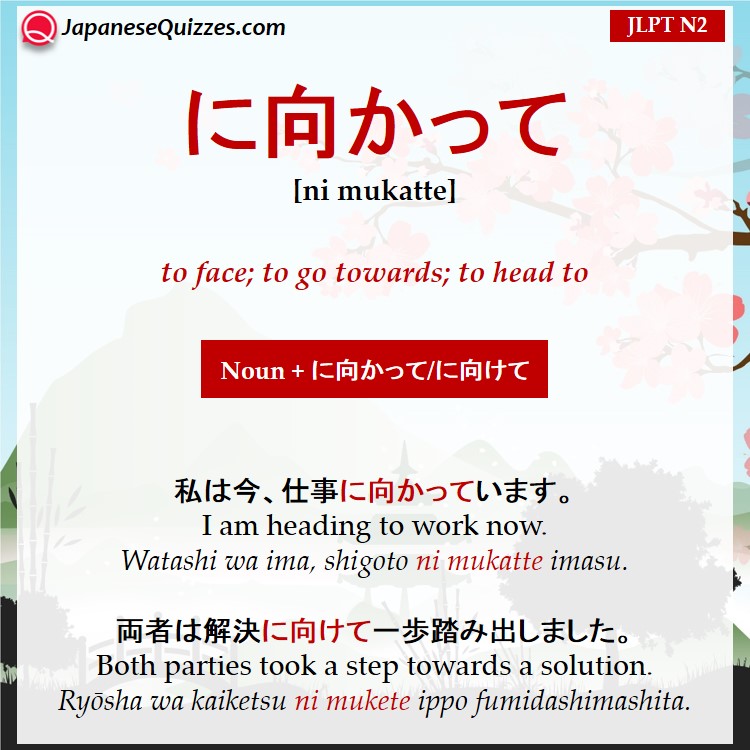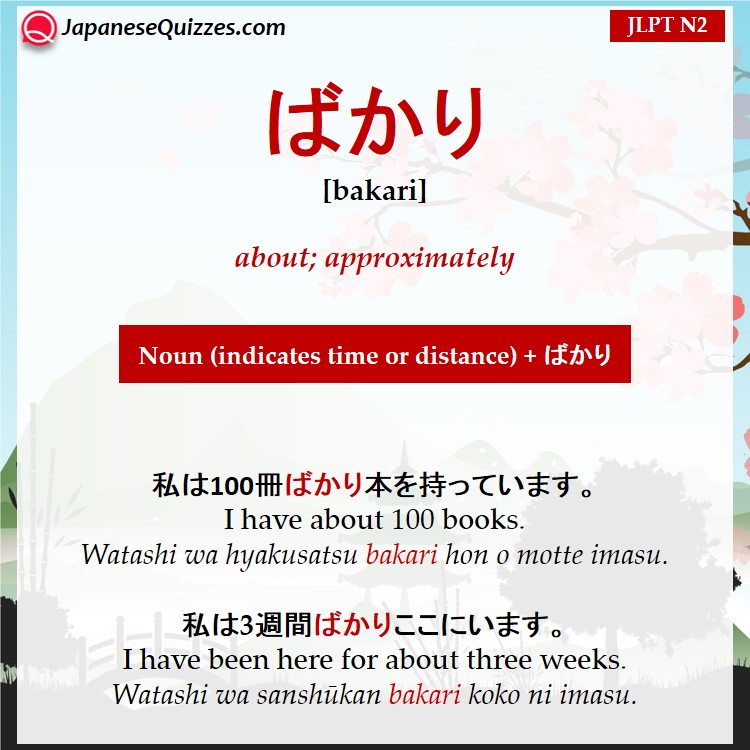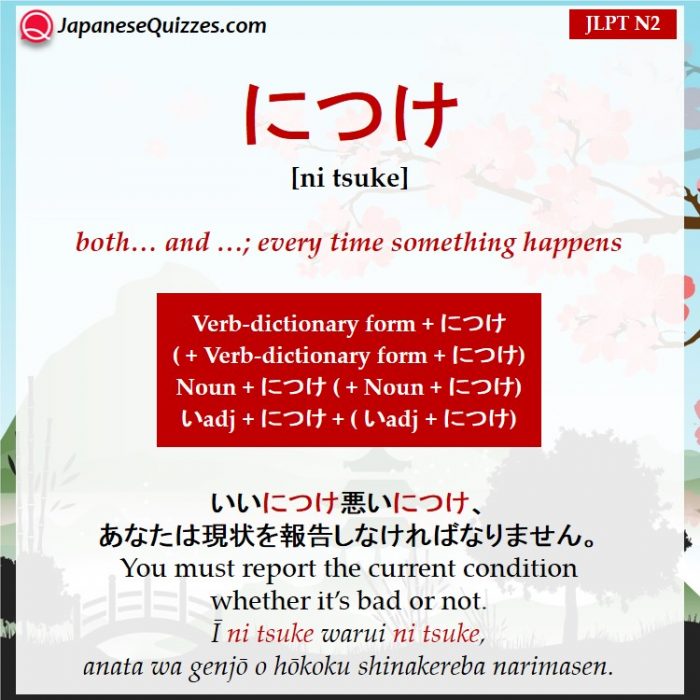
both… and …; every time something happens

Formations
Verb-dictionary form + につけ ( + Verb-dictionary form + につけ)
Noun + につけ ( + Noun + につけ)
いadj + につけ + ( いadj + につけ)
Examples
その写真を見るにつけ、小学校のころを思い出す / 思い出します。
Sono shashin o miru ni tsuke, shōgakkō no koro o omoidasu/ omoidashimasu.
Whenever I see that photo, I think back to my elementary school days.
その音楽を聴くにつけ、昔の彼氏のことを思い出す / 思い出します。
Sono ongaku o kiku ni tsuke, mukashi no kareshi no koto o omoidasu/ omoidashimasu.
Whenever I listen to the music, I remember my ex-boyfriend.
試験での失敗を思い出すにつけ、悔しさがよみがえる / よみがえります。
Shiken de no shippai o omoidasu ni tsuke, kuyashi-sa ga yomigaeru/ yomigaerimasu.
Whenever I remember the exam that I failed, my regrets come back.
雨につけ雪につけ、妹は毎日一時間散歩をする / 散歩をします。
Ame ni tsuke yuki ni tsuke, imōto wa mainichi ichijikan sanpo o suru/ sanpo o shimasu.
Whether it rains or snows, my younger sister always takes a walk for one hour every day.
いいにつけ悪いにつけ、あなたは現状を報告しなければならない / 報告しなければなりません。
Ī ni tsuke warui ni tsuke, anata wa genjō o hōkoku shinakereba naranai/ hōkoku shinakereba narimasen.
You must report the current condition whether it’s bad or not.
私が料理をすると、味が濃いにつけ薄いにつけ、家族は不平を言う / 不平を言います。
Watashi ga ryōri o suru to, aji ga koi ni tsuke usui ni tsuke, kazoku wa fuheiwoiu/ fuhei o iimasu.
Each time I cook, either way, if the flavor is strong or weak, my family complain.
See also
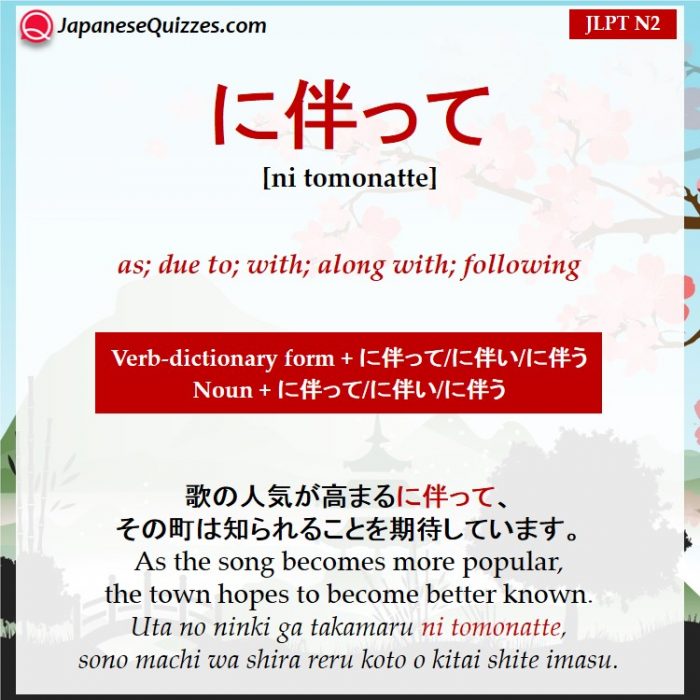
as; due to; with; along with; following

Formations
Verb-dictionary form + に伴って/に伴い/に伴う
Noun + に伴って/に伴い/に伴う
Examples
猫が成長するに伴って、餌の量も増える / 増えます。
Neko ga seichō suru nitomonatte, esa no ryō mo fueru/ fuemasu.
As my cat grows, the amount of food also increases.
経済が発展するに伴って環境破壊が問題になっている / 問題になっています。
Keizai ga hatten suru nitomonatte kankyō hakai ga mondai ni natte iru/ mondai ni natte imasu.
As the economy develops, environmental destruction is becoming a problem.
歌の人気が高まるに伴って、その町は知られることを期待している / 期待しています。
Uta no ninki ga takamaru nitomonatte, sono machi wa shira reru koto o kitai shite iru/ kitai shite imasu.
As the song becomes more popular, the town hopes to become better known.
少子化に伴い高齢者が高齢者を介護するようになる / 介護するようになります。
Shōshika ni tomonai kōrei-sha ga kōrei-sha o kaigo suru yō ni naru/ kaigo suru yō ni narimasu.
Along with the declining birth rate, the elderly will begin to care for the elderly.
部長のスケジュールに伴い私たちはタイムスケジュールを調整する必要がある / 必要があります。
Buchō no sukejūru ni tomonai watashitachi wa taimusukejūru o chōsei suruhitsuyōgāru/ hitsuyō ga arimasu.
Along with the manager ‘s schedule, we need to modify the time schedule.
新しいオフィスへの引っ越しに伴い昼食を食べる場所の選択肢の数が増えた / 増えました。
Atarashī ofisu e no hikkoshi ni tomonai chūshoku o taberu basho no sentakushi no kazu ga fueta/ fuemashita.
Along with the move into the new office, the number of options for the place to eat lunch has increased.
See also
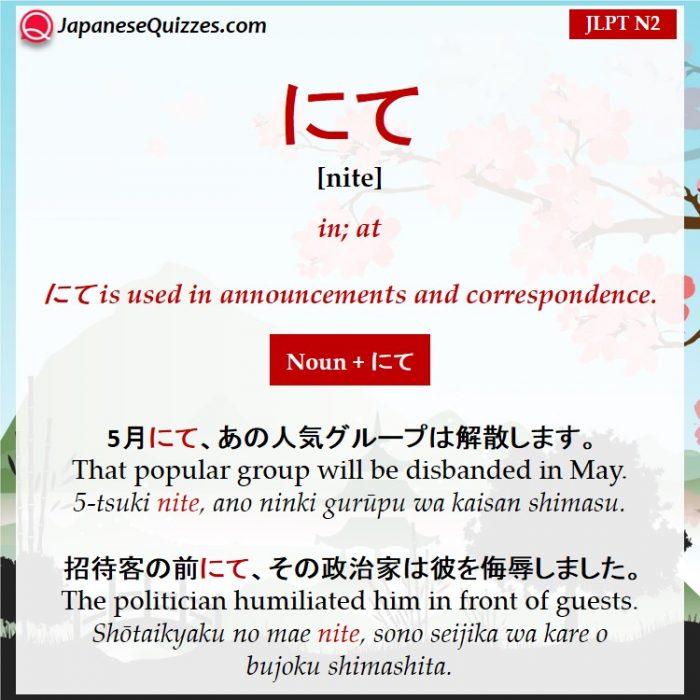
in; at
にて is used in announcements and correspondence.

Formations
Noun + にて
Examples
空港にて、あなたのホストファミリーはあなたを待っている / 待っています。
Kūkō nite, anata no hosutofamirī wa anata o matte iru/ matteimasu.
Your host family is waiting for you at the airport.
奈良公園にてシカたちはあなたを待っている / 待っています。
Narakōen nite shika-tachi wa anata o matte iru/ matteimasu.
Deer are waiting for you at Nara Park.
明日にて国会は解散する / 解散します。
Ashita nite kokkai wa kaisan suru/ kaisan shimasu.
The Diet will soon be dissolved tomorrow.
5月にて、あの人気グループは解散する / 解散します。
5 gatsu nite, ano ninki gurūpu wa kaisan suru/ kaisan shimasu.
That popular group will be disbanded in May.
招待客の前にて、その政治家は彼を侮辱した / 侮辱しました。
Shōtaikyaku no mae nite, sono seijika wa kare o bujoku shita/ bujoku shimashita.
The politician humiliated him in front of guests.
メールにて、今月末までにあなたに連絡する / 連絡します。
Mēru nite, kongetsusue made ni anata ni renraku suru/ renraku shimasu.
I will contact you by email by the end of this month.
See also
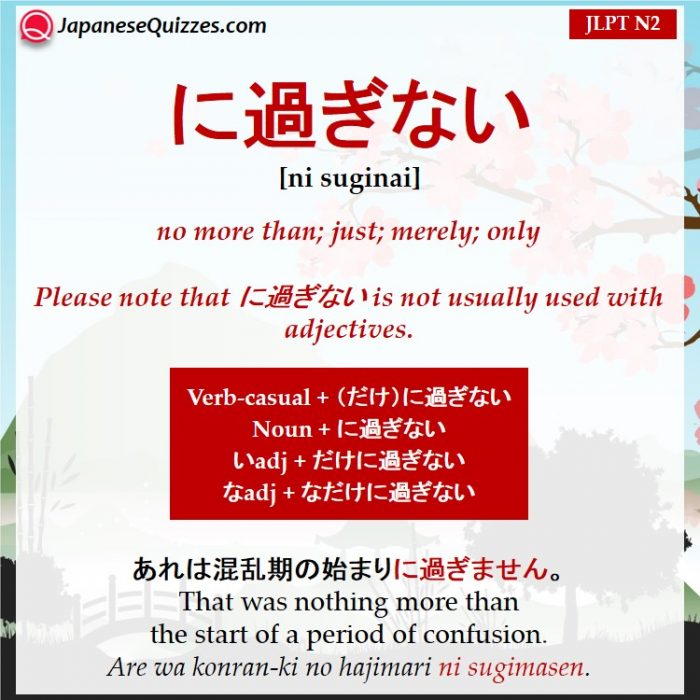
no more than; just; merely; only
Please note that に過ぎない is not usually used with adjectives.

Formations
Verb-casual + (だけ)に過ぎない
Noun + に過ぎない
いadj + だけに過ぎない
なadj + なだけに過ぎない
Examples
それらは序章に過ぎない / 序章に過ぎません。
Sorera wa joshō nisuginai/ joshō ni sugimasen.
Those are nothing more than a preface.
あれは混乱期の始まりに過ぎない / 始まりに過ぎません。
Are wa konran-ki no hajimari nisuginai/ hajimari ni sugimasen.
That was nothing more than the start of a period of confusion.
私にとってそれは単なる通過点に過ぎない / 通過点に過ぎません。
Watashi ni totte sore wa tan’naru tsūka-ten nisuginai/ tsūka-ten ni sugimasen.
That is nothing but a simple checkpoint for me.
市長の計画は空想に過ぎない / 空想に過ぎません。
Shichō no keikaku wa kūsō nisuginai/ kūsō ni sugimasen.
The mayor’s plan is sheer fantasy.
日本にまだ忍者がいるというのは、誤解に過ぎない / 誤解に過ぎません。
Nihon ni mada ninja ga iru to iu no wa, gokai nisuginai/ gokai ni sugimasen.
It is merely misunderstanding that there is still the ninja in Japan.
日本語が話せると私は言ったけれど、簡単な表現を使えるに過ぎない/ 使えるに過ぎません。
Nihongo ga hanaseru to watashi wa ittakeredo, kantan’na hyōgen o tsukaeru ni suginai/ tsukaeru ni sugimasen.
I can only use simple expressions in Japanese.
See also
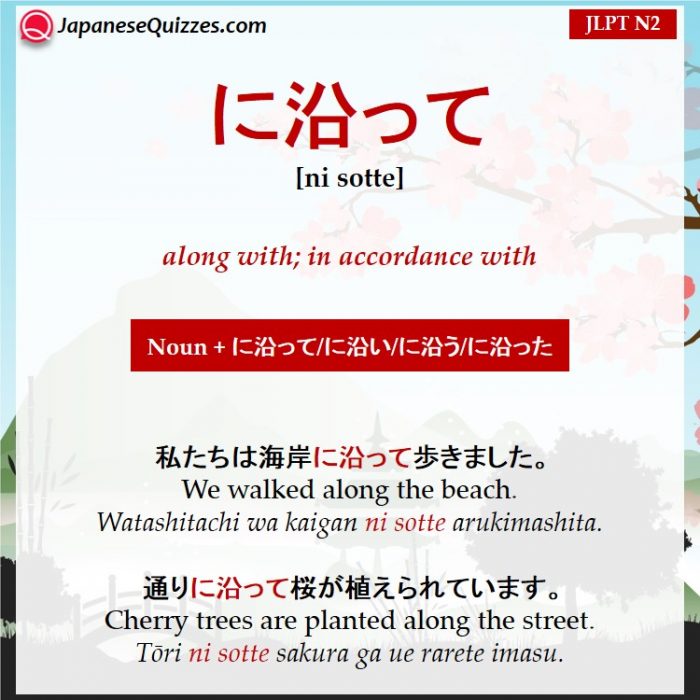
along with; in accordance with

Formations
Noun + に沿って/に沿い/に沿う/に沿った
Examples
ゲイリーは川に沿って散歩した / 散歩しました。
Geirī wa kawa ni sotte sanpo shita/ sanpo shimashita.
Gary took a walk along the river.
私たちは海岸に沿って歩いた / 歩きました。
Watashitachi wa kaigan ni sotte aruita/ arukimashita.
We walked along the beach.
通りに沿って桜が植えられている / 植えられています。
Tōri ni sotte sakura ga ue rarete iru/ ue rarete imasu.
Cherry trees are planted along the street.
通りに沿って私たちはパレードが進んでいくのを見た / 見ました。
Tōri ni sotte watashitachi wa parēdo ga susunde iku no o mita/ mimashita.
We saw the parade move down the street.
私たちは彼の計画に沿って物事を進めた / 進めました。
Watashitachi wa kare no keikaku ni sotte monogoto o susumeta/ susumemashita.
We went along with his plans.
会社の経営方針に沿って、来年度の計画が立てられた / 立てられました。
Kaisha no keiei hōshin ni sotte, rainendo no keikaku ga tate rareta/ tate raremashita.
In line with the company’s managerial policy, the plans for the next fiscal year were made.
See also
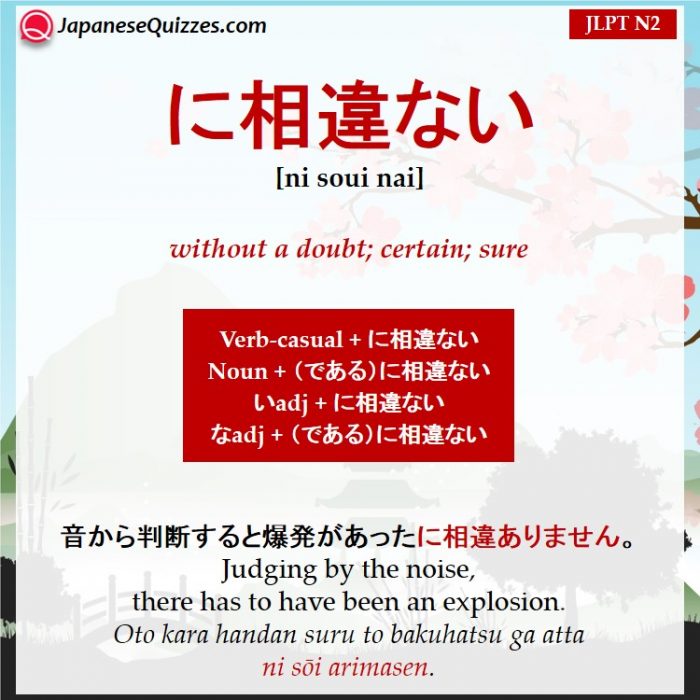
without a doubt; certain; sure

Formations
Verb-casual + に相違ない
Noun + (である)に相違ない
いadj + に相違ない
なadj + (である)に相違ない
Examples
この計画を実行するのは困難に相違ない / 相違ありません。
Kono keikaku o jikkō suru no wa kon’nan ni sōinai/ sōi arimasen.
This plan will definitely be difficult to put into action.
姉はこの選挙で選出されるに相違ない / 相違ありません。
Ane wa kono senkyo de senshutsu sa reru ni sōinai/ sōi arimasen.
My elder sister will definitely be elected this election.
その情報を漏らしたのは弟に相違ない / 相違ありません。
Sono jōhō o morashita no wa otōto ni sōinai/ sōi arimasen.
The one who leaked that information must be my younger brother.
音から判断すると爆発があったに相違ない / 相違ありません。
Oto kara handan suru to bakuhatsu ga atta ni sōinai/ sōi arimasen.
Judging by the noise, there has to have been an explosion.
この紛争の背後にはだれか扇動者がいるに相違ない / 相違ありません。
Kono funsō no haigo ni wa dare ka sendō-sha ga iru ni sōinai/ sōi arimasen.
Someone must be behind this disturbance.
私の猫はこの惑星で一番かわいい猫であるに相違ない / 相違ありません。
Watashi no neko wa kono wakusei de ichiban kawaī nekodearu ni sōinai/ sōi arimasen.
Without a doubt, my cat is the cutest cat on this planet.
See also