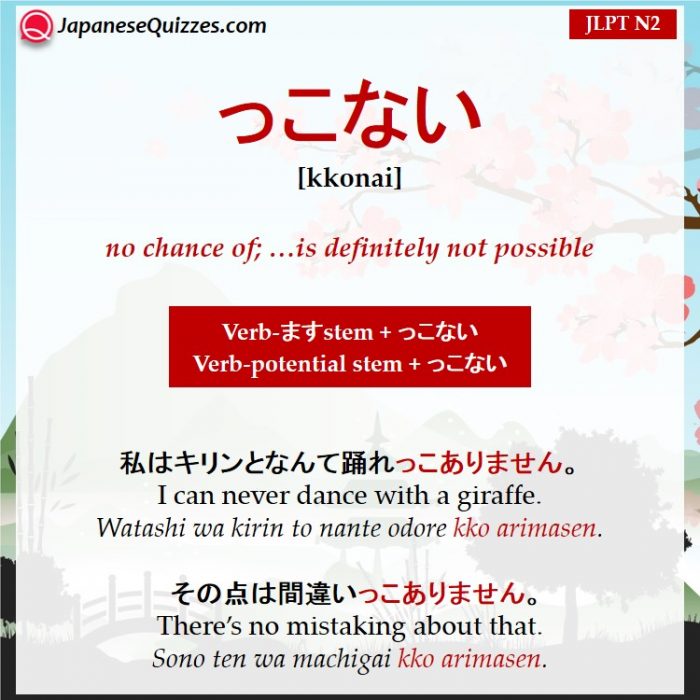
no chance of; …is definitely not possible

Formations
Verb-ますstem + っこない
Verb-potential stem + っこない
Examples
私はキリンとなんて踊れっこない / 踊れっこありません。
Watashi wa Kirin to nante odore kkonai/ odore kko arimasen.
I can never dance with a giraffe.
その点は間違いっこない / 間違いっこありません。
Sono ten wa machigai kkonai/ machigai kko arimasen.
There’s no mistaking about that.
わたしはノーベル賞なんてもらえっこない / もらえっこありません。
Watashi wa nōberu-shō nante morae kkonai/ morae kko arimasen.
I can’t possibly get a Nobel prize.
あのキリンがあなたを傷つけるなんてできっこない / できっこありません。
Ano Kirin ga anata o kizutsukeru nante de kikkonai/ de kikko arimasen.
There’s no way that that giraffe would dare to try to hurt you.
私がどんな体験をしたかなんて、あなたにわかりっこない / わかりっこありません。
Watashi ga don’na taiken o shita ka nante, anata ni wakari kkonai/ wakari kko arimasen.
You will never realize what I went through.
将来、何が起こるかなんて、誰にもわかりっこない / わかりっこありません。
Shōrai, nani ga okoru ka nante, darenimo wakari kkonai/ wakari kko arimasen.
What will happen in the future there is no way anyone could tell.
See also

Formations
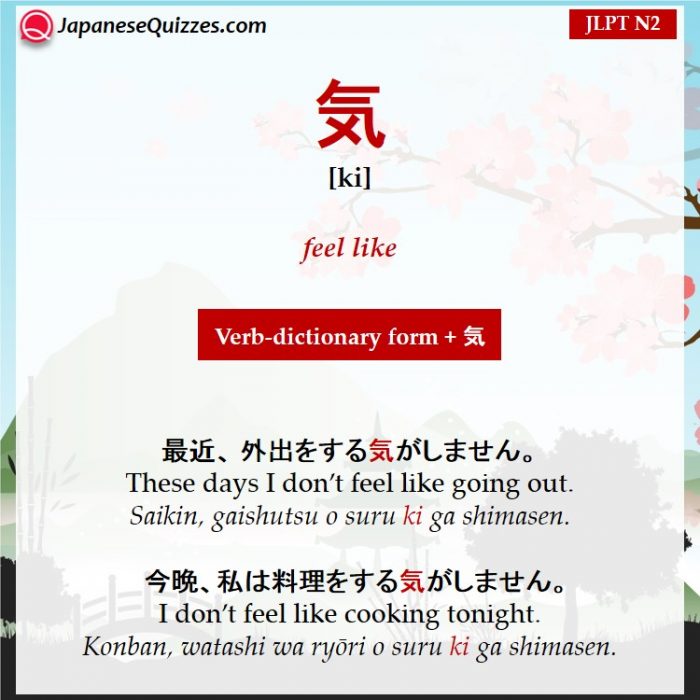
Verb-dictionary form + 気
Examples
たまに野良猫と目が合う気がする / 気がします。
Tamani noraneko to me ga au ki ga suru/ ki ga shimasu.
I have the feeling that I sometimes make eye contact with a stray cat.
最近、 外出をする気がしない / 気がしません。
Saikin, gaishutsu o suru ki ga shinai/ ki ga shimasen.
These days I don’t feel like going out.
今晩、私は料理をする気がしない / 気がしません。
Konban, watashi wa ryōri o suru ki ga shinai/ ki ga shimasen.
I don’t feel like cooking tonight.
今日、私はあまり食べる気がしない / 食べる気がしません。
Kyō, watashi wa amari taberu ki ga shinai/ taberu ki ga shimasen.
Today, I do not feel like eating much.
姉は私の企画に協力する気がなかった / 協力する気がありませんでした。
Ane wa watashi no kikaku ni kyōryoku suru ki ga nakatta/ kyōryoku suru ki ga arimasendeshita.
My older sister did not want to cooperate with my project.
私は決まり文句を繰り返す気はなかった / 繰り返す気はありませんでした。
Watashi wa kimari monku o kurikaesu ki wa nakatta/ kurikaesu ki wa arimasendeshita.
I didn’t want to repeat the standard bromides.
See also
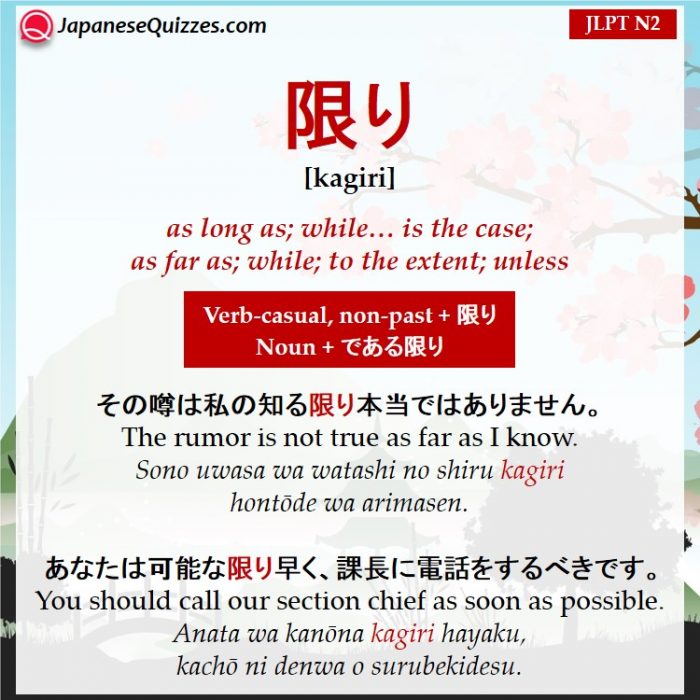
as long as; while… is the case; as far as; while; to the extent; unless

Formations
Verb-casual, non-past + 限り
Noun + である限り
Examples
その噂は私の知る限り本当ではない / 本当ではありません。
Sono uwasa wa watashi no shiru kagiri hontōde wanai/ hontōde wa arimasen.
The rumor is not true as far as I know.
あなたは可能な限り早く、課長に電話をするべきだ / 電話をするべきです。
Anata wa kanōna kagiri hayaku, kachō ni denwa o surubekida/ denwa o surubekidesu.
You should call our section chief as soon as possible.
すべての言語は話されている限り変化する / 変化します。
Subete no gengo wa hanasa rete iru kagiri henka suru/ henka shimasu.
Every language continues to change as long as it is spoken.
目がとどく限り、砂以外の何もなかった / 何もありませんでした。
Me ga todoku kagiri, suna igai no nani mo nakatta/ nani mo arimasendeshita.
As far as the eye could see, there was nothing but sand.
夜遅く一人で歩かない限り、この場所はかなり安全だ / 安全です。
Yoru osoku hitori de arukanai kagiri, kono basho wa kanari anzenda/ anzendesu.
As long as you don’t walk alone at night, this place is pretty safe.
社会人である限り、自分の行動に責任を持つべきだ / 持つべきです。
Shakai jin dearu kagiri, jibun no kōdō ni sekinin o motsubekida/ motsubekidesu.
As long as you’re a member of the society, you must take responsibility for your actions.
See also
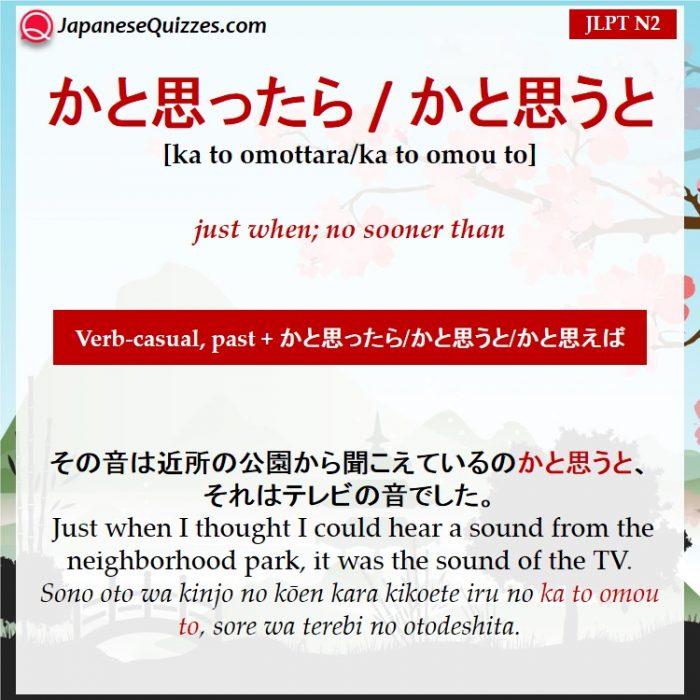
just when; no sooner than

Formations
Verb-casual, past + かと思ったら/かと思うと/かと思えば
Examples
空が暗くなったかと思ったら、激しく雨が降り始めた / 降り始めました。
Sora ga kuraku natta ka to omottara, hageshiku ame ga ori hajimeta/ ori hajimemashita.
As soon as the sky turned black, it started raining heavily.
台風が一つ通り過ぎたかと思ったら、すぐに次の台風が接近する / 接近しています。
Taifū ga hitotsu tōrisugita ka to omottara, sugu ni tsugi no taifū ga sekkin suru/ sekkin shite imasu.
No sooner has one typhoon passed than the next one approaches.
私がその本を読み始めたかと思ったら誰かがドアをノックした / ノックしました。
Watashi ga sono-hon o yomi hajimeta ka to omottara darekaga doa o nokku shita/ nokku shimashita.
I had hardly begun to read the book before someone knocked at the door.
私が部屋のドアを閉めたかと思うと、太った猫がドアを開けた / 開けました。
Watashi ga heya no doa o shimeta ka to omou to, futotta neko ga doa o aketa/ akemashita.
As soon as I shut the door of the room, a fat cat opened the door.
姉は出かけたかと思うと、すぐ忘れ物を取りに帰ってきた / 帰ってきました。
Ane wa dekaketa ka to omou to, sugu wasuremono o tori ni kaettekita/ kaette kimashita.
As soon as my big sister left, she came back to get something she forgot.
その音は近所の公園から聞こえているのかと思うと、それはテレビの音だった / 音でした。
Sono Oto wa kinjo no kōen kara kikoete iru no ka to omou to, soreha terebi no otodatta/ otodeshita.
Just when I thought I could hear a sound from the neighborhood park, it was the sound of the TV.
See also
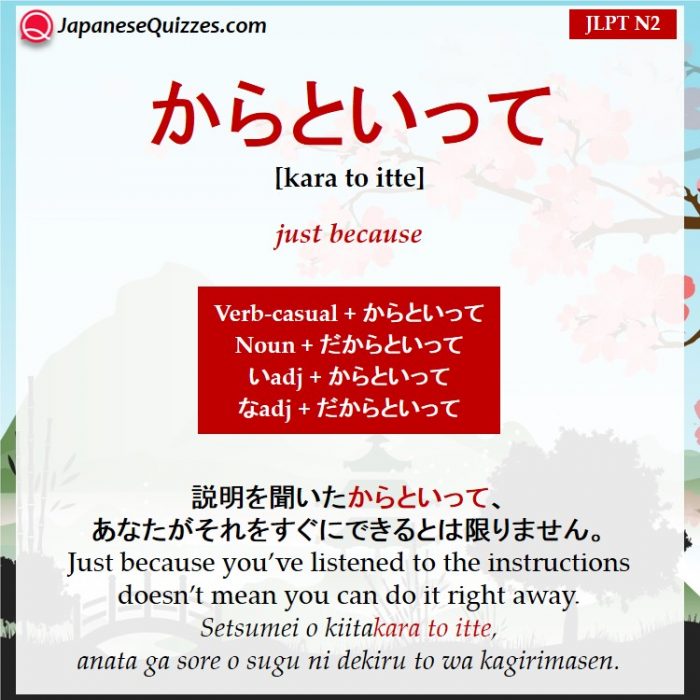

Formations
Verb-casual + からといって
Noun + だからといって
いadj + からといって
なadj + だからといって
Examples
ベトナムに住んでいるからといってベトナム語が話せるとは限らない / 限りません。
Betonamu ni sunde irukara to itte Betonamu-go ga hanaseru to wa kagiranai/ kagirimasen.
Just because you live in Vietnam doesn’t mean you can speak Vietnamese.
説明を聞いたからといって、あなたがそれをすぐにできるとは限らない / 限りません。
Setsumei o kiitakara to itte, anata ga sore o sugu ni dekiru to wa kagiranai/ kagirimasen.
Just because you’ve listened to the instructions doesn’t mean you can do it right away.
誰かが間違いをしたからといって、それを笑うのは無作法だ / 不作法です。
Darekaga machigai o shitakara to itte, sore o warau no wa busahōda/ busahōdesu.
It is not good manners to laugh at someone when he makes mistakes.
彼は貧しいからといって不幸だということにはならない / 不幸だということにはなりません。
Kare wa mazushīkara to itte fukōda to iu koto ni wa naranai/ fukōda to iu koto ni wa narimasen.
Just because he’s poor, it doesn’t follow that he’s unhappy.
私は彼女が金持ちだからといって結婚したのではない / 結婚したのではありません。
Watashi wa kanojo ga kanemochi dakaratoitte kekkon shita node wanai/ kekkon shita node wa arimasen.
I didn’t marry her just because she is rich.
その人が完璧だからといって恋に落ちるわけではない / 恋に落ちるわけではありません。
Sono hito ga kanpeki dakaratoitte koi ni ochiru wakede wanai/ koi ni ochiru wakede wa arimasen.
You don’t fall in love with somebody just because he’s perfect.
See also
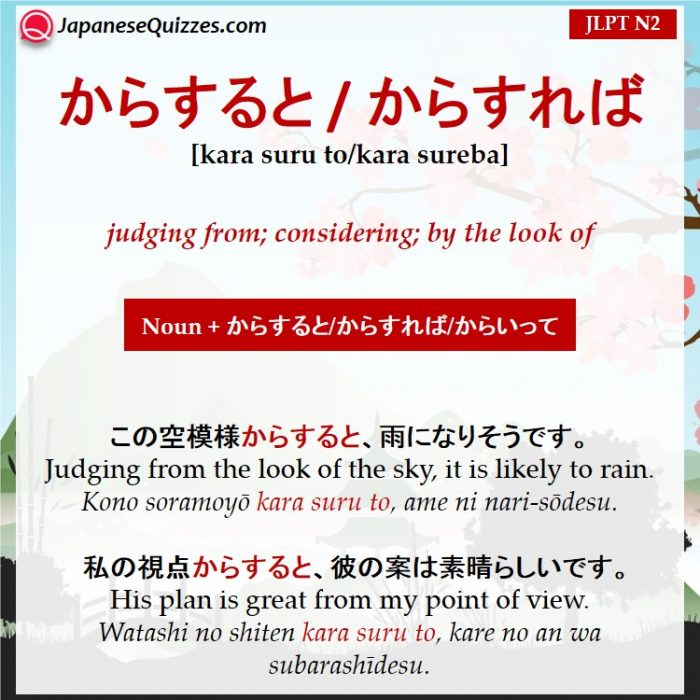
judging from; considering; by the look of

Formations
Noun + からすると/からすれば/からいって
Examples
この空模様からすると、雨になりそうだ / 雨になりそうです。
Kono soramoyō kara suru to, ame ni nari-sōda/ ame ni nari-sōdesu.
Judging from the look of the sky, it is likely to rain.
私の視点からすると、彼の案は素晴らしい / 素晴らしいです。
Watashi no shiten kara suru to, kare no an wa subarashī/ subarashīdesu.
His plan is great from my point of view.
実践的見地からすれば彼女の計画は実行しにくい / 実行しにくいです。
Jissen-teki kenchi kara sureba kanojo no keikaku wa jikkō shi nikui/ jikkō shi nikuidesu.
From the practical point of view, her plan is not easy to carry out.
私が聞いた話からすれば、彼が自分でこれを発明したらしい / 発明したらしいです。
Watashi ga kiita hanashi kara sureba, kare ga jibun de kore o hatsumei shitarashī/ hatsumei shitarashīdesu.
From what I’ve heard, it seems that he invented this himself.
彼女の能力からいって、ハーバード大学に十分合格できるだろう / 合格できるでしょう。
Kanojo no nōryoku kara itte, hābādo daigaku ni jūbun gōkaku dekirudarou/ gōkaku dekirudeshou.
Judging from her ability, she’ll surely be able to get into the Harvard University.
工場での噂からいって、工場長は自宅でカンガルーを飼っているらしい / 飼っているらしいです。
Kōjō de no uwasa kara itte, kōbachō wa jitaku de kangarū o katte irurashī/ katte irurashīdesu.
Judging from the rumors going around the factory, the factory manager seems to have a kangaroo at home.
See also