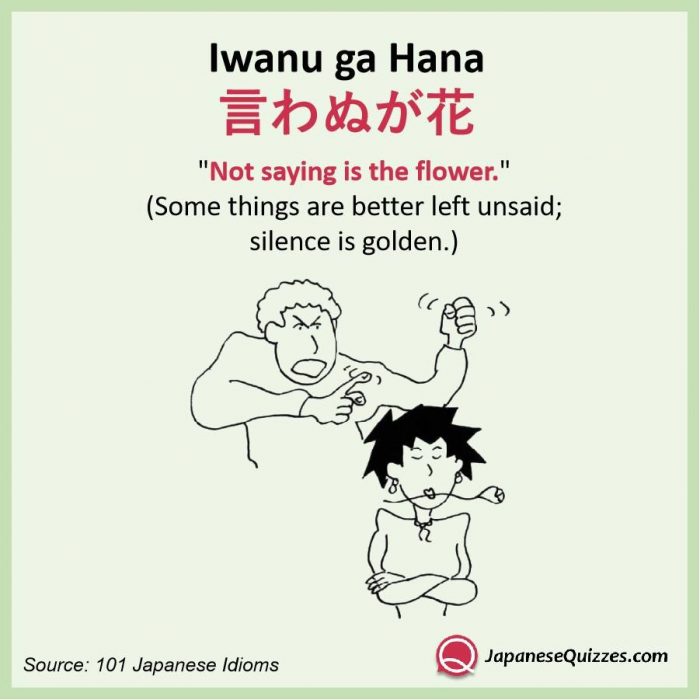
言わぬが花
“Not saying is the flower.”
(Some things are better left unsaid; silence is golden.)

Since one can never really “take back” what one says, there is a high premium on thinking things through before opening one’s mouth. Much harm and nonsense can result from ill-chosen words. Thus the philosophical observation that “Not saying is the flower.”
Sample text:
(Style: spoken/casual/female)
A: Kare ni wa yappari himitsu ni shite okoo to omou no.
B: Soo ne. “Iwanu ga hana” te kotowaza mo arushi ne.
A:彼にはやっぱり秘密にしておこうと思うの。
B:そうね、「言わぬが花」ってことわざもあるしね。
A: I think I’ll keep it a secret from him.
B: That’s good. You know the proverb, “Silence is golden.”
Japanese Idioms
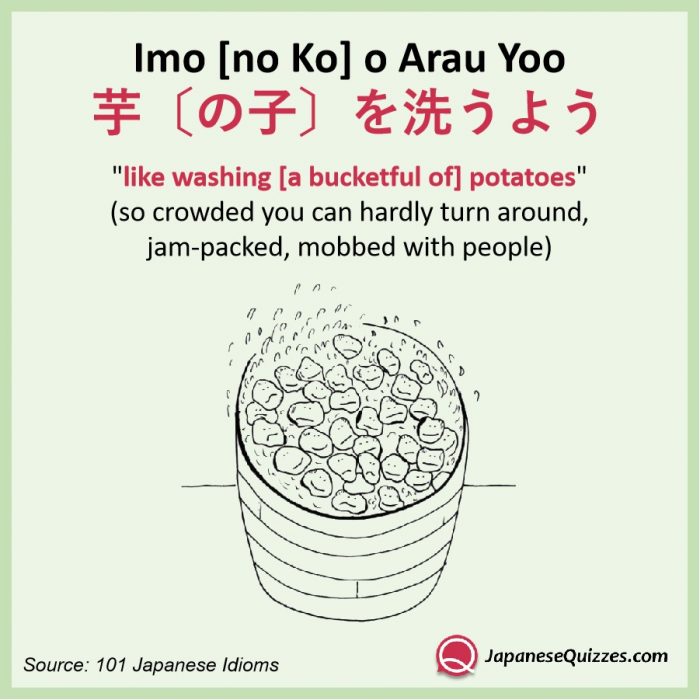
芋[の子]を洗うよう
“like washing [a bucketful of] potatoes”
(so crowded you can hardly turn around, jam-packed, mobbed with people)

Summer weekends at the beach in Japan are impossible. The beaches are so crowded that you can hardly make space for your beach mat. When hordes of people play in the waist-deep ocean waters, wave after wave jostles them into each other. This commotion resembles a wooden bucketful of potatoes sloshing around while being washed by the agitator. Usage is restricted to water-related scenes.
Sample text:
(Style: written/informal)
Shichigatsu gejun no nichiyoobi, natsuyasumi ni haitta node, kodomozure no kazoku ga ooku, kaisui yokujoo wa imo [no ko] o arau yoona konzatsuburi to natta.
七月下旬の日曜日、夏休みに入ったので、子供連れの家族が 多く、海水浴場は芋[の子]を洗うような混雑ぶりとなっった。
Since it was a Sunday toward the end of July and summer vacation, there were a lot of families with kids, and the beach was jam-packed.
Japanese Idioms
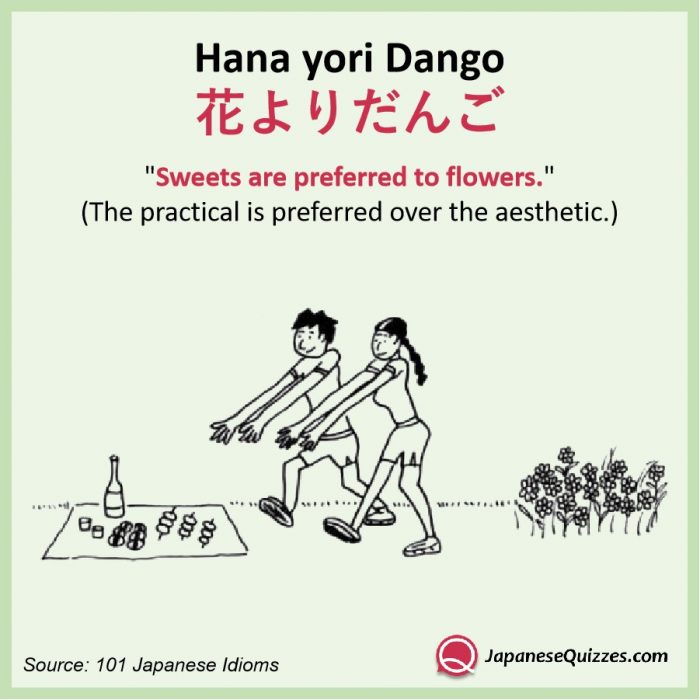
花より団子
“Sweets are preferred to flowers.”
(The practical is preferred over the aesthetic.)

Every spring on the day of “flower viewing,” Japanese traditionally travel to the countryside or visit parks to appreciate the beauty of nature. Yet human nature being what it is, people seem to show considerably more interest in the food than in the flowers.
Sample text:
(Style: spoken/casual/A=female, B=male)
A: Iya da wa. Aki-chan tara sekkaku ohanami ni kita noni,tabete bakari ite.
B: Akio, omae wa yappari hana yori dango no taipu da na.
A:いやだわ、あきちゃんたらせっかくお花見に来たのに、食 べてばかりいて。
B:昭男、お前はやっぱり花よりだんごのタイプだな。
A: Oh boy, Aki-chan is only interested in food, while we came to appreciate the cherry blossom trees in full bloom.
B: Akio, you’re the type who prefers the practical over the aesthetic, aren’t you?
Japanese Idioms
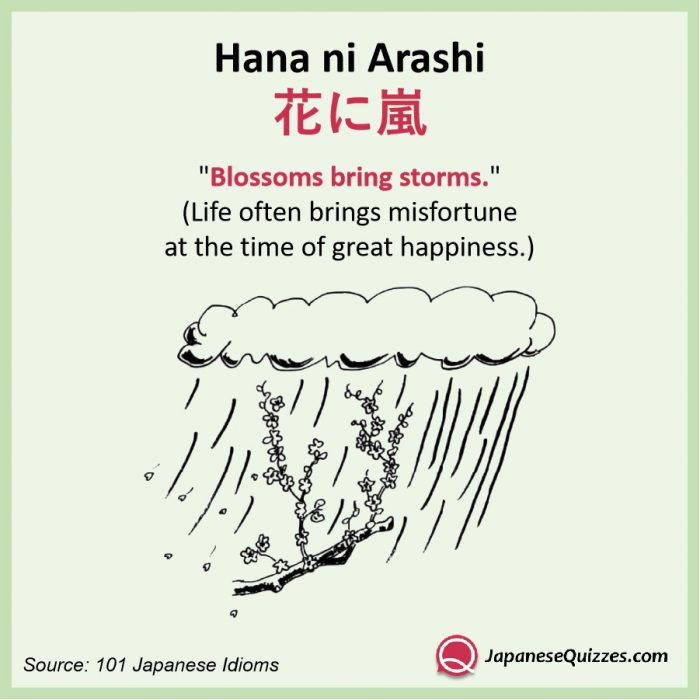
花に嵐
“Blossoms bring storms.”
(Life often brings misfortune at the time of great happiness.)

This fatalistic insight is a shortened version of tsuki ni muragumo, hana ni arashi, which is literally translated, “Clouds over the moon, storm over blossoms.” It often seems that misfortune looms behind even the happiest moments.
Sample text:
(Style: spoken/casual/female)
A: Kekkon shite isshuukan de kyuuni goshujin ga nyuuin towa okinodoku nee.
B: Shiawase ippai no tokoro ni zannen nee. Demo maa “hana ni arashi” to yuu kurai da kara, kooyuu koto mo unmei de shikata ga nai wa ne.
A:結婚して一週間で急に御主人が入院とはおきのどくねえ。
B:幸せいっぱいのところに残念ねえ。でもまあ「花に嵐」と言うくらいだから、こういうことも運命で仕方がないわね。
A: It’s too bad. Only married a week and her new husband got hospitalized.
B: Too bad, when she was so happy. But as they say, “Life often brings misfortune at the time of great happiness.” It’s simply fate. You can’t help it.
Japanese Idioms
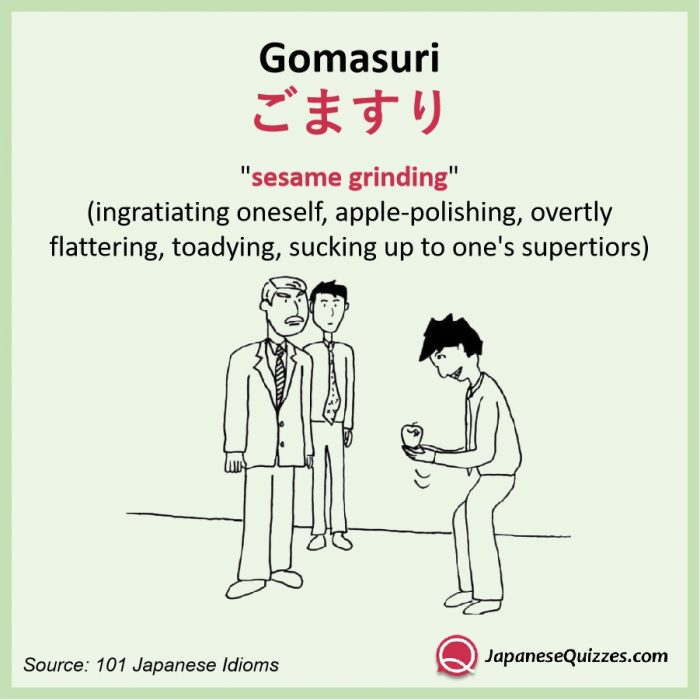
ごますり
“sesame grinding”
(ingratiating oneself, apple-polishing, overtly flattering, toadying, sucking up to one’s supertiors)

When a person makes on overtly ingratiating remark, he or she is “grinding sesame seeds.” Others call attention to the gomasuri either by saying the word, by (nonverbally) making motions with the fist over the palm of the other hand (simulating the grinding of roasted sesame seeds with a pestle and mortar), or by doing both. Like the messy sesame seeds ground up in the mortar, the person seeking favor is sticking to everything (one).
Sample text:
(Style: spoken/formal/male)
A: Katoo-san iyoiyo kakarichoo ni shooshin rashii desu yo.
B: Yappari soo desu ka. Koko sonnen kan zutto gomasuri o yatte kita n da kara, sorosoro kakarichoo ni now daroo to wa omottemashita kedo ne.
A:加藤さんいよいよ係長に昇進らしいですよ。
B:やっぱりそうですか。ここ三年間ずっとごますりをやってきたんだから、そろそろ係長になるだろうとは思ってましたけどね。
A: I hear Mr. Kato is finally going to be promoted to section chief.
B: Just as I thought. I was thinking he would make section chief soon since he’s been apple-polishing for the past three years.
Japanese Idioms
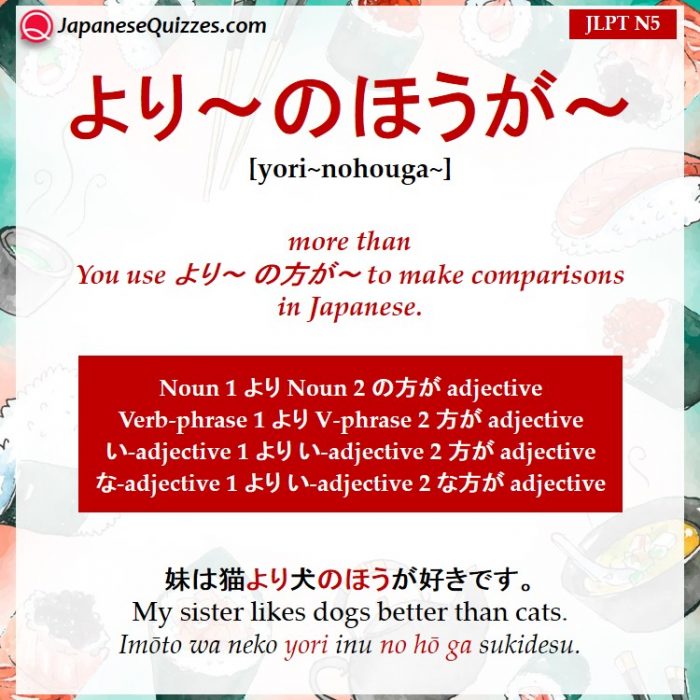
more than
You use より ~ の方が ~to make comparisons in Japanese.

Formations
Noun 1 より Noun 2 の方が adjective
Verb-phrase 1 より V-phrase 2 方が adjective
い-adjective 1 より い-adjective 2 方が adjective
な-adjective 1 より い-adjective 2 な方が adjective
Examples
妹は猫より犬のほうが好きです。
Imōto wa neko yori inu no hō ga sukidesu.
My sister likes dogs better than cats.
私は秋より春のほうが好きです。
Watashi wa aki yori haru no hō ga sukidesu.
I prefer spring to autumn.
昨日より今日のほうが暑いです。
Kinō yori kyō no hō ga atsuidesu.
It is hotter today than it was yesterday.
私はコーヒーよりお茶のほうがいいです。
Watashi wa kōhī yori ocha no hō ga īdesu.
Tea is better than coffee.
彼のほうが兄より背が高い。
Kare no hō ga ani yori segatakai.
He is taller than his brother.
大塚さんより上野さんのほうが水泳がうまい。
Ōtsuka-san yori Ueno-san no hō ga suiei ga umai.
Mr. Ueno is better at swimming than Mr. Otsuka.
社長には、水曜日のほうが土曜日より都合がいい。
Shachō ni wa, suiyōbi no hō ga doyōbi yori tsugōgaī.
Wednesday is more convenient than Saturday for the president.
See also