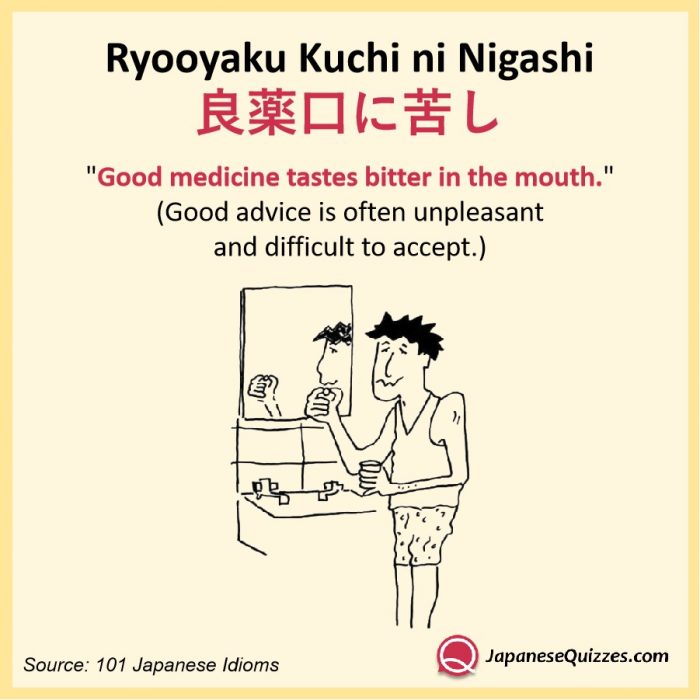
良薬は口に苦し
“Good medicine tastes bitter in the mouth.”
(Good advice is often unpleasant and difficult to accept.)

Teaches that one cannot expect to hear only good news in life. Sometimes, although painful, it is good medicine to taste the bitter truth. It is implicit in the statement that the speaker “cares enough” to speak with unusual candor.
Sample text:
(Style: spoken/casual/male)
A: Itsumo kachoo kara komakaku chuui sareru no ga tamaran yo.
B: “Ryooyaku kuchi ni nigashi” tte yuu janai ka. Ima wa nigai to omottemo atode yokatta to kitto omou yo.
A: いつも課長から細かく注意されるのがたまらんよ。
B: 「良薬口に苦し」って言うじゃないか。今はにがいと思ってもあとで良かったときっと思うよ。
A: I can’t stand being constantly corrected in detail by the manager.
B: You know, they say, “Good medicine tastes bitter in the mouth.” You may think these detailed corrections are unpleasant now but later on you’ll realize their benefit.
Japanese Idioms
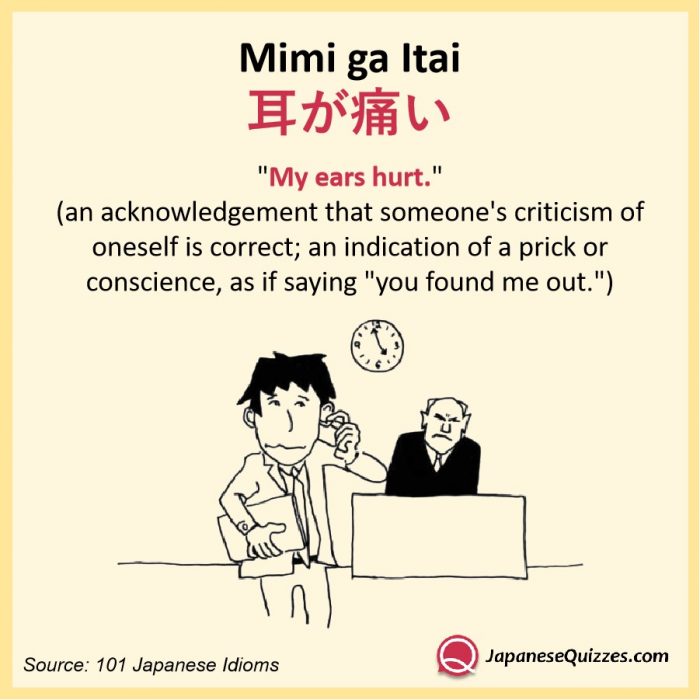
耳が痛い
“My ears hurt.”
(an acknowledgment that someone’s criticism of oneself is correct; an indication of a prick of conscience, as if saying “you found me out.”)

Some say that, despite Japan’s economic might, its people are pretty simple. To say “my ears hurt,” when words of criticism are hurled one’s way, is direct and disarming. It’s a way of saying “you got me.” Implicit in the phrase is the recognition of wrongdoing.
Sample text:
(Style: spoken/casual/male)
A: Isogashii, isogashii tte iinagara, muda banashi bakari shiteiru kara shigoto ga zenzen susumanai n da yo.
B: Iyaa, sono toori. Mimi ga itai na.
A: 忙しい、忙しいって言いながら、むだ話ばかりしているから仕事が全然進まないんだよ。
B: いやあ、その通り。耳が痛いな。
A: You say you’re busy, but you waste your time chit chatting. That’s why you can’t get your work done.
B: You’re right. You got me!
Japanese Idioms

腰が低い
“low-waisted”
(very polite, modest or humble)

It’s probably fair to say that Japanese are preoccupied with hierarchies. Status is indicated physically by one’s posture in relation to others. To bend a little, to lower one’s head, or to bow a deep bow is to position oneself vis-à-vis a person of higher rank. Thus, koshi ga hikui is a compliment-especially to one who, by virtue of wealth or fame, has attained high status.
Sample text:
(Style: spoken/casual/male)
A: Tanaka shachoo, daigaisha no shachoo da kedo chittomo ibaru koto ga nai n da na. Koshi ga hikukute sa. Dakara minna ni sukareru n daroo na.
A: 田中社長、大会社の社長だけどちっともいばることがないんだな。腰が低くてさ。だからみんなに好かれるんだろうな。
A: President Tanaka. You know, even though he’s the president of a big company, he never puts on airs. He’s always modest. That’s why he is liked by everyone.
Japanese Idioms

肩身がせまい
“narrow shoulders”
(a feeling of inferiority or inadequacy)

When in the presence of others who are superior in some respect, one’s feelings of inferiority may be intensified. The physical manifestation of this feeling is a shrinking into oneself. The Japanese picture this reaction as a drawing in of the shoulders.
Sample text:
(Style: spoken/casual/male)
A: Ano paatii wa gakusha to chishikijin no atsumari de ne. Watashi no yooni gakureki no nai mono ni wa chotto katami ga semai yo.
A: あのパーティーは学者と知識人の集まりでね。私のように学歴のない者にはちょっと肩身がせまいよ。
A: The people at that party were mostly scholars and intellectuals. A person like me, who doesn’t have an educational background, feels kind of inadequate.
Japanese Idioms
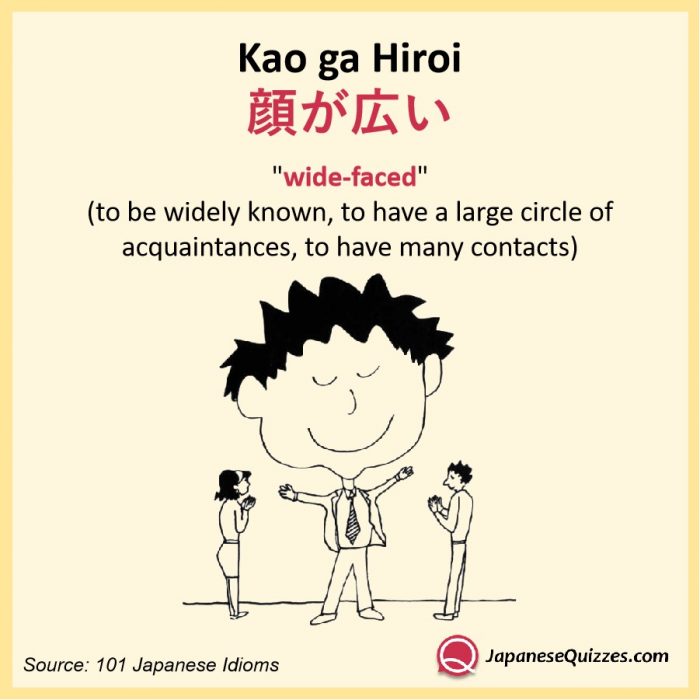
顔が広い
“wide-faced”
(to be widely known, to have a large circle of acquaintances, to have many contacts)

To be established in business or to be respected in society, it is important to be kao ga hiroi. The kao ga hiroi person is often the community leader or the authority figure in the profession. He or she has many contacts in the community and is expected to perform a paternal or maternal role.
Sample text:
(Style: spoken/casual/A=female, B=male)
A: Sachiko-san mata omiai na n desu tte.
B: Tsugi kara tsugi e to yoku miai banashi ga hairu nee.
A: Otoosan ga kao ga hiroi kara iroirona tokoro kara hanashi ga aru n deshoo.
A: 幸子さんまたお見合いなんですって。
B: 次から次へとよく見合い話がはいるねえ。
A: お父さんが顔が広いからいろいろなところから話があるんでしょう。
A: Sachiko has another omiai*, right?
B: She sure gets those miai requests one after another, doesn’t she?
A: Everybody knows her father, so omiai requests must come in from everywhere.
*(O)miai refers to an arranged meeting with a potential marriage partner.
Japanese Idioms
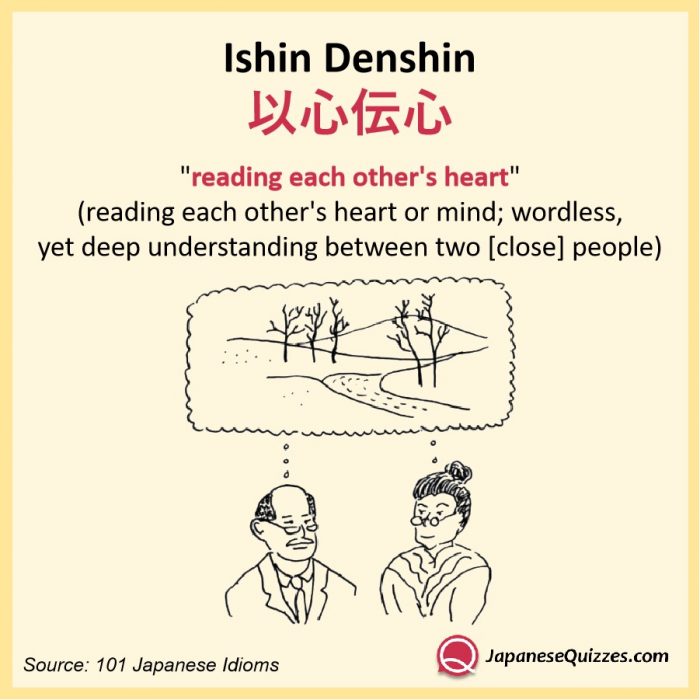
以心伝心
“reading each other’s heart”
(reading each other’s heart or mind; wordless, yet deep understanding between two [close] people)

Wordless yet total communication between two people, as if one heart is in direct contact with the other. Couples who have been married for 50 years may have ishin denshin. Co-workers, business associates, and friends are also capable of this harmonious relationship.
Sample text:
(Style: spoken/casual/A=female, B=male)
A: Keiyakusho o kawashite konakatta no?
B: Ii n da yo. Soo nanimo kamo bunsho ni shinakute mo. Aitsu to ore to wa, nagai aida no tsukiai de ishin denshin da kara ne.
A: 契約書を交わしてこなかったの?
B: いいんだよ。そう何もかも文書にしなくても。あいつとおれとは、長い間のつきあいで以心伝心だからね。
A: Didn’t you two sign a contract?
B: It’s OK. We don’t need to put everything down in words. He and I have been friends for a long time; we read each other’s mind.
Japanese Idioms