腹芸
“belly performance”
(intuitive decision making, going on a gut feeling, negotiating without the use of direct words)

The origin of the word haragei is a drama performed on the belly of a person lying down, or a skit performed with a face painted on one’s belly. From this comes the meaning of a theatrical strategy to communicate to others without words. Today haragei is thought of as a nonverbal, intuitive problem-solving technique requiring experience, sensitivity, and a keen knowledge of others.
Sample text:
(Style: spoken/casual/male)
A: Kondo no chiji wa oomono da nee. Hito o ugokasu sokojikara ga aru yoo da.
B: Soo rashii. Nanishiro haragei ni taketa hito da te yuu uwasa ga aru kurai da kara.
A: 今度の知事は大物だねえ。人を動かす底力があるようだ。
B: そうらしい。何しろ腹芸にたけた人だっていううわさがあるくらいだから。
A: Our new governor is a real “Mover and Shaker.” He seems to have a knack for mobilizing people into action.
B: That’s what I hear, too. People say it’s because his intuitive negotiating technique is very effective.
Japanese Idioms
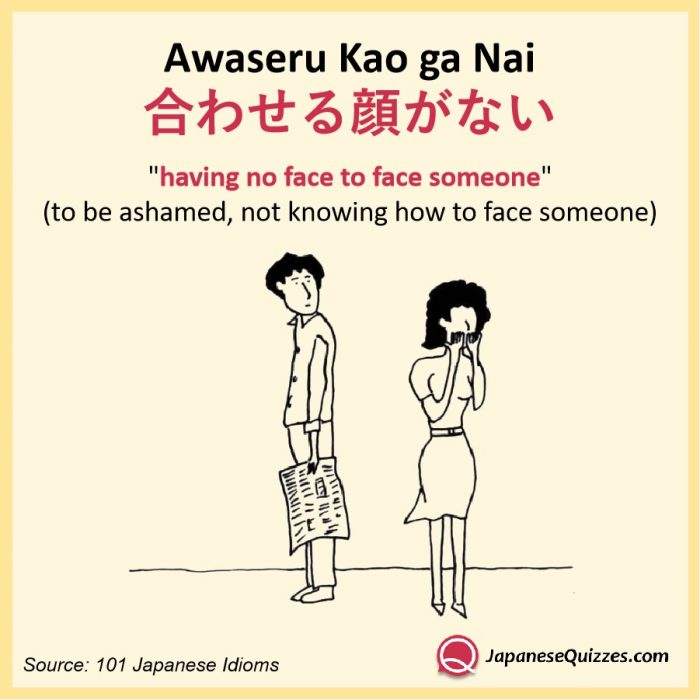
合わせる顔がない
“having no face to face someone”
(to be ashamed, not knowing how to face someone)

This idiom captures the deep concern Japanese have for maintaining face. “Face,” of course, means one’s positive image, one’s public identity and correct behavior within the community. The “having no face part of the expression can be interpreted as “not knowing what expression to wear,” or “not knowing even how to compose one’s expression” when having to face someone at a time when one feels deeply ashamed.
Sample text:
(Style: spoken/formal)
A: Sumimasen. Konkai no purojekuto ga umaku ikanakatta no wa zenbu watashi no fuchuui ni yoru mono desu. Mattaku awaseru kao ga arimasen.
A: すみません。今回のプロジェクトがうまくいかなかったの は全部私の不注意によるものです。全く合わせる顔がありません。
A: I’m sorry. It was due to my carelessness that the project didn’t go well. I have no idea how to face you….
Japanese Idioms
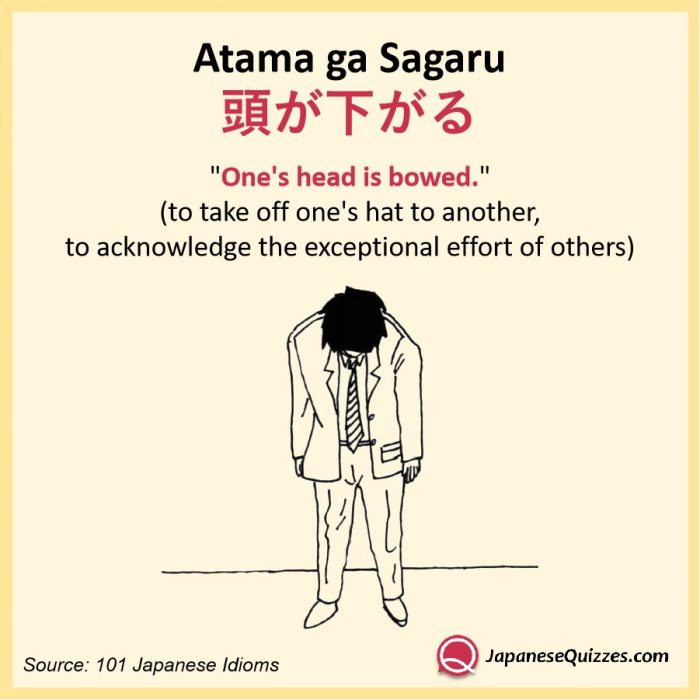
頭が下がる
“One’s head is bowed.”
(to take off one’s hat to another, to acknowledge the exceptional effort of others)

When moved by another’s extraordinary effort, one’s head, voluntarily or involuntarily lowers in respect. Such is the reaction depicted by atama ga sagaru.
Sample text:
(Style: spoken/casual/female)
A: Hontooni ano hito no doryoku o miru to, atama ga sagaru omoi ga suru wa.
B: Dare no koto?
A: Hora, itsumo toshokan de benkyoo shiteiru wakai hito, Maeda-san He yuu n janakatta?
A: 本当にあの人の努力を見ると、頭が下がる思いがするわ。
B: 誰のこと?
A: ほら、いつも図書館で勉強している若い人、前田さんって言うんじゃなかった?
A: Watching that guy work, I really have to take off my hat to him!
B: What guy?
A: You know, that young guy who’s always studying in the library. Wasn’t his name Maeda?
Japanese Idioms
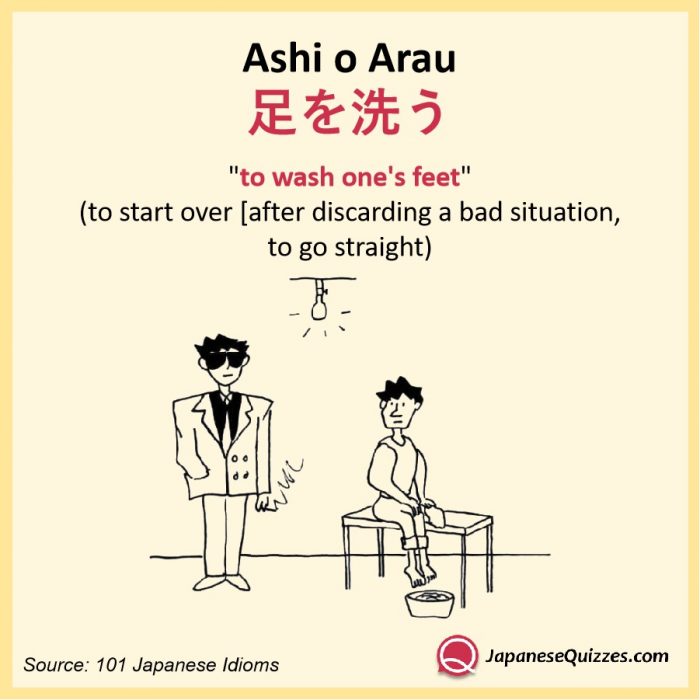
足を洗う
“to wash one’s feet”
(to start over (after discarding a bad situation), to go straight)

Menial, less prestigious jobs often require working outdoors and sometimes even working barefooted. So to wash one’s feet figuratively means to give up a lowly job or to rise up from a morally wrong way of life (crime).
Sample text:
(Style: written/informal)
Ichido furyoo nakama ni haittara, nakanaka nuke dasenai mono da. Yakuza no sekai to onaji de, aru shuudan ni nakamairi shite shimau to ningen wa kantanni wa ashi o araenai mono dearu.
一度不良仲間に入ったら、なかなか抜け出せないものだ。や くざの世界と同じで、ある集団に仲間入りしてしまうと人間 は簡単には足を洗えないものである。
When a man becomes a member of a gang, it’s very difficult to break away from it. As in the case of the world of yakuza (Japanese organized crime), once you’re a part of it, it is not an easy thing to go straight.
Japanese Idioms
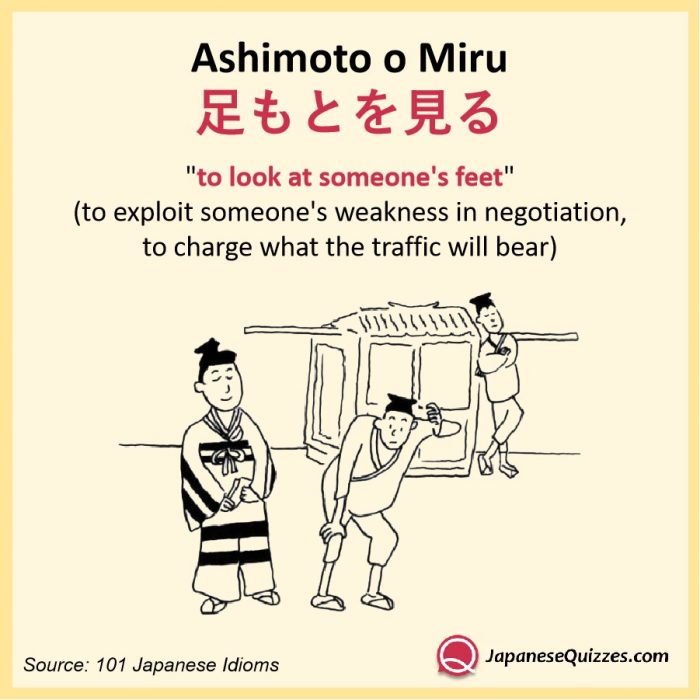
足もとを見る
“to look at someone’s feet”
(to exploit someone’s weakness in negotiation, to charge what the traffic will bear)

According to Japanese etymological sources, ashimoto o miru comes from the Feudal Age when the palanquin carriers would examine the legs and feet of prospective customers to judge their level of exhaustion, then raise the fare accordingly.
Sample text:
(Style: spoken/casual/male)
A: Kinoo wa taihen datta yo. Nakagawa to niji made nonjatte sa. Kaeri no takushii ne, ashimoto o mirarechatte, takushiidai, zuibun torareta n da.
A: きのうは大変だったよ。中川と二時まで飲んじゃってさ。帰りのタクシーね、足もとを見られちゃって、タクシ代、随分とられたんだ。
A: Last night was a disaster. I ended up drinking with Nakagawa until two in the morning. And of course, the taxi driver took advantage of my condition and overcharged me like crazy.
Japanese Idioms
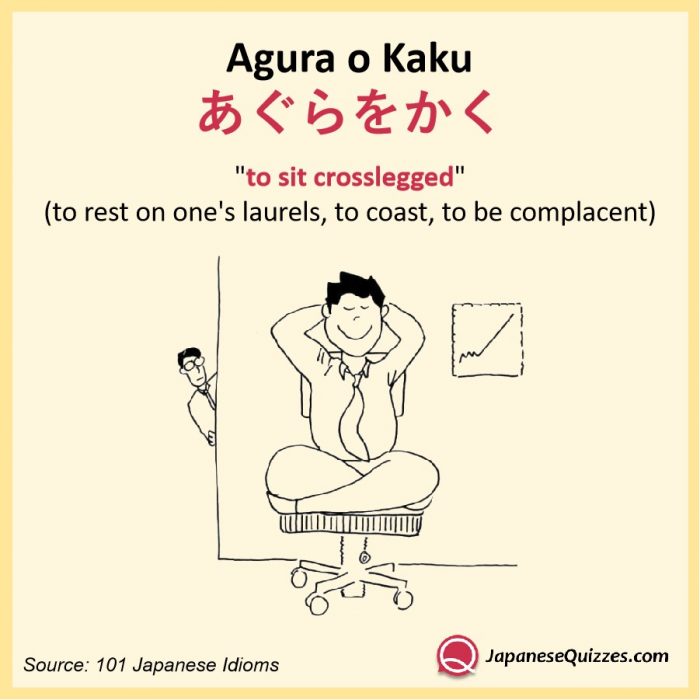
あぐらをかく
“to sit crosslegged”
(to rest on one’s laurels, to coast, to be complacent)

Sitting on the edge of one’s chair with both feet firmly planted on the ground shows eagerness, enthusiasm, and a spirit of trying hard to succeed. In contrast, a relaxed pose of sitting on a cushion with one’s legs crossed means to coast, to rest on one’s laurels.
Sample text:
(Style: spoken/casual/male)
A: Doose moo tairitsu suru aite wa inai daroo to omotte, itsumade mo shachoo no za ni agura o kaite irareru to omottara oomachigai da.
A: どうせもう対立する相手はいないだろうと思って、いつまでも社長の座にあぐらをかいていられると思ったら大間違いだ。
A: You think you have no competitors; but it’s a mistake to believe that you can sit forever in the company’s president’s position and rest on your laurels.
Japanese Idioms