雨降って地固まる
“Rain firms the ground.”
(Adversity builds character; the more challenges successfully met, the stronger one or a relationship becomes.)

Ame futte ji katamaru is often said to the bride and groom on their wedding day. In addition to meaning that bad experiences may actually be good, the expression admonishes young newlyweds that, for better or for worse, the ties that bind are strengthened through tough times.
Sample text:
(Style: spoken/formal)
A: Kekkon seikatsu wa mochiron barairo no koto bakari dewa nai deshoo. Ame futte ji katamaru to iwaremasu yooni jinsei no kuroo o wakeatte suenagaku oshiawase ni.
A: 結婚生活はもちろんバラ色のことばかりではないでしょう。雨降って地固まると言われますように人生の苦労を分け合って末長くお幸せに。
A: Married life will not always be rosy. But as the saying “Rain firms the ground” goes, I hope you will enjoy a happy and long relationship as you share the hardships of life.
Japanese Idioms

雨が降ろう と槍が降ろうと
“even if rain falls or spears fall”
(no matter what, under any circumstances)
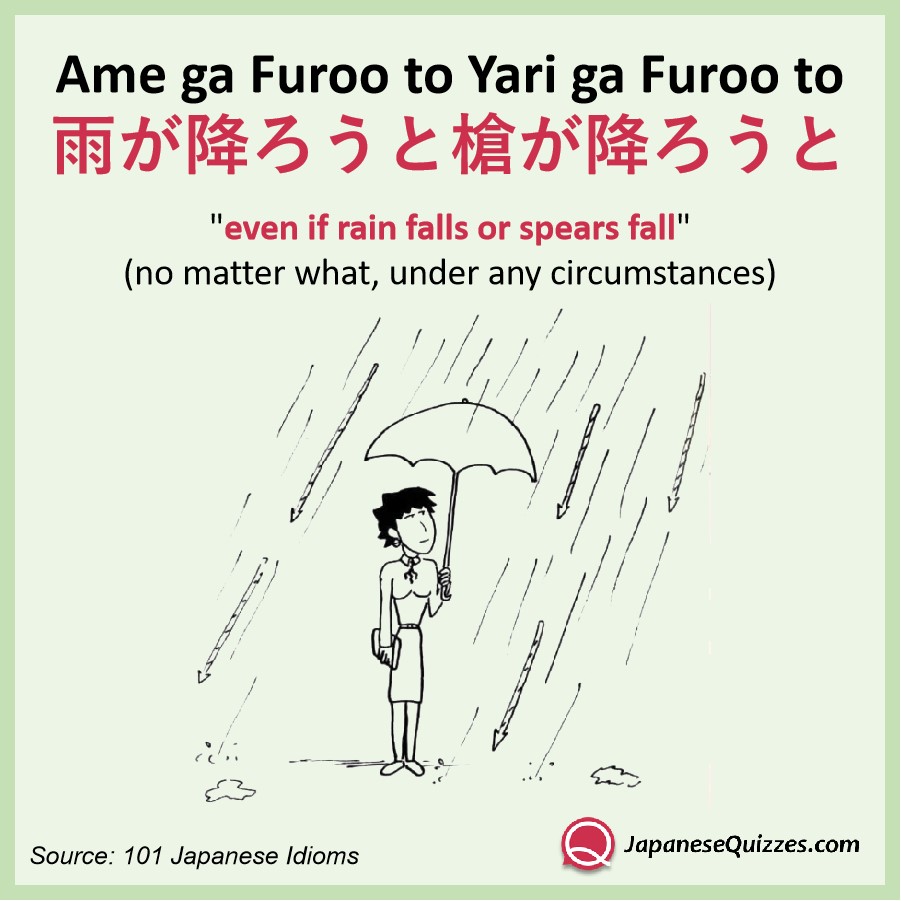
This expression reflects the firm determination Japanese are expected to have toward achieving their goal. Once the objective is set, after extensive deliberation and consideration, “come hell or high water,” the project will be brought to a successful conclusion.
Sample text:
(Style: written informal)
Sankagetsu mo moe kara yotei shiteita ryokoo da kara, ashita wa ame ga furoo to yari ga furoo to shuppatsu suru tsumori da.
三か月も前から予定していた旅行だから、明日は雨が降ろう と槍が降ろうと出発するつもりだ。
I’ve been planning this trip for three months, so I intend to leave tomorrow, no matter what.
Japanese Idioms

寄らば大樹の陰
“[Seek shelter in] the shade of a big tree.”
(Choose secure and solid protection.)

Shade is figurative for protection. The tree you choose should be important and highly placed within your organization or in society in general. This expression is close in nuance to “it never hurts to have friends in high places.”
Sample text:
(Style: written/informal)
Saikin no gakusei wa gakusha no kenkyuu teema dewa naku, gakusha no chimeido ya seijiryoku ni yotte kyooju o erabu keikoo ga aru. “Yoraba taiju no kage” to you wake ka.
最近の学生は学者の研究テーマではなく、学者の知名度や政治力によって教授を選ぶ傾向がある。「寄らば大樹の陰」と いうわけか。
There is a tendency among current students to choose an academic mentor not because of the professor’s research interests but because of the professor’s fame or political clout. I suppose it’s because they say, “Seek shelter in the shade of a big tree.”
Japanese Idioms

瓜二つ
“two halves of a cucumber”
(two peas in a pod, Tweedledum and Tweedledee, frick and frack)

Nature provides ample evidence of perfect symmetry. Split lengthwise, the two halves of a fruit or vegetable are perfectly identical. When two people are so much alike in appearance, they are uri futatsu.
Sample text:
(Style: spoken/casual/male)
A: Ano kyoodai wa futatsu chigai da kedo, mattaku uri futatsu da nee. Kono aida, machigaechatte ne. Komatta yo, hontoni!
A: あの兄弟は二つちがいだけど、全く瓜二つだねえ。この間、まちがえちゃってね。困ったよ、ほんとに!
A: Those brothers are two years apart, yet they’re as alike as two peas in a pod. The other day I mistook one for the other, and was I embarrassed!
Japanese Idioms

竹を割ったよう
“as clean as a split bamboo”
(honest, frank, decisive, a straight-shooter)
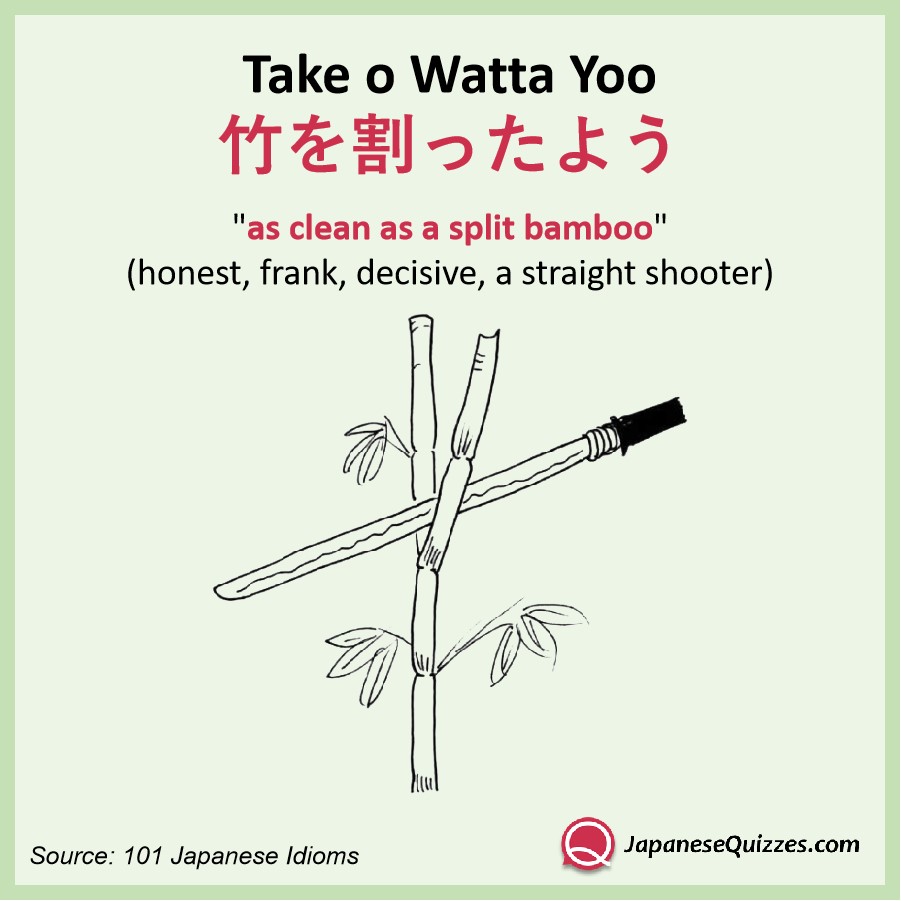
When a bamboo pole is split lengthwise, the cut is true and straight-a clean split. Take o watta yoo describes a frank, decisive, and morally righteous person-usually in reference to a man, but sometimes in reference to a woman.
Sample text:
(Style: written/informal)
Nihonjin ga konomu dansei no imeeji wa, take o watta yoona seikaku de, hakkiri shiteite ketsudanryoku no aru hito dearu koto go ooi. Shikashi, ippan ni josei ni wa take o watta yoona seikaku fo you yori, mushiro yasashisa ga nozomareru.
日本人が好む男性のイメージは、竹を割ったような性格で、 はっきりしていて決断力のある人であることが多い。しか し、一般に女性には竹を割ったような性格というより、むし ろやさしさが望まれる。
The male image that the Japanese prefer is generally of a man who is honest, frank, and decisive. In a woman, however, they generally value tenderness much more highly than frankness or decisiveness.
Japanese Idioms

高嶺の花
“flower on a high peak”
(unrealizable desire, an unobtainable object, something out of one’s reach)

Wistfully, a prize you can see but simply cannot reach. The beautiful flower is so far away that there is no real hope of picking it. Used to describe the object of desire which is completely out of reach.
Sample text:
(Style: spoken/casual/A=female, B=male)
A: Yamamoto kun ne, Yooko-san ni kataomoi na n da tte.
B: Sorya, minoranu koi da. Aite ga Yooko-san jo, takane no hana da kara naa.
A: 山本君ね、洋子さんに片思いなんだって。
B: そりゃ、実らぬ恋だ。相手が洋子さんじゃ、高嶺の花だからなあ。
A: You know Yamamoto, right? The rumor is he’s in love with Yoko, but it’s a one-way affair.
B: Oh boy! That kind of love is fruitless. His heart may be set on Yoko, but she really is an unobtainable prize.
Japanese Idioms