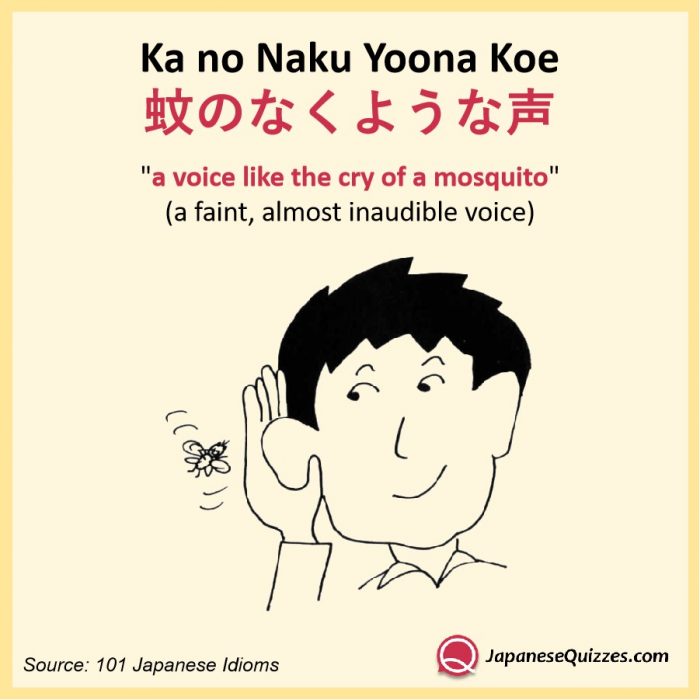
蚊の鳴くような声
“a voice like the cry of a mosquito”
(a faint, almost inaudible voice)

Like a mosquito that buzzes in and out of your range, the person’s voice is faint and hard to hear.
Sample text:
(Style: spoken/formal/female)
A: Sonna ka no naku yoona koe de wa minna ni kikoemasen yo. Motto ookina koe de moo ichido itte minasai.
A: そんな蚊のなくような声ではみんなに聞こえませんよ。もっと大きな声でもう一度言ってみなさい。
A: Nobody can hear your faint voice. Try saying it again, only louder.
Japanese Idioms
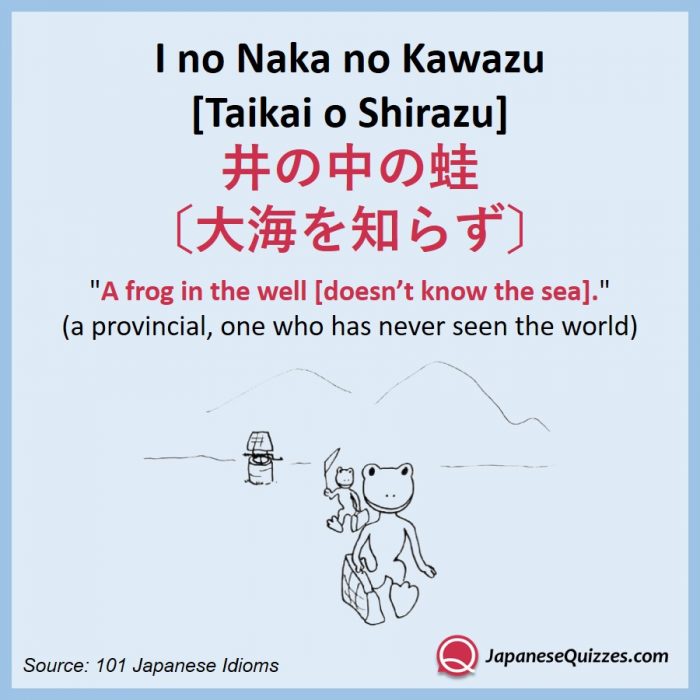
井の中の蛙〔大海を知らず〕
“A frog in the well [doesn’t know the sea]”
(a provincial, one who has never seen the world)

Used to advocate greater travel beyond the Japanese islands, it captures the Japanese sense of awareness of being like a frog in a well. Comfortable as the well may be, it is but a small part of the whole world. Japanese teachers often recite this proverb to encourage their students to progress beyond the circumstances into which they were born.
Sample text:
(Style: written/informal)
Ningen wa dare demo onaji basho ni nagaku sumu to, i no naka no kawazu ni naru. Dakara tokidoki jibun no sodatta kankyoo, jibun no sumi nareta sekai to chigau soto no ooking sekai ni mo, jibun jishin o oite miru koto ga taisetsu dearu.
人間は誰でも同じ場所に長く住むと、井の中の蛙になる。だ から時々自分の育った環境、自分の住み慣れた世界と違う外 の大きな世界にも、自分自身を置いてみることが大切である。
When a person remains in the same location for many years, he or she becomes a frog in the well. So it is important sometimes to place ourselves in the wide world outside of the environment where we grew up or the narrow world we have grown accustomed to.
Japanese Idioms

ひっぱりダコ
“a spread-eagled octopus”
(Mr./Mrs./Ms. Popularity, a person in great demand, being pulled in all directions)

This expression originates from the way an octopus is stretched out to dry. All eight legs are spread out and stretched to their limits. Thus, when the pretty young starlet or the renowned architect is suddenly in great demand, the impression is like a hippari dako.
Sample text:
(Style: A=informal/male, B=formal/male)
A: Ano shinjin kashu, saikin zuibun ninki ga dete kita ne.
B: Soo na n desu yo. Moo iroirona tokoro kara hippari dako de ne. Uchi no zasshi no intabyuu toru no mo taihenna kurai na n desu yo.
A: あの新人歌手、最近ずいぶん人気が出てきたね。
B:そうなんですよ。もういろいろなところからひっぱりダコでね。うちの雑誌のインタビューとるのも大変なくらいなんですよ.
A: That new singer is really getting popular.
B: She sure is! She’s in great demand; actually it was difficult booking her for our magazine interview.
Japanese Idioms
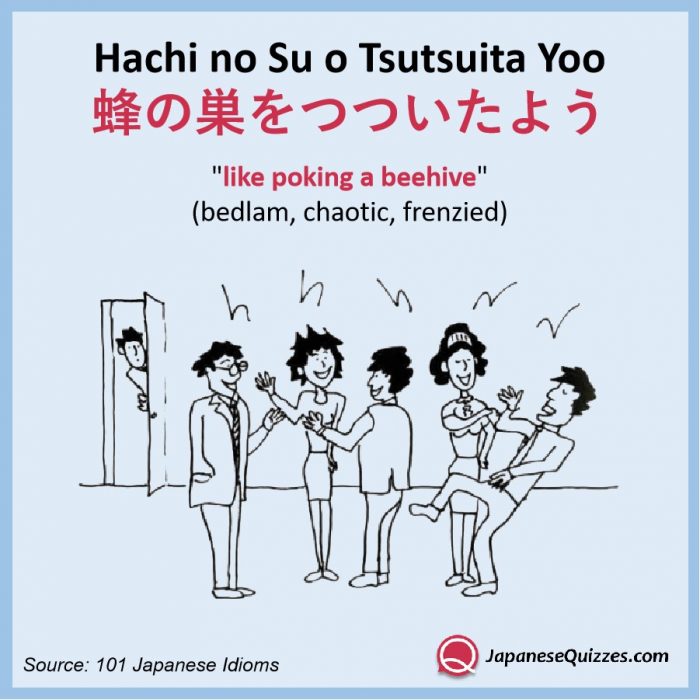
蜂の巣をつついたよう
“like poking a beehive”
(bedlam, chaotic, frenzied)

The impression is that of a swarm of noisy bees buzzing around in a frenzy of confusion. Complete bedlam that one is not happy about.
Sample text:
(Style: written/informal)
Nigakki no hajime. Sensei ga kuru mae, kodomo tachi wa natsuyasumi no hanashi ya shukudai no koto nado, waiwai gayagaya. Marude hachi no su o tsutsuita yoona sawagashisa da.
二学期のはじめ。先生が来る前、子供達は夏休みの話や宿題 のことなど、ワイワイガヤガヤ。まるで蜂の巣をつついたよ うな騒がしさだ。
The beginning of the second semester. Before the teacher shows up, the children are chatting about their summer vacations and about their assignments. It’s chaotic.
Japanese Idioms
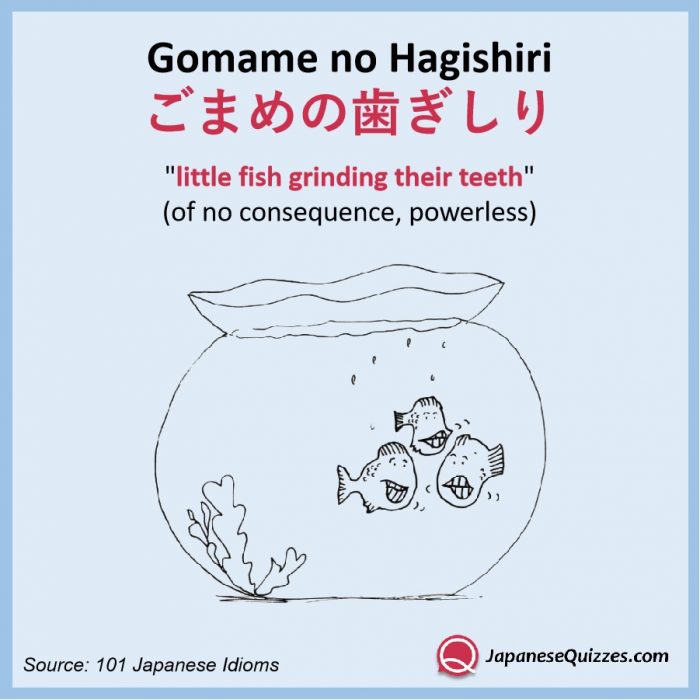
ごまめの歯ぎしり
“little fish grinding their teeth”
(of no consequence, powerless)

If sharks were to grind their teeth, it might be a big deal. Shock waves would radiate in all directions. But a bunch of little fish furiously grinding their teeth is of no consequence. Who would know? Who would care?
Sample text:
(Style: spoken/casual/male)
A: Konnendo no shinnyuu buin wa monku bakari itteru ne.
B: Ki ni shinai, ki ni shinai. Doose gomame no hagishiri na n da kara, ima made doori ni yatte ikeba ii sa.
A: 今年度の新入部員は文句ばかり言ってるね。
B: 気にしない、気にしない。どうせごまめの歯ぎしりなんだから、今まで通りにやっていけばいいさ。
A: This year’s new club members do nothing but complain.
B: Don’t worry, don’t worry. What they say is of no consequence anyway. We’ll just carry on as we always have.
Japanese Idioms
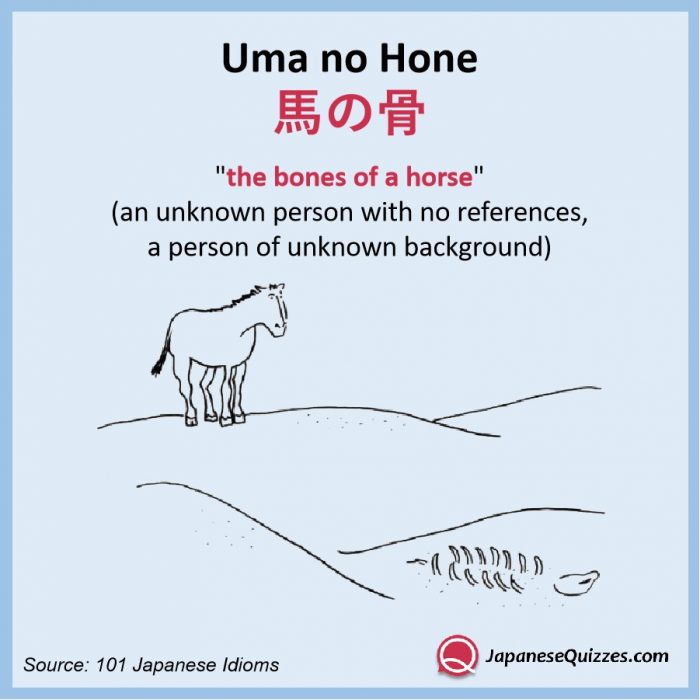
馬の骨
“the bones of a horse”
(an unknown person with no references, a person of unknown background)

Imagine the skeleton of a horse half-buried in the sand. Who knows who the horse was? What of the horse’s master? Nobody knows. That’s the feeling behind the expression when applied to a newcomer in the tight-knit Japanese society. Uma no hone carries a heavy negative connotation when referring to an outsider.
Sample text:
(Style: spoken/formal/female)
A: Kekkon mae no musume ga doko no uma no hone da ka wakaranai yoona otoko to tsukiatte wa ikemasen yo.
A: 結婚前の娘がどこの馬の骨だか分からないような男とつきあってはいけませんよ。
A: Before marriage a girl should not go out with a man of unknown background.
Japanese Idioms