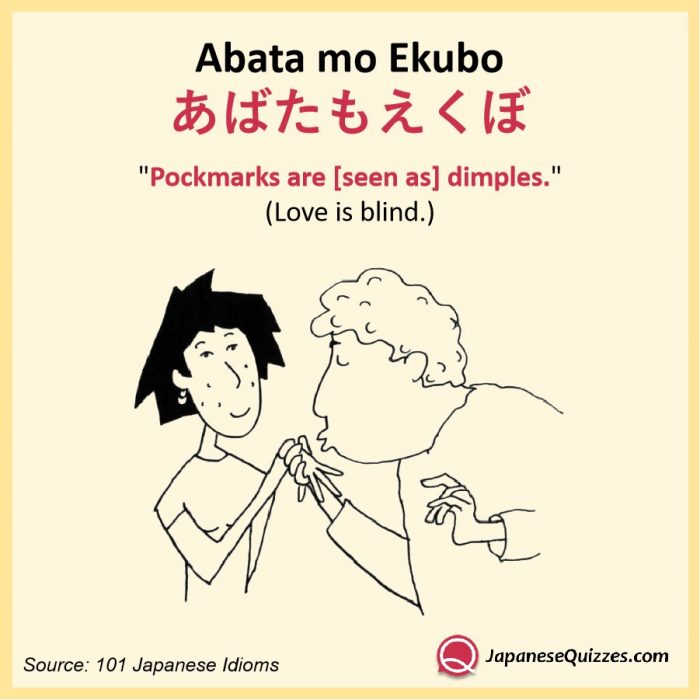
あばたもえくぼ
“Pockmarks are [seen as] dimples.”
(Love is blind.)
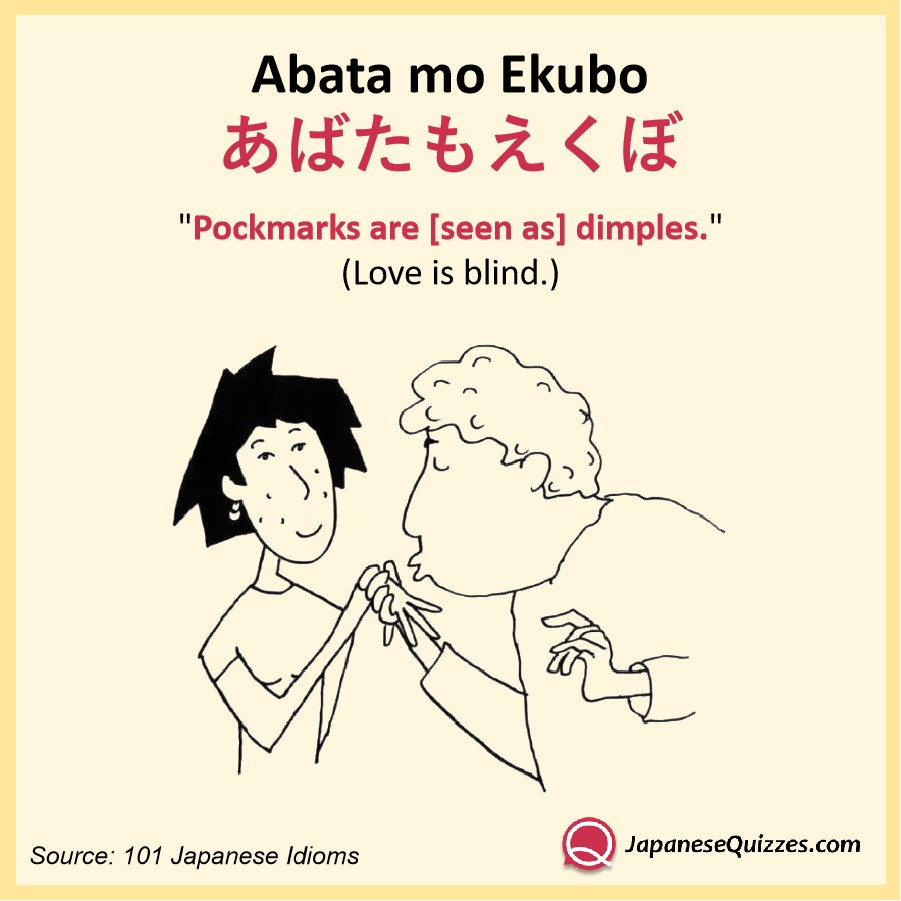
Abata mo ekubo is another way of saying, “Beauty is in the eye of the beholder.” But in this Japanese expression, the beholder is almost always a man who is beholding a woman. Her face may not have physical beauty, but her personality makes her attractive to him.
Sample text:
(Style: spoken/casual/female)
A: Akio-kun ne, kon’yaku shita n da te.
B: Hee, doko no ojoosan to? Kireina hito?
A: Kirei to you wake demo nai kedo, kawaii ko yo. Soreni sukini nareba abata mo ekubo da kara ne.
A: 昭男君ね、結婚したんだって。
B: へえ、どこのお嬢さんと?きれいな人?
A: きれいと言うわけでもないけど、かわいい子よ。それに好きになればあばたもえくぼだからね。
A: You know Akio- I hear he got engaged.
B: Really? With whom? Is she pretty?
A: I wouldn’t call her pretty, but she’s cute. Besides, you know love is blind.
Japanese Idioms
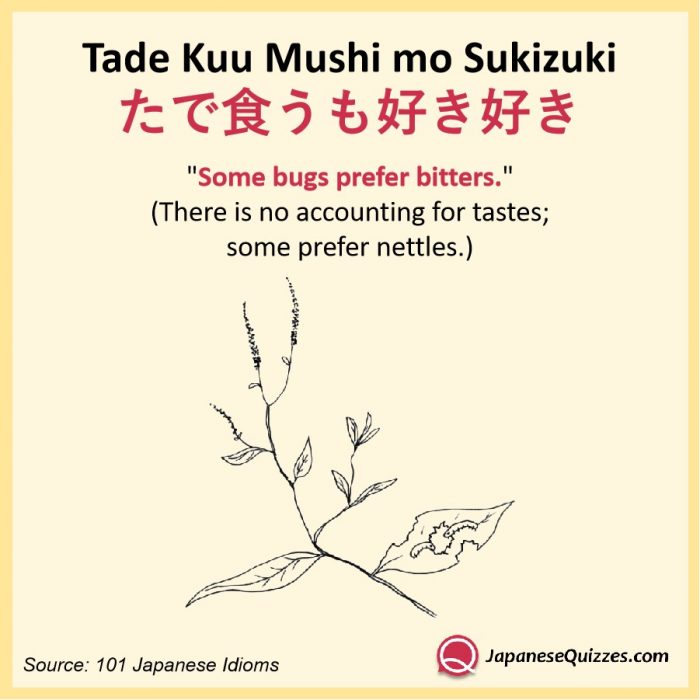
たで食う虫も好き好き
“Some bugs prefer bitters.”
(There is no accounting for tastes; some prefer nettles.)
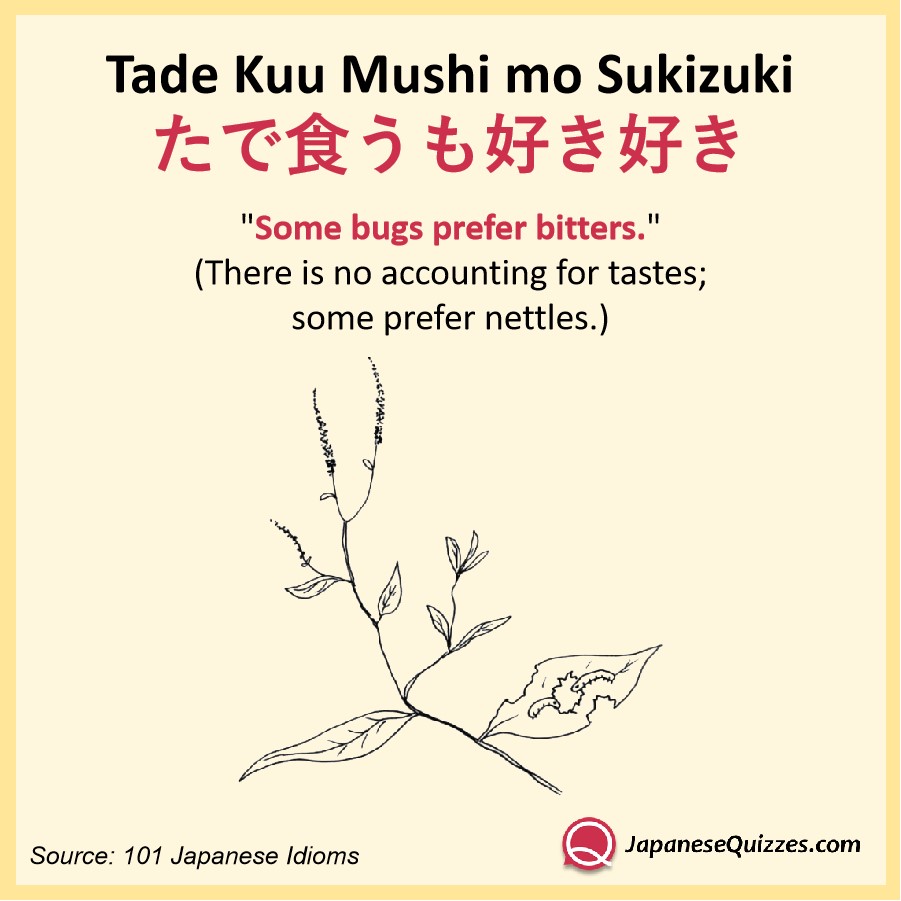
This Japanese proverb acknowledges the reality that people have different tastes. Also used to warn people not to judge others by one’s own taste. Tade is smartweed, a bitter tasting plant. Yet some insects prefer it.
Sample text:
(Style: spoken/casual/A=male, B=female)
A: Aitsu naze anna ii okusan to wakarete, mata henna onna to saikon shita n daroo.
B: Datte “tade kuu mushi mo sukizuki” te you deshoo.
A: あいつなぜあんないい奥さんと別れて、又変な女と再婚したんだろう。
B: だって、「たで食う虫も好き好き」って言うでしょう。
A: Why did he divorce such a good woman and remarry such a weirdo?
B: Oh well, you know, there’s no accounting for tastes.
Japanese Idioms

さばを読む
“to read the mackerel”
(to manipulate the figures to one’s advantage, to offer false numbers intentionally, to inflate or deflate figures)
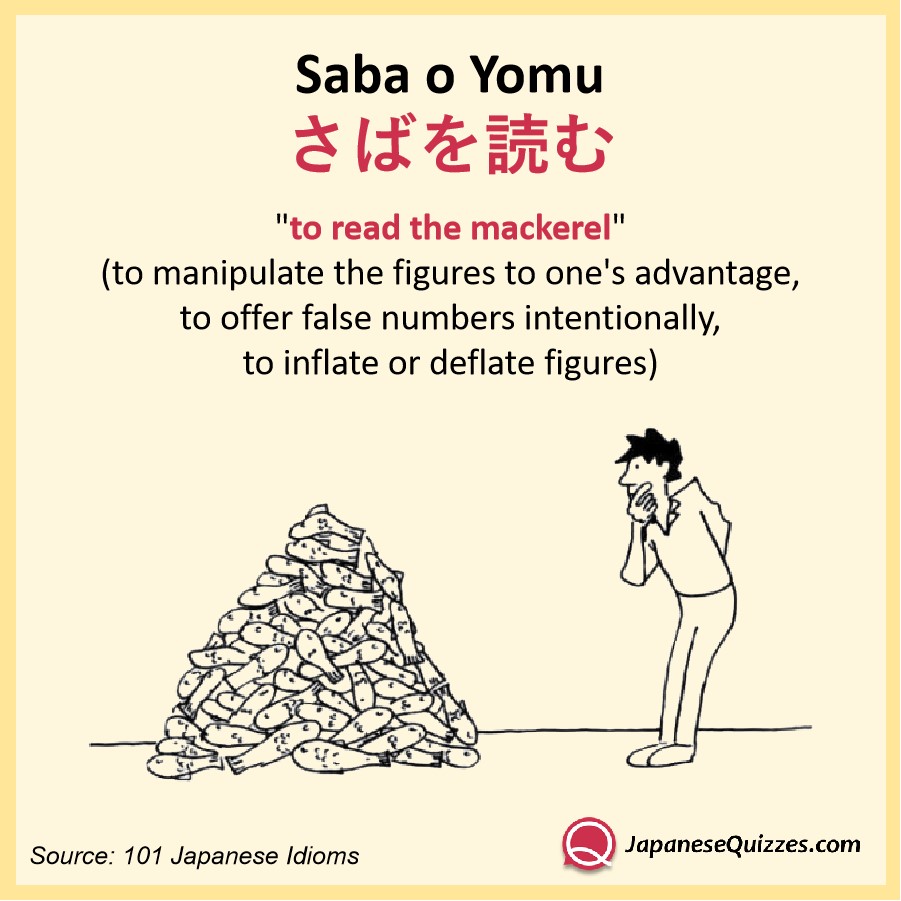
Among fish caught in nets, mackerel are so little valued that Japanese fishermen may not bother to count them. Often the rough estimates of mackerel have been highly inflated, giving rise to the use of the phrase “reading the mackerel” to indicate the practice of “guesstimating” in one’s own favor.
Sample text:
(Style: spoken/casual/A=female, B=male)
A: Kono kaikei, zuibun takai to omowanai? Nomimono yonjuuhachinin bun the aru kedo.
B: Kanari saba o yonderu n janai ka. Kaisha barai da kara wakaranai to omotteiru n daroo.
A: この会計、ずいぶん高いと思わない? 飲みもの四十八人分ってあるけど。
B: かなりさばを読んでるんじゃないか。会社払いだからわからないと思っているんだろう。
A: Don’t you think this bill is awfully high? They list 48 drinks!
B: They must be inflating the figures. They probably figure nobody will catch it since the company’s paying for it.
Japanese Idioms
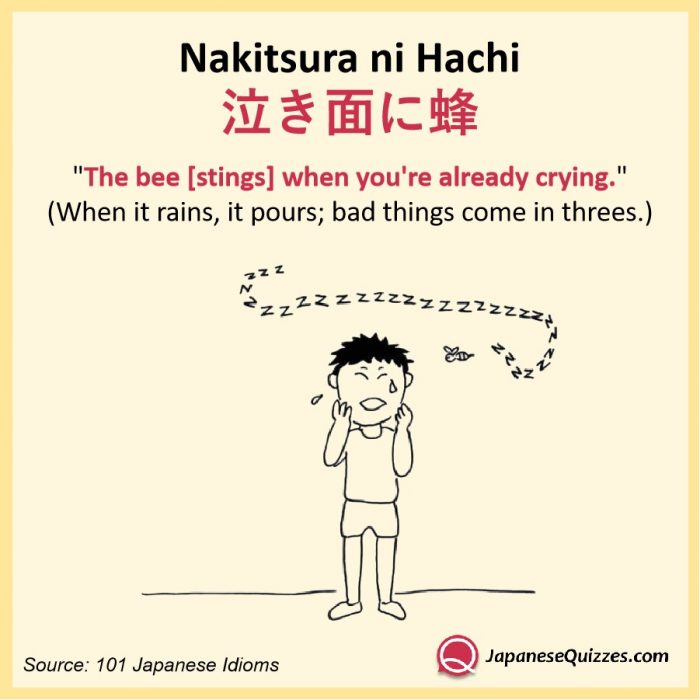
泣き面に蜂
“The bee [stings] when you’re already crying.”
(When it rains, it pours; bad things come in threes.)

When someone has been hit simultaneously with several bad breaks, it may be consoling to hear a friend say, “Nakitsura ni hachi.” The philosophical surety of the phrase reminds Japanese that misfortune may indeed come in twos (or even threes).
Sample text:
(Style: spoken/casual/male)
A: Yukari wa kinoo sensei ni shikararete nakinagara kaette kuru tochuu, Masao-kun ni nagurareta rashii n da. Mattaku nakitsura ni hachi to wa kono koto da na.
A: ゆかりはきのう先生にしかられて泣きながら帰ってくる途中、正夫君になぐられたらしいんだ。全く泣き面に蜂とはこのことだな。
A: Yesterday, apparently, Yukari’s teacher scolded her, and then as she was crying on her way home, Masao beat her up. It’s really true: “When it rains, it pours.”
Japanese Idioms
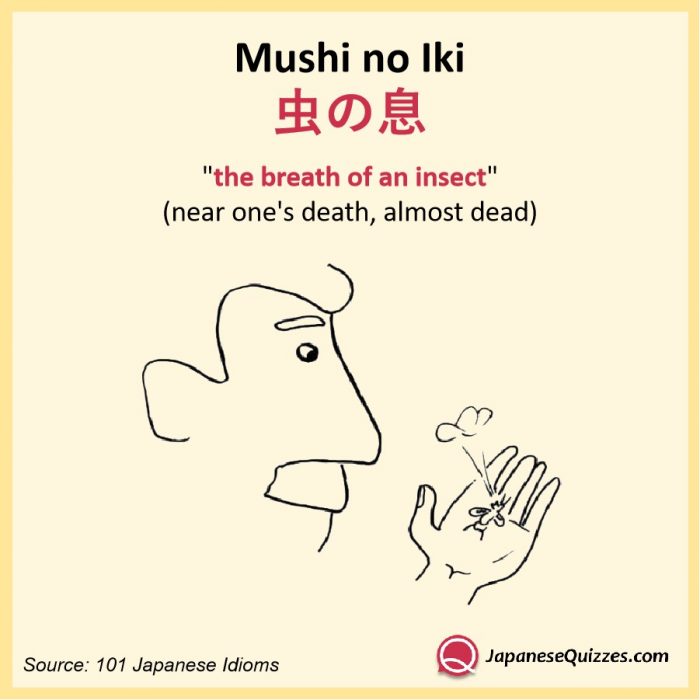
虫の息
“the breath of an insect”
(near one’s death, almost dead)

Since insects are small, imagine how faint their breath must be. The chances of recovery are extremely slim for a man whose breath is as faint as that of an insect.
Sample text:
(Style: spoken/formal/female)
A: Tanaka-san no oniisan, mattaku kinodokuni nee. Kootsuu jiko de nakunattan desu te ne.
B: Ee, soo na n desu te. Ookina jiko de ne, byooin ni tsuita toki wa moo mushi no iki datta rashii n desu yo.
A: 田中さんのお兄さん、全く気の毒にねえ。交通事故で亡くなったんですってね。
B: ええ、そうなんですって。大きな事故でね。病院に着いた時はもう虫の息だったらしいんですよ。
A: Tanaka’s brother, what a tragedy! I hear he was killed in a traffic accident.
B: Yes, that’s what I heard, too. It was a pretty serious accident. It seems he was almost dead by the time he arrived at the hospital.
Japanese Idioms

まな板の上の鯉
“carp on the cutting board”
(doomed, in the hands of God, at the mercy of fate)

This fatalistic expression is used when one feels helpless to control one’s immediate destiny. The foreboding overtone comes from the knowledge of what inevitably befalls a fish laid out on a cutting board.
Sample text:
(Style: spoken/casual/A=female, B=male)
A: Murata-san ne, shakkin ga kasanatte toosan sunzen na n da te. Ato wa ginkoo no dekata shidai to you koto rashii wa.
B: Soreja marukkiri manaita no ue no koi janai ka. Shinseki ka shiriai no tsute de doonika naranai no ka ne.
A: 村田さんね、借金がかさなって倒産寸前なんだって。あとは銀行の出方次第ということらしいわ。
B: それじゃまるっきりまな板の上の鯉じゃないか。親戚か知り合いのつてでどうにかならないのかね。
A: I hear that Mr. Murata is in great debt and is on the verge of bankruptcy. It all seems to depend on the bank now.
B: He’s doomed then. Can’t his relatives and friends do something about it?
Japanese Idioms