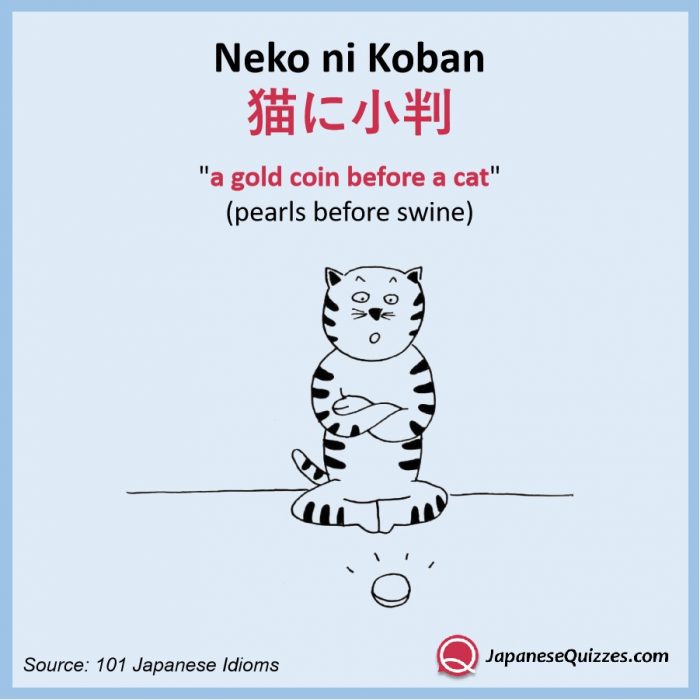
猫に小判
“a gold coin before a cat”
(pearls before swine)

Koban is a small oval-shaped gold coin which circulated in Japan prior to the Meiji Restoration of 1868. The expression is used when suggesting that not everyone can appreciate an object to the same degree. Similar to “do not cast pearls before swine”, it means “don’t offer anything of value and merit to those who are incapable of appreciating it.”
Sample text:
(Style: spoken/casual/female)
A: Sasaki-san no tokoro ne, musukosan no tame ni gurando piano o katta n da tte. Demo musukosan wa ongaku ni wa mattoku kyoomi ga nai mitai yo. Neko ni koban to wo ano koto ne.
A: 佐々木さんのところね、息子さんのためにグランドピアノを買ったんだって。でも、息子さんは音楽には全く興味が ないみたいよ。猫に小判とはあのことね。
A: I hear that Sasaki bought a grand piano for his son, but the son isn’t interested in music at all. That is truly a case of “pearls before swine,” isn’t it?
Japanese Idioms
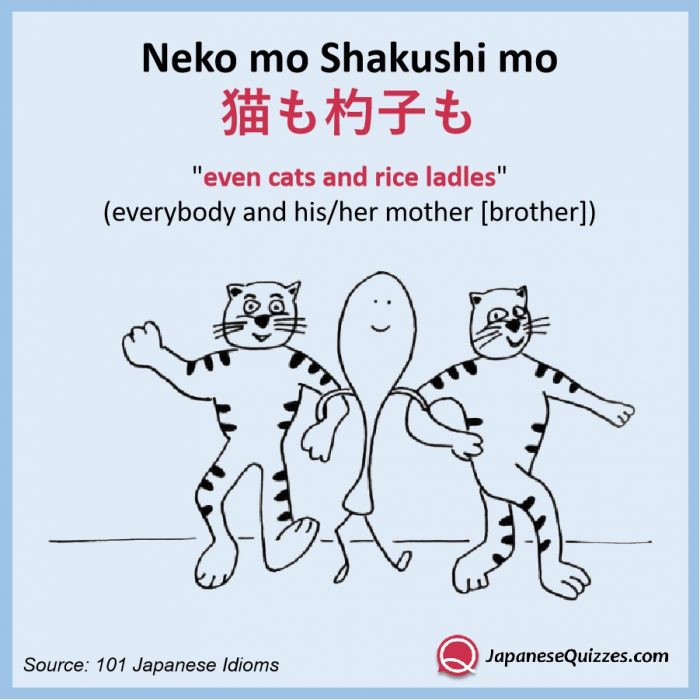
猫も杓子も
“even cats and rice ladles”
(everybody and his/her mother [brother])

According to one folk etymology, the rice ladle symbolizes housewives; since cats and housewives are virtually universal to Japanese households, the expression means “everybody.” An opposite interpretation holds cats to be rare and rice ladles to be universal, so that the expression is all-inclusive of both rare and abundant items.
Sample text:
(Style: spoken/casual/female)
A: Saikin mata sukaato take ga sukoshi mijikaku natta yoo ne.
B: Soo na no yo. Korede mata, neko mo shakushi mo mijikai sukaato ni naru n desho. Kosei ga nakute iya ni naru wa ne, mattaku.
A: 最近またスカート丈が少し短くなったようね。
B: そうなのよ。これで又、猫も杓子も短いスカートになるん ないでしょ。個性がなくていやになるわね、全く。
A: It seems skirt lengths have shortened recently.
B: You noticed, too? Now everybody and her mother will be wearing shorter skirts. There’s absolutely no individual style- I hate it!
Japanese Idioms
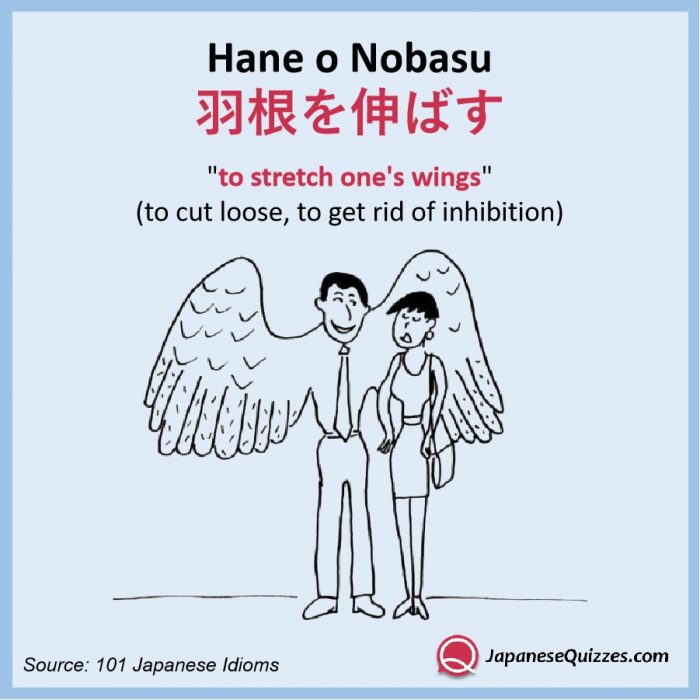
羽根を伸ばす
“to stretch one’s wings”
(to cut loose, to get rid of inhibition)

Away from home or the office, without constraints of position in society or conformity of rank within the Japanese company, one is more free to be adventurous. Hane o nobasu carries connotations of “sowing a few wild oats” as well as “letting one’s hair down.”
Sample text:
(Style: written/informal)
Nihonjin wa shigoto nado de isogashii no ga suki da keredo, toki ni wa shigoto ya katei o hanarete, ryokoo ya rejaa o tanoshinde, hane o nobasu koto mo aru.
日本人は仕事などで忙しいのが好きだけれど、時には仕事や 家庭をはなれて、旅行やレジャーを楽しんで、羽根を伸ばすこともある。
Japanese prefer to be busy at work; but sometimes when they set foot outside the worksite and away from their homes to travel or pursue leisure activities, they really cut loose.
Japanese Idioms
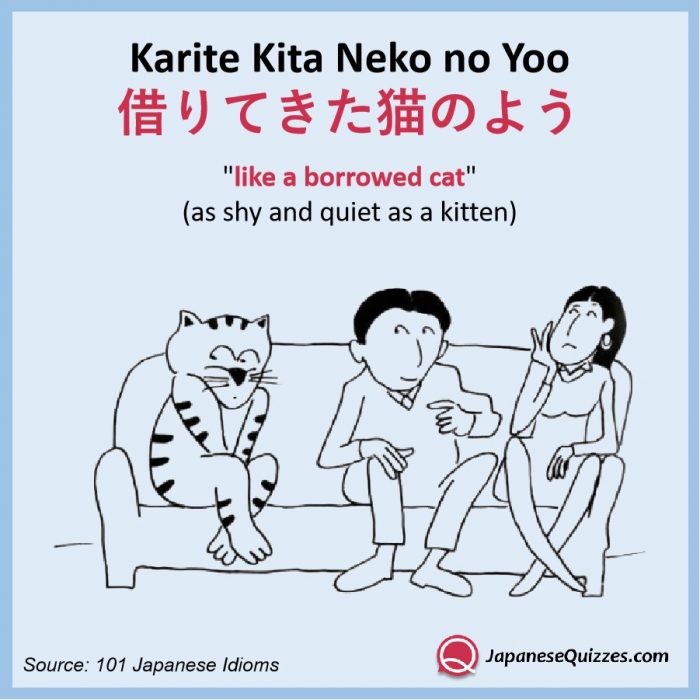
借りてきた猫のよう
“like a borrowed cat”
(as shy and quiet as a kitten)

If a cat has a distant and aloof personality even within its own home, imagine how remote it would act in a strange place. The expression describes a shy, timid person who is not at home in his surroundings.
Sample text:
(Style: spoken/casual/female)
A: Asobi ni kiteiru Takahashi-san no tokoro no Masao-kun, tottemo otonashii n da te?
B: Soo rashii wa ne. Uchi de wa genki sugite komatteru rashii kedo, yoso no uchi de wa karite kita neko no yooni otonashii n datte.
A: 遊びにきてる高橋さんのところの正夫君、とってもおとなしいんだって?
B: そうらしいわね。うちでは元気すぎて困ってるらしいけど、よそのうちでは借りてきた猫のようにおとなしいんだって。
A: I hear the Takahashi’s boy Masao is visiting, but he’s really quiet.
B: That’s what I hear. He’s almost hyperactive and troublesome at home, but in someone else’s home, he’s as shy and quiet as a borrowed cat.
Japanese Idioms
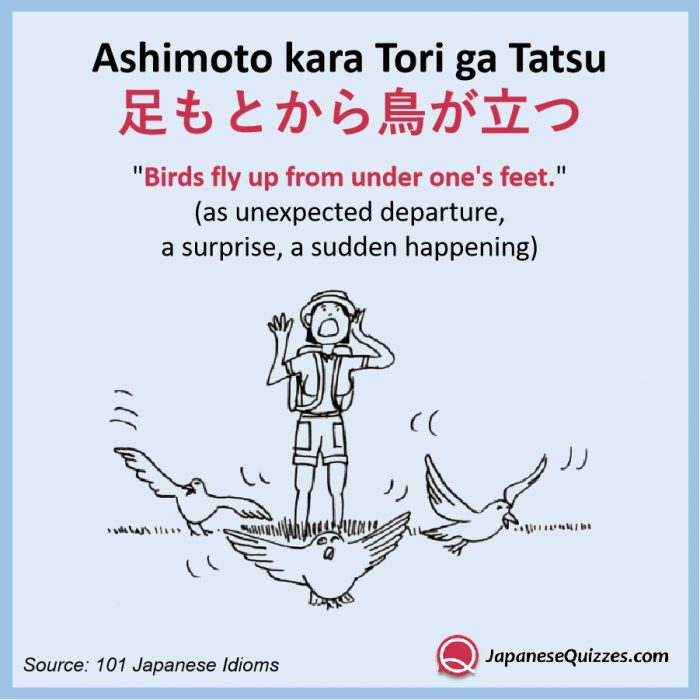
足もとから鳥が立つ
“Birds fly up from under one’s feet.”
(an unexpected departure, a surprise, a sudden happening)

What could be more startling than a pheasant or other ground-nesting bird flying up suddenly from in front of you? That’s the feeling Japanese experience when a friend or an acquaintance leaves without warning. To be caught unawares.
Sample text:
(Style: spoken/casual/female)
A: Tonari no manshon ni sundeita Kawakami-san, hikkoshita no?
B: Ee. Kyuuni Shidonii ni tenkin de ne. Mattaku “ashimoto kara fori ga tatsu” to wa, ano koto ne. Aru hi kyuuni satto hikiharatchatta no yo.
A: となりのマンションに住んでいた川上さん、引っ越したの?
B: ええ。急にシドニーに転勤でね。全く「足もとから鳥が立つ」とは。あのことね。ある日急にサッとひき払っちゃっ たのよ。
A: Did Kawakami move, the guy next door in your condominium?
B: Yeah. He was unexpectedly transferred to Sydney. Such a surprise, you know. Suddenly one day he simply moved out.
Japanese Idioms
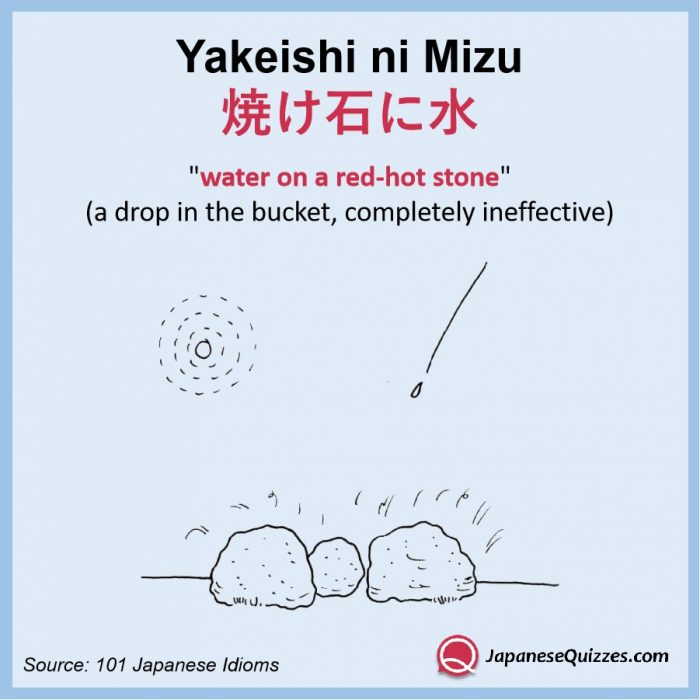
焼け石に水
“water on a red-hot stone”
(a drop in the bucket, completely ineffective)
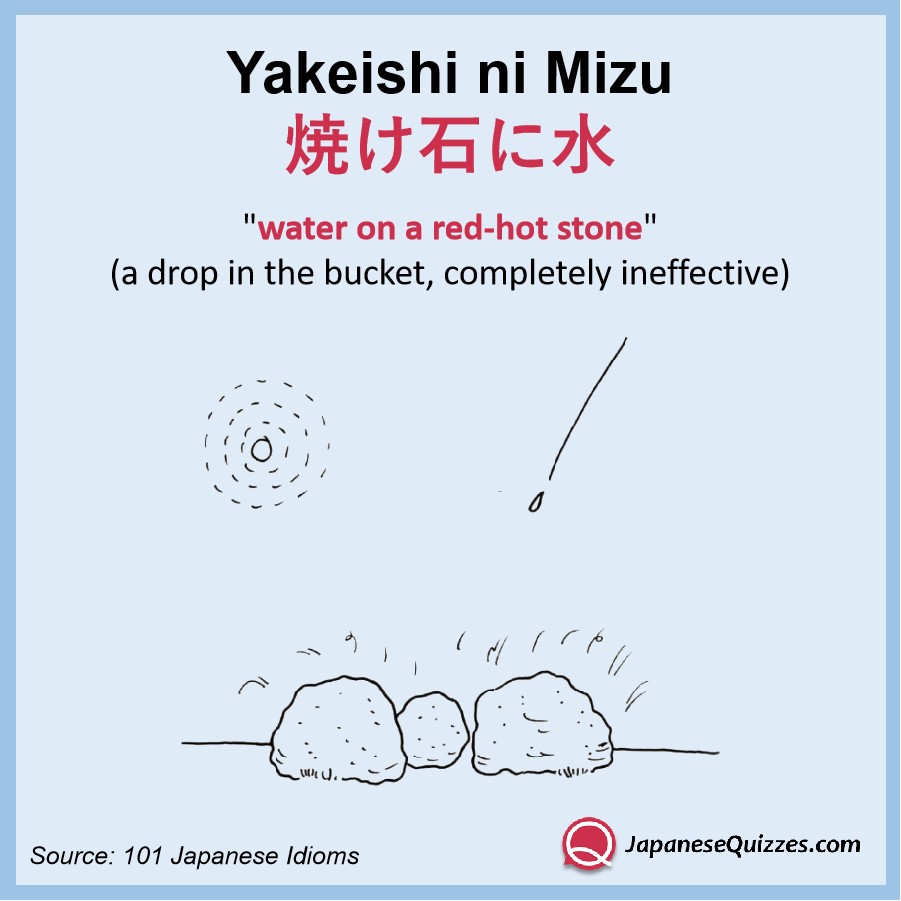
A drop of water thrown on a red-hot stone is of no consequence. Instead of cooling the stone, the drop of water evaporates in an instant. Yakeishi ni mizu expresses a grossly inadequate remedy to a problem.
Sample text:
(Style: spoken/casual/female)
A: Kongetsu wa monosugoi akaji na no yo. Sukoshi shokuhi o setsuyaku shite mita kedo, yakeishi ni mizu de doonimo naranai wa.
A: 今月はものすごい赤字なのよ。少し食費を節約してみたけと、焼け石に水でどうにもならないわ。
A: We are ‘way in the red this month. I tried to spend less for groceries, but it’s a drop in the bucket. I just don’t know what to do.
Japanese Idioms